Iraq militia fear reprisals after US exit
Awakening Councils, who helped end Sunni uprising, to lose American protection
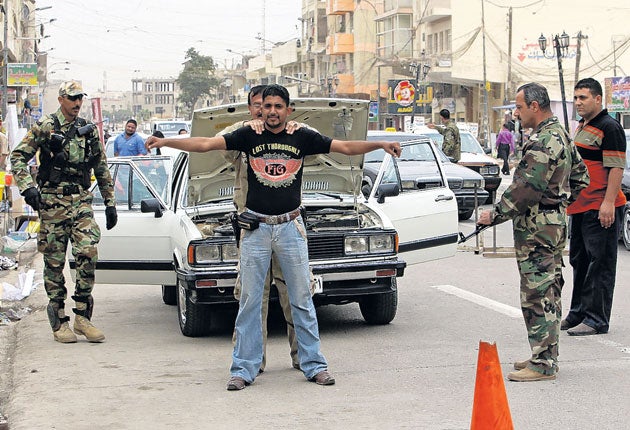
The Sunni Arabs lost their dominant position in Iraq when Saddam Hussein was overthrown, but they began to regain their strength when the United States recruited them as foot soldiers to fight against al-Qa’ida. But now, as American troops prepare to go home, the Sunni who changed from insurgents to US allies over the last two years are once more fearful for their future.
This weekend was a case in point. In the latest attack, a suicide bomber – almost certainly from al-Qa’ida – killed 13 and wounded 30 Sunni paramilitaries. The victims were all members of the Awakening Councils, the US-backed Sunni militia groups, which had at first fought the American occupation until they revolted against growing al-Qa’ida control of the rebellion. In all an estimated 53 Awakening Council members were killed last week.
Not only are members of the Awakening Council being targeted by the bombers and assassins of al-Qa’ida. They are regarded with extreme distrust by the largely Shioa government and security forces in Baghdad at the very moment that their American protectors are departing.
Some 250 of the lightly armed Awakening Council fighters, also known as al-Sahwa or the Sons of Iraq, were milling around outside an Iraqi army base in the town of Jbala, 35 miles south of Baghdad, waiting to collect their pay when the bomber struck on Saturday. He was wearing an explosives belt and was able to infiltrate the crowd because he was wearing the same uniform as the Awakening Council members.
"What have we done to deserve this?" shouted Mohammed al-Janabi, who was seriously wounded in the stomach and legs by the blast. "We helped to make this area safe and when come to receive our salaries, our bodies are ripped apart. God damn al-Qa'ida! God damn al-Qa'ida!"
The latest attack shows al-Qa'ida, while weaker than it was in 2005-07 at the height of the Sunni-Shia civil war, still has the ability to recruit, equip and target suicide bombers in central and northern Iraq. Last Friday a truck loaded with 2,000lb of explosives crashed into the entrance of the main military base in the northern city of Mosul, killing five US soldiers and two members of the Iraqi security forces.
The Awakening Councils, whose emergence at the end of 2006 was crucial to ending the Sunni uprising against the US occupation, contain many former anti-American insurgents and al-Qa'ida members. This makes it easy for al-Qa'ida to obtain intelligence on when the paramilitaries are most vulnerable to attack. A sign of the deep suspicions dividing members of the Awakening Councils and the predominantly Shia government security forces is that the Sunni fighters had not been allowed to enter together the base at Jbala to receive their pay, which was in any case three months' late. Instead of being protected by the base's fortifications the fighters were compelled to wait in the street outside while small parties entered the base to get their money.
The Awakening Councils have always been suspected by the Iraqi government, which is dominated by Shia and Kurds, of containing many former Baathists and insurgents who cannot be trusted. The original backlash against al-Qa'ida in overwhelmingly Sunni Anbar province and in Sunni strongholds in and around Baghdad was largely spontaneous.
But the US forces swiftly gave full backing and pay to the Awakening Councils, a move only grudgingly supported by the Iraqi security forces.
With US soldiers due to leave Baghdad and other cities on 30 June under a Status of Forces Agreement signed between Iraq and the US last year, many Sunni Arabs and Awakening Council members believe the government will move against them. Last October the government agreed to pay the Awakening Council members, but their salaries often arrive late and sometimes not at all.
The government has also been averse to giving the paramilitaries the influential jobs in the security services which they have demanded. Many Awakening Council leaders and members have been arrested over the past year. In Baghdad in March, assisted by US forces, they moved against the Sunni fighters in the al-Fadhil district, a commercial area in central Baghdad specialising in selling building supplies, timber and metal. Local Awakening Council members were arrested or dispersed.
The Awakening Councils in the past have threatened to become insurgents again. "Most of the Sunni people believe the government will never allow al-Sahwa to continue their work and their role is finished," said one Sunni resident of west Baghdad who did not want his name published. "The government is wrong if it thinks this because most of the al-Sahwa were in al-Qa'ida or in the Islamic Army of Iraq and it is easy for them to switch back."
But it may be difficult for the Awakening Council members to change allegiances once again. The Sunni community to which they belong has been seriously weakened. It makes up 20 per cent of the Iraqi population; the Shias make up 60 per cent. As a result of sectarian cleansing, Baghdad is now overwhelmingly Shia. Sunni who fled to Jordan and Syria have often not returned and, when they do, not to their old homes.
The Awakening Councils are also disunited. In some areas they are fighting the government but in others they want a share in state authority and patronage.
In Ramadi, the capital of Anbar, Sheikh Ahmed Abu Risha, whose brother, later assassinated by al-Qa'ida, started the first Awakening Council, leads a political party drawn from the Awakening movement. He says he is renouncing armed struggle and is prepared to work with the Prime Minister Nouri al-Maliki. "If we want a unified Iraq," he said, "we must work in that direction, on uniting Sunnis and Shias, to build one country."
Whether Sheikh Ahmed's goal can be achieved remains to be seen. From their bases in Mosul and Baquaba, al-Qa'ida remains a force to be reckoned with. And for the members of the Awakening Councils, that is a more frightening prospect than ever.
Join our commenting forum
Join thought-provoking conversations, follow other Independent readers and see their replies
Comments