Iraq provincial election is most peaceful since the fall of Saddam
The last regional poll, in 2005, triggered two years of civil war. This time, there was not a single major attack anywhere in the country
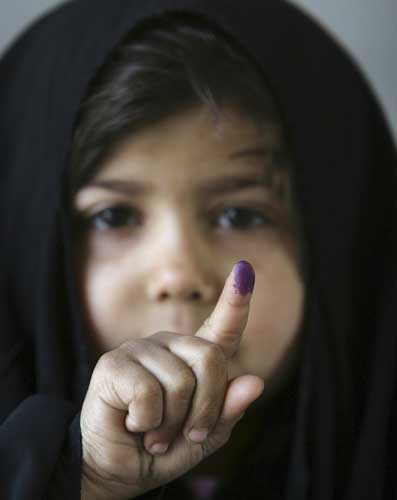
Iraqis voted yesterday in fortress-like polling booths, protected by rings of police and razor wire, as the country held provincial elections that will determine who will hold power after the end of the US occupation. City centres were silent, because the normal bumper-to-bumper traffic was banned from the streets to prevent car bombs, and border crossings and airports were closed.
The precautions seemed to have worked. The election proved to be the most peaceful since the fall of Saddam Hussein, with not a single major attack reported anywhere in the country. "The purple fingers have returned to build Iraq," Prime Minister Nouri al-Maliki said in a televised address after the polls closed, referring to the indelible ink stains on index fingers that show voters have cast their ballots.
The last provincial election, in January 2005, was hailed by President George Bush as a hopeful sign that Iraq was moving towards democracy. But the poll was boycotted by most Sunni Arabs; instead of bringing peace, it was the starting pistol for a savage Sunni-Shia civil war, in which tens of thousands died.
Yesterday's voting was nothing like the bloodbath of 2005-07. Then, voters who proudly waved purple-coloured index fingertips to show they had voted sometimes had the same finger amputated by groups enforcing a boycott of the election.
The 14,500 candidates are competing for control of 14 out of 18 Iraqi provinces, the exceptions being the three autonomous Kurdish provinces and the oil province of Tameem, which is disputed between Kurds, Arabs and Turkomans.
The success or failure of the different parties will be seen as a clue to the outcome of parliamentary elections to be held in December, but it is also hoped that this weekend's poll could settle disputes between the three main communities – Sunni and Shia Arabs and the Kurds – which are being fought out with the gun.
In the mixed Shia-Sunni-Kurdish Diyala province, the scene of some of the worst fighting, the Sunni have a small majority, but the province is ruled by the Shia. The new council here, as elsewhere in Iraq, will be far more powerful than the old, appointing the governor and other senior officials. But the real test of the success of the election will be whether or not its results convince Sunnis that they can get a fair share of power through the ballot box.
A critical contest will be in Nineveh province and its capital, Mosul, whose people are an ethnic mosaic. Sunni Arabs are in the majority, but there are large minorities of Kurds, Yazidis, Shabaks and Christians, and Sunni insurgents remain active and dangerous. The present council has a Kurdish majority, thanks to the Sunni boycott of 2005, but the Sunnis will be looking to end Kurdish control of the city.
The election is a critical test for Mr Maliki, who has cobbled together a coalition of interests to support his small Dawa party. Mr Maliki is popular because of his success against the Mehdi Army militia of the Shia cleric Muqtada al-Sadr, in March and April last year. He also refused to sign a new defence agreement with the US until it continued with a timetable for the withdrawal of 142,000 US troops over the next three years, and has been standing up to his Kurdish allies by introducing non-Kurdish military and special police units into Mosul.
Mr Maliki has strengthened the state machinery and his control over the army and security forces. He has used tribal councils to funnel money and jobs to potential supporters in the provinces, much to the rage of the largest Shia party, the Islamic Supreme Council of Iraq (ISCI), and the Kurdish parties in the north, who accuse the Prime Minister of using state funds for party purposes. Control of the government is vital in Iraqi politics because in a country of mass unemployment the state provides almost all the jobs, paid for with its oil revenues. All the parties try to promote their own followers to jobs in the ministries and security forces, and sack the supporters of their opponents.
The other big struggle in the election will be within communities. The Iraqi Islamic Party benefited from being the only Sunni party to stand in 2005 – in the giant Sunni province of Anbar where it captured 34 out of 41 seats. This time it will be fighting the anti-al-Qa'ida Awakening Councils, whose members are often former insurgents. It is not expected to do well.
In Basra, which sits on top of three-quarters of Iraq's oil reserves, power is held by three Shia parties: ISCI in control of security; Fadhila in government and the oil industry; and the Sadrists in the streets. Government forces won back military control in April 2008, but the region's political future is uncertain. In Basra, as elsewhere, the parties know that the winners in this year's elections are likely to be the permanent rulers of Iraq after the US occupation. The political shape of post-war Iraq should soon become clear.
Join our commenting forum
Join thought-provoking conversations, follow other Independent readers and see their replies
Comments