Is Netanyahu ready to make peace? The test is yet to come
Hardliner would have to break with his own ideology to deliver a deal
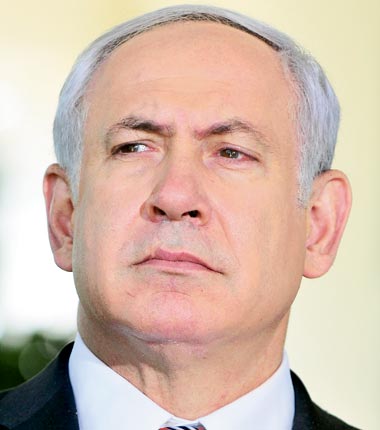
Whatever else two days of high-octane schmoozing in Washington may have achieved, it has failed, at least as far as the outside world is concerned, to answer one of the great diplomatic riddles of the times.
Which is, what did Benjamin Netanyahu tell Barack Obama in July that convinced the US President that it was worth, first applying fierce pressure on the Palestinian President Mahmoud Abbas to enter direct negotiations with Israel, with a view to achieving a peace deal within a year, and then launching the talks this week in Washington amid such fanfare. The White House has repeatedly made it clear to those who need to know that something was said – but not what it was.
Assuming that this is not mere spin, there is now a reasonable chance not only of solving the riddle but also of testing whether Netanyahu is as good as his word. That test is still to come. The Washington choreography was skilful; the Israeli Prime Minister used some positive language he has not used before; Abbas sought to shed his reservations, at least in public; the talks were given as good a send-off as could be expected.
But as far anyone can tell the meeting did not move the process forward, beyond agreeing to another in mid-September. Even the most urgent issue –that of the imminent end to the partial settlement freeze on 26 September, which Abbas says needs to be renewed if he is to stay in the talks – remains unresolved. It will require all the Americans' ingenuity to find a formula to ensure that the first working meeting on 14-15 September will not also be the last.
But what if that corner is turned, as it may be? The remaining obstacles, which explain why expectations are currently so low, are, of course, all too easy to rehearse; they include the fact that Hamas, excluded from the debate, has already given a glimpse of its potential capacity to destabilise the peace efforts; the unanswered questions about how Gaza, which it controls, could be brought within a putative Palestinian state; the deep opposition of many within the Netanyahu government, never mind outside it, to any division of the land, much less the minimum one the Palestinians could accept; the absence of a figure of Ariel Sharon's standing, in Israeli eyes, to force through the dismantling of settlements – some of them very hard line – that would almost certainly be needed if the deal was done.
That said, no one who was around when the Northern Ireland peace process began amid similarly dismal expectations can wholly rule out the prospect, however remote, that today's cynicism could yet be confounded. True, that process only worked when – unlike the Middle East process – it included the main armed faction; but despite the differences it's presumably his experience in Belfast that helps spur on George Mitchell, the US presidential envoy to the region, despite his 77 years.
So let's suspend disbelief for a moment, turn the argument round for once and approach the July riddle in a different way, by asking what rubicons Netanyahu would have to cross to bring a deal within sight. That isn't unreasonable; he represents massively the stronger of the parties, and the one with the territory to give up.
Moreover, a paradox of Abbas's weak position is that his room for accepting any less than 22 per cent of the West Bank, with East Jerusalem as its capital, and for some recognition by Israel of responsibility for the displacement of the 1948 refugees, is all the lesser. He has already been castigated by much of the Arab press for selling out – somewhat unfairly since he has conceded nothing yet, beyond agreeing to talk. But this means that even if he agrees a deal that is every bit as good for the Palestinians as the one Arafat would have accepted, he could still find it a lot harder to sell.
So Netanyahu remains the most pivotal, as well as the most unreadable, of the players. His mastery of public relations in recent months has been vastly superior to that of the Palestinian leadership, especially in presenting himself as the willing negotiating partner. But that only deepens the puzzle; does all this represent a true yearning for a place in history as a peacemaker; or is it a mere trick to convince a suspicious international community?
A recently retired top Israeli official, with experience of previous negotiations going back to the early Nineties suggested this week that Netanyahu had "matured" since his first premiership. He was less sure that he had abandoned, deep down, his "life time ideology"; and while granting that he might have done, he was even more agnostic over whether the Prime Minister was prepared to forsake his political base, as Sharon did when he broke up Likud to bring the settlers out of Gaza (and Netanyahu, only five years ago, was his chief opponent on the hard right).
For all that would indeed be necessary. He would need, whether for reasons of legacy or to put Washington in his debt at a time when he needs their help in preventing a nuclear Iran, to break decisively with his own ideology – and that of many in his own family, not least his formidably right-wing father. He would need to walk the same path that his predecessor Ehud Olmert did, when in the dying days of his premiership he began to negotiate seriously with Abbas.
To secure the final status settlement he says is achievable within a year, Netanyahu would therefore have to break with his long-held public positions by agreeing to share Jerusalem and to part with some of the most cherished settlements, not all of them on remote hilltops. (To take a detailed example, there is a wide Israeli consensus that the big settlements, or settlement blocs, of Gush Etzion, Maale Adumim and Ariel would be part of Israel in any final deal. But there are unconfirmed suggestions that Washington's view is that to bridge the gap between the two sides Ariel would revert to the new Palestine).
And he could only do this by a major and dramatic reshaping of his coalition, in which not only the smaller, hard-right nationalist parties, but also some of his own Likud ministers would have to be jettisoned, in favour of a much more centrist-to-left government around Tzipi Livni's Kadima. The settlers would scream treachery, and so would the block of some 40 Knesset members already preparing for just such an eventuality. And a politician notoriously susceptible in the past to pressure would have to find the steel to face down his tormentors.
There may be some truth in the argument that peace can better be made from the right, without a Netanyahu in opposition to agitate against it, as he did with such vigour and demagogy against Rabin after Oslo. The question is whether, against all the expectations, Netanyahu Mark II has calculated all this, is politically and psychologically ready for it, and has convinced the US President that he is. We should know the answer to that conundrum within a year.
EU chief blames 'Jewish lobby'
The EU's trade chief apologised yesterday for blaming Jews and the "Jewish lobby" in Washington for blocking a peace deal in the Middle East. Karel De Gucht, 56, said he did not mean to stigmatise Jewish people and stressed in a statement that, "anti-Semitism has no place in today's world". A spokeswoman for the European Commission also dismissed the remarks as not representing EU policy. Mr De Gucht's comments came in a Thursday radio interview as the US formally convened the first direct negotiations between Israel and the Palestinians in nearly two years.
The European Jewish Congress, an umbrella group, had demanded a retraction of his remarks in which he maintained that Israel frustrates US-led peace efforts and warned not to "underestimate the Jewish lobby on Capitol Hill".
"That is the best organised lobby that exists there," the former Belgian foreign minister said in the interview with the Dutch-speaking VRT radio network.
"Don't underestimate the opinion ... of the average Jew outside of Israel," he said. "There is, indeed, a belief, I can hardly describe it differently, among most Jews that they are right. So it is not easy to have a rational discussion with a moderate Jew about what is happening in the Middle East. It is a very emotional issue."
Join our commenting forum
Join thought-provoking conversations, follow other Independent readers and see their replies
Comments
Bookmark popover
Removed from bookmarks