Israel loses UN vote on Gaza 'war crimes'
Report calling for inquiry into invasion approved despite US opposition
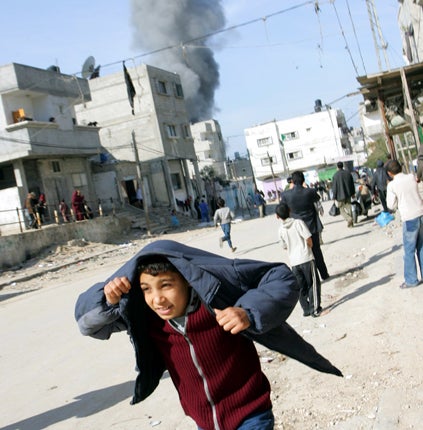
The Goldstone report calling for a war crimes investigation into Israel's military offensive in Gaza last winter easily cleared its first UN hurdle yesterday despite intense lobbying by Israel and the US.
The 25-6 vote at the UN Human Rights Council in Geneva brings one step closer – at least in theory – the possibility that Israel could face International Criminal Court proceedings if it does not launch its own independent investigation into its conduct of the war. The decision, which was described as "unjust" and "one-sided" by Israel yesterday, refers the report of the council's fact-finding mission headed by the former South African Supreme Court judge Richard Goldstone to the UN General Assembly for further consideration.
Opponents included the US and Italy, while Britain and France, which had been expected to register formal abstentions, instead called in vain for a delay in the decision and did not participate in the vote at all. Both countries had been under intense pressure from Israel and the US to oppose the resolution.
Yesterday's vote followed a U-turn by the Palestinian President, Mahmoud Abbas, who faced severe internal criticism after succumbing to US demands to agree to defer the whole issue until next year when the Human Rights Council first debated the report two weeks ago.
While recognising the likelihood that the resolution would be passed after the volte face by the moderate West Bank Palestinian leadership, Israel had hoped that opposition by Britain – whose Prime Minister Gordon Brown spoke to his Israeli counterpart Benjamin Netanyahu at least twice in the run up to the vote, and France – would dent its impact.
Yesterday's resolution also condemned more recent actions by Israel in the occupied Palestinian territories and East Jerusalem. Though strongly disagreeing with some – but by no means all – elements of yesterday's resolution, the British Government has so far been open in urging Israel to carry out its own independent investigation into the conduct of Operation Cast Lead, which left more than 1,300 Palestinians dead.
The Goldstone report, which said that Hamas as well as Israel was guilty of possible war crimes and crimes against humanity because of rockets fired at Israeli civilians, recommended that the UN Security Council should refer the accusations to the International Criminal Court if Israel did not carry out an adequate investigation.
It is far from clear whether yesterday's decision will lead to such an outcome, since the US is likely to veto any such Security Council decision. A senior US diplomat in Geneva, Douglas Griffiths, said the US had opposed yesterday's decision because of its "one-sidedness" and because it could unsettle a Middle East peace process.
As well as the intense telephone lobbying of European leaders by Mr Netanyahu, his Defence Minister Ehud Barak and his Foreign Minister Avigdor Lieberman, the US Secretary of State Hillary Clinton also urged the British Foreign Secretary, David Miliband, to oppose the resolution in a telephone call on Thursday.
According to one Middle East diplomat, Mrs Clinton failed to overcome one argument of the British and the French, which was that outright opposition to the resolution would jepoardise the already weakened authority of Mr Abbas. Mrs Clinton is reported to have contended that Palestinian problems needed to be resolved in Ramallah and Gaza – which is controlled internally by Hamas – and not in Geneva.
The Israeli foreign ministry noted yesterday that the vote was an "improvement" on the original decision, backed by 33 countries, to set up the Goldstone mission. But it added that its adoption "impairs both the effort to protect human rights in accordance with international law, and the effort to promote peace in Middle East. This resolution provides encouragement for terrorist organisations worldwide and undermines global peace".
It added that it ignored Hamas abuses and "the unprecedented precautions taken by Israeli forces in order to avoid harming civilians".
The British call for a delay was proposed by Mr Brown on the basis of contact between No 10 and Mr Netanyahu's office, up to and including yesterday, over the possibility of Israel setting up a transparent inquiry into the Gaza war, better humanitarian access to Gaza and a West Bank settlement freeze – which Mr Netanyhau has already rejected despite coming under strong pressure from Washington.
A Foreign Office spokesman said: "We were involved in intensive discussions with Israel (and the Palestinians) about potential substantive improvements in the situation on the ground." Whitehall officials declined to speculate last night on whether there was any realistic possibility of Israel making such concessions had the vote been further delayed.
In Gaza, Hamas spokesman Taher al-Nonou welcomed the decision and added: "We hope that the vote may be the beginning of the prosecution of the leaders of the occupation."
Join our commenting forum
Join thought-provoking conversations, follow other Independent readers and see their replies
Comments