Joy is in short supply for Eid
Gaza's blockade means that this is the hardest holiday its people can remember.
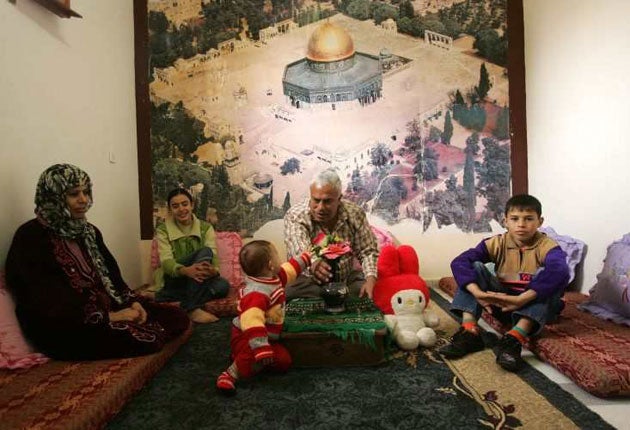
Ironic text messages of goodwill for the great festival of Eid Al Adha – easily as central to the Muslim calendar as Christmas is in the West – became the vogue in Gaza this week.
"Despite there being no salaries, the money we don't have to give to our children, the high price of Egyptian lamb, and the switching off of power, we will celebrate by the light of an Egyptian candle," read one. It summed up the daily power cuts, the utter impossibility for most families this year of affording the traditional Eid sheep and the fact that smuggling tunnels under the border with Egypt have turned into a lifeline for the 1.5 million inhabitants of blockaded, Hamas-controlled Gaza.
The sardonic text message marking the most miserable Eid in Gaza anyone can remember came up on the mobile belonging to Adel Razeq. He runs Gaza's National Agency for Family Care and has been struggling with meagre resources to set up a "food bank" intended to distribute meals – in some cases repackaged leftovers from restaurants, wedding parties and even funerals – to the growing legion of undernourished in Gaza, where more than 50 per cent of families have for the first time been classified as living below the "deep poverty" line of £315 per month for two adults and six children.
Mr Razeq's team has identified severe need in 10 times the 400 to 500 families he is already helping and he believes that a much higher underlying demand is hidden by the pride of unemployed fathers. "We even get kids coming in here when the parents won't," he explains. "They will say 'I love my dad but he can't give us what we need'."
Certainly, the jobless man of the house remains discreetly indoors as his daughter, Besma El Ghoulah, 19, prepares this year's apology for an Eid feast for a family of 15: half a sheep's stomach cooking over an outdoor fire from wood foraged in the street. It was a neighbour's present to Besma's brother-in-law, who lost his job in a factory brought to a halt by Israel's blockade on commercial goods imposed after Hamas took full control of Gaza by force in June 2007. Unable to afford fruit or red meat, the family usually only eats a fresh chicken once a month. Besma says that her two- year-old brother Bilal has been diagnosed with slow growth and anaemia, reinforcing the recently leaked findings of the Red Cross that chronic malnutrition in Gaza is on the rise.
Meanwhile, two other Eid traditions – the menfolk visiting their female relatives and giving new clothes to the children – have this year been nullified. "My father didn't go out of the house," explains Besma. "He has no money to travel. Sometimes my father cries when he has no money to give my little brother sweets."
Not far away in the city's eastern Shajaia suburb, Eid has been even bleaker under the leaky asbestos roof of the ramshackle three-room house where Rabbia Farahad, 59, lives with his wife, Najah, and 10 children. Mrs Farahad says the family have fruit once a month and vegetables once a week. "If we have apples I give out half of one to each," she says. The family epitomise another conclusion of the Red Cross report, that mutual support mechanisms are beginning to break down. "This is the worst Eid we have ever been through," says Mr Farahad, who used to be a farmworker in Israel. "Before, people used to help us but now no one has any money."
The family has no compunction in citing the de facto Hamas government – and its split with Fatah – among the culprits. "First I blame the Israeli occupation [for the blockade]," says Mr Farahad's 16-year-old daughter Tahani, before adding sarcastically: "Then I blame our two beloved governments. They are the reason for this." For Tahani, as for so many other Gazans, the only answer is, "unity of Fatah, Hamas and the rest of the factions".
Adeeb Yusef Zarouk, 46, a father of seven, can remember the prosperous Eids his family enjoyed when he worked as a welder in Israel. His only living repairing satellite dishes has dried up because his customers have no money. He says he too would "love to see" a unity government. But blaming malign influence by Iran and Syria, he doesn't think it will happen after Hamas's no-show at talks brokered by Cairo. An opponent of Hamas, he is cynical about the possible renewal next week of the ceasefire, noting that it did not open the crossings or restart the economy when it was enforced for four months. "The truce will be extended because Israel and Hamas will benefit," he says. "But it won't help the public."
He believes, like many other Gazans, that Israel's blockade is having exactly the opposite effect to that it intends. Jobless young people are being given little option but to join Hamas or another armed faction. Charging that Hamas had distributed $100 payments to its supporters this Eid, he says: "This siege is having a very strong effect on the people but though they say it is against Hamas it is not affecting Hamas at all. The Israelis don't know what they are doing. Hamas is the only one who is benefiting."
Join our commenting forum
Join thought-provoking conversations, follow other Independent readers and see their replies
Comments
Bookmark popover
Removed from bookmarks