Make way, Fatah young guns tell Arafat generation
First convention in two decades seeks to regain ground lost to Hamas and deal with corruption
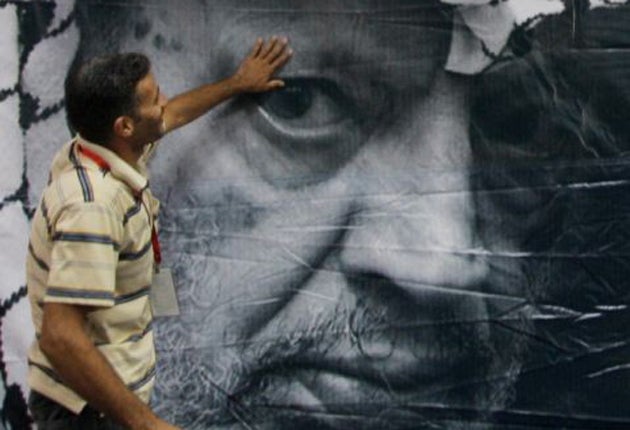
Fatah, the dominant Palestinian movement under Yasser Arafat that has gone from debacle to defeat since his death, begins its first leadership convention in 20 years today.
The big question as more than 2,000 delegates gather in Bethlehem is whether the secular group on which the world pins any remaining hopes for a peace deal with Israel can cast off the taint of corruption, regain its legitimacy and put forward new faces who can take back the ground lost to the Islamic fundamentalist Hamas movement.
One such face belongs to Ziyad Abu Ayn, a close associate of the jailed leader of the second intifada, Marwan Barghouthi. Flashing smiles in all directions, Mr Abu Ayn worked the crowd and exchanged pecks on the cheeks with delegates from Lebanon, Syria and the West Bank. He said: "This is a conference for change; 80 per cent of the leadership must be changed because they failed at everything. It is time for a change of generations." The 50-year-old, who has spent more than a decade in Israeli prisons, added that most of the people on the executive committee were aged in their late 60s or 70s.
The international community and Israel will watch the three-day convention closely, particularly Fatah's continued commitment to negotiations. A 41-page draft proposal that emerged yesterday marginalises Fatah's once-central theme of "armed struggle" against Israel but demands a complete freeze of Israeli settlement before talks for a final peace deal can take place.
It is due to be presented for approval during the convention. But this will be no small task for a movement that includes both advocates of negotiations, such as Mr Abbas, who see Fatah as a political party, and more militant figures who believe Fatah should remain a national liberation movement that can resort to armed struggle as long as Israeli occupation persists and Palestinian demands including the return of refugees are not met.
As well as defining the group's programme, there will also be elections to Fatah's central committee and revolutionary council. Deal-making and campaigning were already under way over cups of coffee in the crowded and stuffy lobby of the Bethlehem Hotel.
Old guard leaders and former cronies of Mr Arafat have for years resisted a party congress out of fear that they would lose seats and power to younger leaders. But in recent months, Mr Arafat's successor, the Palestinian President Mahmoud Abbas, has reached the conclusion that a meeting needed to be convened to stem Fatah's decline.
The group's downturn began with the death of Mr Arafat in 2004, which set the stage for twin disasters under Mr Abbas: the unprecedented loss of parliamentary elections to Hamas in 2006 and the seizure of the Gaza Strip by Hamas the following year.
There has thus far been no accountability in Fatah. Indeed, rather than resign, the people responsible for its debacles are now seeking promotions. Nabil Amr, an Abbas ally and a one-time Arafat associate who was trounced by a Hamas candidate in parliamentary elections for the Hebron district, is trying to nevertheless move up from the revolutionary council to the central committee.
Mohammed Dahlan, whose security forces were routed by Hamas fighters in Gaza, has his sights on the top body.
And Rawhi Fattouh, a former speaker of parliament who caused embarrassment last year when Israeli border inspectors found 3,000 contraband mobile phones in his car, is also a candidate.
Without naming names, Musa Fawaz, a delegate from Lebanon, said that the success of discredited figures in these leadership elections would sound a death knell for Fatah. "Failure to transform Fatah with a new, popular, non-corrupt leadership will mean its destruction," he said.
Everyone in the lobby of the Bethlehem Hotel was talking yesterday about the need for change. But few are willing to predict whether it will actually materialise. Some delegates said that a legacy of Mr Arafat's tenure meant that Fatah had an ingrained culture of supporting the leader even if he was not doing a good job."We are used to being slaves, not to acting like free people. And many of the slaves among Fatah will re-elect the failed leadership," said Hossam Khader.
Hamas did its best to derail the gathering by banning the 400 Fatah delegates representing Gaza from leaving the Strip unless Mr Abbas ordered the release of hundreds of Hamas leaders and activists jailed by the Fatah-controlled security forces in the West Bank.
Organisers decided to go ahead with the conference without the contingent of delegates from Gaza.
Join our commenting forum
Join thought-provoking conversations, follow other Independent readers and see their replies
Comments
Bookmark popover
Removed from bookmarks