Mary Dejevsky: The town that measures life in 15-second intervals
You can tell almost as much about a country from the things they want you to see as the things they would prefer you didn't. And just now one of things Israel really wants the outside world to see is daily life as it is lived in the depressed southern town of Sderot.
A "new town" created as a regional centre in the 1950s to accommodate the early waves of mainly north African refugees, Sderot was once distinguished only by middle-brow ordinariness and its relaxed lifestyle in the sun. More recently, it has stamped itself on Israel's political and psychological map as the chief target of Palestinian rockets.
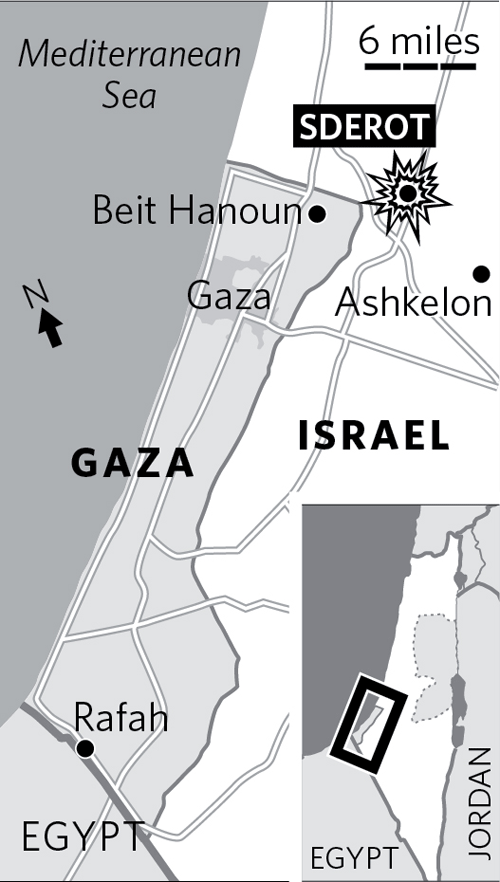
The town's vulnerability is apparent as you approach from the north. The urban sprawl of Gaza City is clearly visible on the near horizon – just across what could one day be the border of a Palestinian state. The distance – or lack of it - places Sderot just within the 10km range of Qassam rockets fired from the village of Beit Hanoun, essentially a northerly suburb of Gaza City.
Israel fears that, as the still quite amateurish rocketry of the Palestinian militants improves, other, much bigger, places – such as Ashkelon, which has a population of 110,000 – will come within range. For the moment, though, it is Sderot that bears the brunt.
Life here is measured in intervals of 15 seconds. It is how long the people of Sderot have between the sounding of the sirens and the inevitable explosion. Civic life is almost non-existent. People are on edge, unwilling to plan anything in advance, entertaining – if at all – at home, and fearful of dropping their children at school, lest it is the last time they see them.
Sitting in the spacious dining room of her house in Sinai Street, Shula Sasson explains, with the weary voice of experience, that 15 seconds is not long enough for anyone except the most agile to get to the safer downstairs from upstairs. "If you have to carry a small child, you haven't a hope." So the upstairs of their large house is hardly used. Mattresses are piled up behind the settee. Everyone – seven people – now sleeps in the living room.
A child of Sderot, Mrs Sasson was born in the fifties to Libyan-Jewish refugees and remembers happy childhood days, a close sense of community, with a sense of safety.
She shows off an extension built by her grown-up son with his pay-off from the army. It includes a "safe" room, with a metal door and strengthened walls. At about 6ft by 4ft, it is just about big enough for everyone to squash in. After next door was hit last year, her 13-year-old son has taken to sleeping there every night – "like a dog in a kennel".
Shula remembers to the minute when the rocket hit next door: 4.15pm on a Thursday. She saw the rocket coming in, heard the crashing and smashing as "windows, doors, everything exploded", and recalls the red-hot debris that she found on her porch.
More than half of next door's roof was ripped off, and the house stands, apparently abandoned. The neighbours, who were not at home at the time, were evacuated; the Sassons have adopted their dogs, which mill around the tiled courtyard. And there, as the sun suddenly comes out, and the lush greenery casts its shade, you catch a glimpse of the agreeable life for which Mrs Sasson is so nostalgic.
Now, though, hardly anyone walks outdoors unless they have to. Once-pleasant residential streets are deserted. Bus shelters double as rocket-shelters.
At the Superdahan supermarket in what passes for the centre of Sderot, the manager, Dan Dahan, offers a range that would put most small British supermarkets to shame. He stocks everything any household would need, with colourful racks of fresh vegetables and fruit. He wonders, though, how much longer he will be able to stay in business. And if the supermarket closes, then so probably will the other remaining shops. Increasingly he has to collect goods from the wholesalers himself; no one will deliver in Sderot any more.
His trade has halved in past year. It is not only because about 30 per cent of the population has left, it is because the exiles were the better-off residents, the ones without mortgages or with money to spare, who could afford to move. He observes, too, that shopping habits have changed. "Children are taken straight home from school by their parents; they don't drop in to buy sweets."
There is fear in Sderot - fear of rockets and fear for the psychological damage to the next generation. But there is subdued anger, too. Far from hailing Israel's withdrawal from Gaza or the recent resumption of the peace process, Mrs Sasson and her family feel abandoned.
Like Mr Dahan, she accuses the government of treating the residents of Sderot as "second-class citizens". If Sderot were wealthier, if the majority of its population were of European origin, if it were closer to Jerusalem – their inference is – then perhaps the government would have been tougher in its response.
As elsewhere in Israel, there was scorn in Sderot for the shutdown of the power station in Gaza – blamed on Israel – and the candle-carrying Palestinian children. The whole episode was dismissed as a Hamas publicity stunt.
What Israel seems to have learnt, however, is that it is not just with rockets, but with publicity that this conflict is increasingly being fought.
Join our commenting forum
Join thought-provoking conversations, follow other Independent readers and see their replies
Comments
Bookmark popover
Removed from bookmarks