Military whistleblower tells of 'indiscriminate' Israeli attacks
Troops fired tear gas during a curfew in a West Bank village to stop peaceful demonstrations
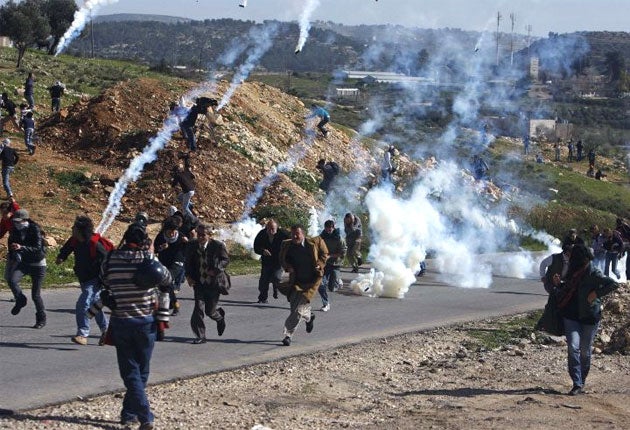
Israeli troops fired tear gas indiscriminately and sometimes dangerously to enforce a daytime curfew inside a West Bank village to stop Palestinians holding a peaceful demonstration on their own land, a military whistleblower has told The Independent.
The soldier's insight into the methods of troops comes as the Israeli military prepares for demonstrations predicted when the Palestinian President Mahmoud Abbas submits an application for the recognition of statehood to the UN next week.
The testimony also reinforces a report by the human rights agency B'Tselem which argues that the way Israel deals with protests in the small village of Nabi Saleh is denying the "basic right" to demonstrate in the West Bank. The right to demonstrate is enshrined in international conventions ratified by Israel.
The soldier, a reservist NCO with extensive combat experience, was among more than 20 soldiers sent into the village more than two hours before a planned Friday demonstration in July, to try to quash protests before they began. The protests started in December 2009 after Jewish settlers appropriated a spring on privately-owned Nabi Saleh land.
The reservist, who originally testified to the veterans' organisation Breaking the Silence, told The Independent that they went into a house in the village and took a position on the roof. "The sun was very hot, but we had to keep our helmets on," he said. "Then some soldiers start getting bored and start shooting tear gas on people. Every guy who is not in his house or in the mosque is a target."
He said that 150 rounds of tear gas or stun grenades were fired during the day and one soldier boasted that he had fired a tear gas canister which passed within one centimetre of a resident's head.
Army rules prohibit firing canisters directly at people because they have caused serious injuries in the past. Another soldier travelling with the whistleblower in a military vehicle out of the village was left with an unfired tear gas canister.
"He should have fired it into an open field but we passed a grocery story with some people outside it with children. After we passed it he just turned round and fired it at them."
The reservist was given a week's preparation on the use of stun grenades, rubber bullets and tear gas. He had been impressed by a four to five -hour visit to the trainees by the Binyamin Brigade Commander Sa'ar Tzur who addressed "issues of ethics and human life, not just on our side but on the other side".
Some soldiers complained about the strictness of prohibitions – not always honoured, according to the leaders of the weekly Nabi Saleh protests – on the use of live ammunition. But Colonel Tzur "was very strict on the fact that these are the rules and that anyone who breaks them will pay for it".
But the battalion officer, a religious West Bank settler, was "exactly the opposite," he added. "At the base there was a mission statement signed by the Brigade Commander which said 'we need to maintain the fabric of life for the civilian population, Israelis and Palestinians.' The battalion officer crossed out the word 'Palestinians' and all the soldiers around started laughing."
The reservist's testimony supports B'Tselem's s main conclusions, including that the military makes "excessive use of crowd control weapons, primarily the firing of tear-gas canisters."
He said: "It was very difficult for me. I want to be in the army to defend my country. On the other hand I saw that the job I was doing did not have any connection with defending Israel."
He said that his unit was called to the village square when the battalion officer showed around 40 Palestinians and foreign activists a written order declaring the village a "closed military zone." The soldiers had earlier heard shouting elsewhere by demonstrators before they were almost immediately dispersed by border police firing tear gas. The reservist said the people in the square "were just standing there. The officer said to the soldiers: 'Everybody should get out of here. The Palestinians into their homes and the foreigners should get out. Anyone left should be arrested.' One Palestinian was arrested when a soldier decided that he had 'looked at him in a way he didn't like'."
As well as 35 Palestinian injuries in Nabi Saleh this year, there have been 80 detentions since the protests began, including of 18 minors, and protest leader Bassem Tamimi, currently awaiting military trial based largely on the interrogation of a 14-year-old boy arrested at home at gunpoint at 2am.
The military said it has "clear, detailed, and professional guidelines" for the use of tear gas to disperse "riots", and that after two years of "dangerous and violent riots" it declared the village a "closed military area" on Fridays to "prevent these riots before they turn into violent ones".
The military's tactics have varied. A 13-year-old Palestinian boy was seriously injured by a rubber-coated bullet fired at close range during protracted clashes between armed troops and stone-throwing youths observed last year by The Independent. Those clashes started when troops fired tear gas and rubber bullets on the hitherto peaceful march towards the spring.
The reservist said he had seen no stones thrown on the day he was there. adding: "If they want to stop people throwing stones at the spring, why don't [the troops] wait at the spring? Why are they coming into the village?" He added: "The headline of the whole Friday, as I see it, if the army won't be in the village nothing would happen because the demonstration was not violent."
Join our commenting forum
Join thought-provoking conversations, follow other Independent readers and see their replies
Comments