My descent into Gaza's smuggling underworld
The tunnels under the Egypt border have become an economic lifeline, as Donald Macintyre discovered
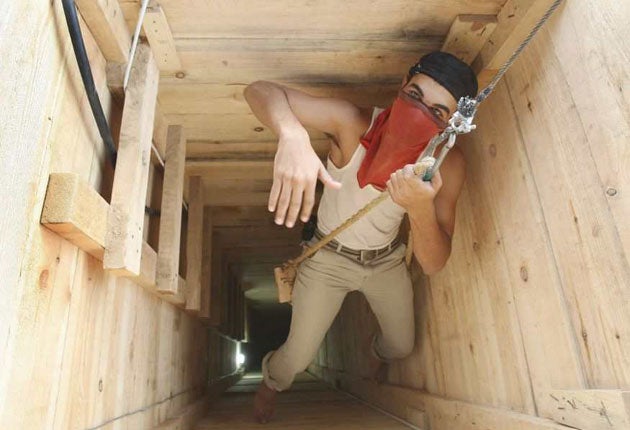
Crawling south in the dank metre-high passage, you have to hope the crude wooden supports will keep the thick layers of clay and sand above your head from crashing down on to you. Anyone who has been in a narrow-seam coal mine can relate to the mild sense of claustrophobia induced by a visit to Gaza's smugglers' tunnels, in which workers were killed at roughly the rate of three a week last month.
To get to this one, you have to lower yourself down the shaft like an ungainly monkey, gingerly placing your hands and feet on the frustratingly narrow ledges embedded in its also wooden walls. Given the awkward access and the cramped conditions, it's a surprise to see the lights on when you reach your destination. Welcome to the subterranean world below Gaza's border with Egypt.
The light bulbs are run off long cables from Rafah's municipal power supply and in their glow, "Felix", a cheerful 27-year-old black Palestinian, has been using his intercom phone to talk to his Egyptian counterpart at the other end of the tunnel a kilometre away. Beside him, the whirring electric motor is turning the long steel cables, which are hauling canisters of Egyptian-made cooking gas into Gaza. Two hundred have arrived this morning alone. "I spent two years doing a diploma in decoration," Felix says. "But I have five children to support and this is the only work I can find".
Every merchant who buys one of the prized blue canisters will pay a $40 (£25) premium for the difficult and dangerous task of just transporting them, says his boss, Ahmed. But in Gaza, where cooking gas has been virtually unobtainable, the merchants recoup that outlay, selling them on for more than $100. "Everything people lack in Gaza comes through the tunnels," he explains.
The hundreds of tunnels ferry every possible commodity – from diesel fuel, clothing, chocolate, cigarettes and potato chips to cattle and Chinese-made motorcycles. And reportedly even the occasional hospital patient who has been to Egypt for treatment and is then shipped on a trolley and drugged to prevent panic attacks underground.
It's a thought-provoking irony that the tunnel network, which a United Nations report this month said was a "vital lifeline" and the "direct result" of a siege designed to weaken Hamas, is actually now putting money into the Islamic faction's coffers.
A few hundred metres along what is left of the steel wall blown up by Hamas last January, Karim and Eyad are supervising the digging of a new, and deeper, stone and cement shaft. Like the others, it is protected from the weather by a large tent. The two men, both 35, have paid the Hamas-controlled Rafah municipality 10,000 shekels (£1,665) for permission to dig their tunnel, under new regulations.
A lean and patient dun horse repeatedly hauls a decrepit leather bucket of mud from the bottom 20 metres, right under the watchful eyes of Egyptian soldiers in a watchtower just across the border. Eyad explains the difficulties of routing tunnels so that at the other end they will escape the attention of Egyptian forces, who have pledged to destroy them.
"We use Google Earth to plan the tunnel," he says. "We have to find a hidden place, a deserted house or something like that." In constant touch by mobile phone with an Egyptian worker – well paid for risking a prison sentence if he is discovered – and using a long pole, which can protrude above the ground, "we make a sign of where we've got to. Then he tells us, yes that's the right place or move to the left or right, or go another 50 metres."
Rafah's Mayor, Issa al-Nashar, says the new tunnel rules drawn up by Hamas have already resulted in the "registration" of – and levies on – about half of the 400 tunnels here, thought to employ more than 6,000 workers. Hamas officials started inspecting the tunnels last month and have drawn up an agreement under which the owners are required to pay compensation for those injured or killed in them.
The tunnels are a painful inevitability imposed by the siege, Mr Nashar says, adding: "As soon as the crossings are opened, they will be dismantled." The smuggled goods themselves are not being taxed by the Hamas de facto government, he insists, but acknowledges: "This is possible in the future."
For the tunnels are now big business. Karim, who used to work in construction in Israel, says the cost of building his tunnel is about $70,000. "I sold my car, my wife's gold, everything to pay for it." But he hopes to make between $10,000 and $50,000 a month once it is fully working, 24 hours a day, seven days a week, out of which he will have to pay the 20 workers he expects to employ. Ahmed, the boss of the other tunnel, says tunnels that are already operational are now being bought and sold at prices up to $150,000.
While, on the Palestinian side, the tunnels may be operating openly, none of the operators would give their full names. "If we want to go Egypt, we could be arrested," explains Karim. Israel is convinced that Hamas – through more discreet tunnels controlled by the faction – has been bringing weaponry into Gaza, but Karim says he does not to expect to be asked to smuggle arms. "There is no market for them," he insists. "There is a truce with Israel, there isn't fighting between Hamas and Fatah, and there are enough weapons in Gaza already."
Karim, who started to train in Romania as a doctor before the second intifada until he ran out of money, reflects that he would rather be doing something else than a job which has already cost 40 lives this year. Looking down the shaft, he adds: "I may be digging my own grave."
Join our commenting forum
Join thought-provoking conversations, follow other Independent readers and see their replies
Comments
Bookmark popover
Removed from bookmarks