My magical mystery tour: Sir Paul McCartney's return to Israel
Last week Sir Paul McCartney returned to Israel, four decades after The Beatles were banned. Here, with comments by Sir Paul, is the pick of his portfolio. And, left, Donald Macintyre reflects on a diplomatic triumph
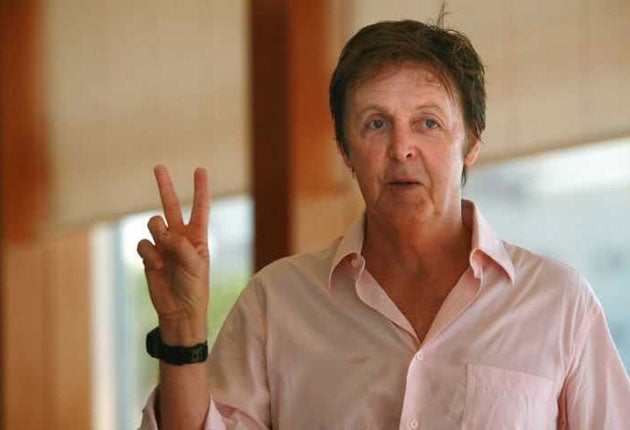
It started with an act of contrition in January when Ron Prosor, Israel's ambassador to Britain, apologised for Israel's "missed opportunity" when it banned The Beatles from the country in 1965. It ended in Hayarkon Park on Thursday night with an excited Tel Aviv audience feeling self-evidently better about themselves, thanks to a Paul McCartney trip 43 years late.
Sir Paul had prepared for the visit with an attention to detail few other superstars would have matched. It was not just the Hebrew patter he painstakingly learnt; it was also a canny ability to steer his way through the hypersensitivities of a visit that might have gone badly wrong.
He had the nous – faced with Maccamania in the Israeli press as well as official boasts of a PR coup, and denunciations by Palestinians in favour of a cultural boycott – to visit the West Bank. And he was flexible enough to take last-minute advice from the British consulate to avoid a potential demonstration clouding his planned visit to Ramallah by travelling instead to Bethlehem to visit children at a music academy named after the late, great Palestinian nationalist and intellectual Edward Said.
According to the British official who was with him when he met the children, he couldn't have handled it better. Happening on a little girl clutching a violin and close to tears from the shock of a VIP invasion, he took the instrument from her, made a horrible noise with it and told her she could obviously play it much better than he could; emboldened she began to play her piece. Unaffectedly he refused an offer of tea and cakes out of respect for the Muslim Ramadan fast.
It turns out too that the lapel badge he sported at Thursday night's concert was that of One Voice, a joint Israeli-Palestinian organisation committed to a two-state solution, and whose Israeli representatives he took the trouble to meet on Thursday afternoon.
So when on Thursday night he led a vast crowd – for Israel – in John Lennon's song "Give Peace A Chance", he had actually thought about the meaning of a message to which an audience in the most liberal city in Israel was well attuned.
When, having used the old Hebrew greeting Shana Tova to wish his Israeli audience well for the Jewish New Year next week, he added in Arabic the also venerable "Ramadan Karim", the cheers were almost as loud. Sir Paul will know well enough by now that it is not this Israel, the one on display in Hayarkon Park, that needs to be convinced by his message of peace. But it seemed mighty glad to hear it all the same.
Paul McCartney in Bethlehem, West Bank
"When I was told there was a concert in Tel Aviv I was looking forward to it. I've never been to Israel and the Beatles were banned originally, but I was conscious of the Jewish-Palestinian conflict. So I said I would like to try to come to Palestine while I had a few days ... Rather than staying in England and saying 'oh yeah, too bad about that lot'. I've been here now and I'm getting a better understanding."
Inside the Church of the Nativity, Bethlehem
"I enjoyed going into Palestine. Israel's a beautiful country, driving down to Jerusalem was a great drive. Being in Jerusalem was very special just because of the history. Then going through the wall was kind of quite special, but in an edgy way. You don't like to see things like that exist in the world – it reminded me of the Berlin Wall."
Speaking to the press in Tel Aviv ahead of the concert
"My little bit is to try to bring people together through music ... It seems to me that most of the people are quite moderate and would like a solution. They would like peace like most people in the world ... They want the governments to decide quite quickly on two states, on two nations rather than this conflict. They want it to work so they can both be separate and peaceful."
With pupils at the Edward Said National Conservatory of Music, a school in Bethlehem
"We were due to go to a music school in Ramallah but a lot of people found out and there was a demonstration so the security people banned me from going there. We were very lucky to come here to Bethlehem to visit this music school ... It's great to see the effort here. The whole policy is to bring people together through music. That's what I hoped to see when I came here. I'm really glad we didn't just turn back and stay in Israel. We came through the checkpoint and got a little idea of what's going on."
Entertaining pupils at the Edward Said National Conservatory of Music
"Kids are the same the world over so it was great to be with them and have a little bit of fun with them, just basically tell them I'm in the same boat, I was in music and we all want to live together peacefully."
At the Church of the Nativity, at Bethlehem in the West Bank
"I went to the church at the site of Jesus Christ's birth. That was great. It was very special to light a candle and just be there. It's a very special place."
Performing on stage during the "Friendship First" concert at Ganey Yehoshua Park in Tel Aviv
"I am always looking forward to gigs, particularly here, because it's been such a long time coming ... music is great for people. It's good for your soul. It is a great international voice for getting people together. I can go to Russia, I can go to Israel, I can go to Palestine – everyone understands music. We all love music, so it is important to me."
Join our commenting forum
Join thought-provoking conversations, follow other Independent readers and see their replies
Comments