Netanyahu: The leader who struts like a superpower
Benjamin Netanyahu is favourite to win Tuesday's Israeli election, and that could put him on a collision course with the Obama White House. Donald Macintyre reports
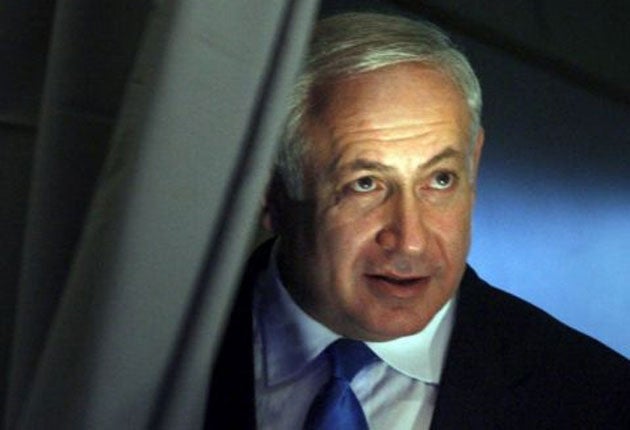
It was Bill Clinton who drily observed after meeting the newly elected Prime Minister Benjamin Netanyahu that "he thinks he is the superpower and we are here to do whatever he requires."
If Mr Netanyahu emerges as victor in next Tuesday's election and in the process of government formation that will follow, he is unlikely to treat President Barack Obama to a repeat of what Mr Clinton's key Middle East aide, Dennis Ross, would later recall as that "nearly insufferable" performance in the White House in 1996.
Mr Netanyahu, who has gone out of his way to be publicly flattering about Mr Obama in recent weeks, knows a little more about diplomacy than he did then; one of several reasons why he lost the election three years later was that the Israeli public was unhappy about how unwelcome their prime minister had become in Washington.
The question of whether this is more than a superficial change, and whether he can manage to avoid alienating a new US president professedly intent on progress in the Middle East, remains a vexed one, however.
With his lead over Tzipi Livni's Kadima party narrowing this weekend, Mr Netanyahu's Likud cannot be regarded as a shoo-in. But if he does win, it will have been on a platform of expanding rather than uprooting existing West Bank settlements, of the indivisibility of Jerusalem as the capital of the Jewish state, and of the need to remedy what he sees as the unfinished military job last month of toppling Hamas. None of these positions, on present showing, are likely to commend themselves to the White House.
The paradox of Mr Netanyahu's uneasy relationship with the US last time around is that he is the most Americanised of Israeli politicians, albeit one more linked to the neo-conservative Republican right. He was given a US education by his émigré Israeli parents, interrupted by military service first in the elite Sayeret Matkal unit – during which he took part in the nocturnal rescue of hostages from a hijacked Sabena jet in 1972 – and later in the 1973 Yom Kippur war.
He might even have pursued an American business career, had his brother, Yoni, not been killed during the much more famous Entebbe raid in 1976; for Bibi – as he is universally if not especially warmly known – that was a seminal event. But in 1982 he took a job in Israel's Washington embassy as a protégé of the leading Likud figure and then-ambassador Moshe Arens, returning to Israel in 1988 to a Knesset seat and deputy ministerial post.
His rise was meteoric, if hardly untroubled. In 1993, when he was fighting for the Likud leadership, his present – and third – wife, Sara, took an anonymous call reporting the existence of a video of her husband in "compromising romantic situations" with a female image consultant. The candidate's response was to go on television, confess to infidelity and then accuse his Likud rivals of using "mafia methods" to undermine him.
What mainly exasperated the Clinton administration once Mr Netanyahu became Prime Minister was his foot-dragging over the Oslo accords – which he had vigorously rejected, personalizing much of his opposition around the then-prime minister, Yitzhak Rabin, assassinated in 1995. Today, he remains deeply opposed to territorial concessions to the Palestinians in any foreseeable future, arguing that they would be to pave the way for a further "Hamastan" – the term he is proud of having coined about Gaza – in the West Bank.
He has several times during the campaign dropped the name of Tony Blair when advancing his own favoured alternative: an "economic peace" under which some of the formidable obstacles to West Bank trade might be removed – but not (as many others, including Mr Blair, envisage) as a prelude to an independent Palestinian state.
The Israeli analyst Yossi Alpher thinks that if Netanyahu wins and is able to form a unity government with Ms Livni and Labour leader Ehud Barak, he might just be able to avert an early collision with the US President. He might, Mr Alpher says, be able to persuade the President's envoy, George Mitchell, that instead of a deal with the Palestinians he could "live with" serious negotiations with Syria as an alternative – despite his campaign pledges not to surrender the Golan. This would at least have the merits of detaching Damascus from Iran – the nuclear threat from which Mr Netanyahu has made a centrepiece of his campaign. But if, instead, he forms a right-wing coalition including the fast-rising Avigdor Lieberman, Mr Alpher believes "he's in trouble."
Either way, a seminal New Yorker profile by David Remnick in 1998 emphasised the influence of the Likud leader's flintily hard-line father, Benzion Netanyahu, an academic and one-time aide to the revisionist Zionist Ze'ev Jabotinsky. "To a considerable degree Bibi Netanyahu's struggle is between an inherited ideology and the tug of political contingencies," Remnick wrote. If Mr Obama seriously wants progress in the Middle East, he is likely to have his work cut out if Mr Netanyahu wins next Tuesday.
Join our commenting forum
Join thought-provoking conversations, follow other Independent readers and see their replies
Comments
Bookmark popover
Removed from bookmarks