New face of power in the Middle East
Turkish Prime Minister Recep Tayyip Erdogan's handling of the Gaza crisis has brought him into the spotlight – and his country into the centre of regional politics. Patrick Cockburn reports
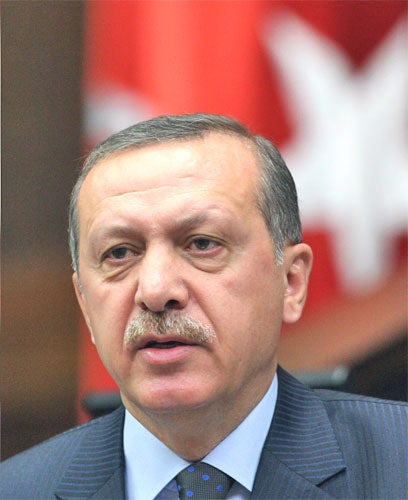
Ever since Israeli commandos stormed a ship carrying aid to Gaza killing nine activists, the face of Turkish Prime Minister Recep Tayyip Erdogan – the man who led denunciations of the raid – has been prominent on front pages and television screens across the Middle East.
The bloody fiasco has led to a crucial change in the balance of power in the Middle East, greater than anything seen in the region since the collapse of the Soviet Union deprived the Arabs of their most powerful ally.
While Muslim states were always going to praise any leader who confronted Israel, Mr Erdogan's personal role is one that will have lasting significance across the region. With his leadership, Turkey is once more becoming a powerful player in the Middle East to a degree that has not happened since the break-up of the Ottoman Empire at the end of the First World War.
Turkey was the driving force behind attempts to denounce the raid at a regional summit that ended yesterday in Istanbul. It received the backing of 21 of the members of an Asian summit but the crucial 22nd member, Israel, blocked any mention of the raid in an end of summit declaration.
Israeli commentators are hopeful that Turkish belligerence is a passing phase and there will be no permanent damage to their country's relations with Turkey. Yet Mr Erdogan has received strong backing for his strong stance following the deaths of his countrymen on board the Mavi Marmara ship.
At a rally in Beirut, thousands of Lebanese waved Turkish flags and nine coffins draped in the red banner were displayed to honour the Turkish flotilla dead. "Oh Allah, the merciful, preserve Erdogan for us," protesters chanted, using language often reserved for Hizbollah's popular leader Sayyed Hassan Nasrallah, who has praised Mr Erdogan's stance.
With a population of 72 million and the second largest armed forces in Nato after the US, it is surprising Turkey had not been a major role in the Middle East before now.
In a televised address on the Israeli raid, Mr Erdogan said "this daring, irresponsible, reckless, unlawful, and inhumane attack by the Israeli government must absolutely be punished. Turkey's hostility is as powerful as its friendship is precious."
Such threats from other Middle East leaders could be ignored because their regimes are too shaky and unpopular for them to do much more than cling to power. But Turkey is different because politically, diplomatically and militarily it has been rapidly growing in strength.
In relations with Iraq, Iran, Syria and its other neighbours it is playing a central role for the first time since Kemal Ataturk, the first President of modern Turkey. In Iraq, for instance, the US depends on Turkey to increase its influence and counterbalance Iran as 92,000 US troops withdraw over the next 18 months.
It is not clear how far Mr Erdogan will go this time to assert Turkey's leadership in the Middle East and take advantage of Israel's fiasco. His track record is as a man who is quick to take advantage of others' mistakes. But he likes to pick his moment and is careful not to overplay his hand. He has done this with great skill in domestic politics in his confrontations with the Turkish army leadership who used to determine Turkey's foreign policy.
Mr Erdogan, the son of a coastguard official, was born in Rize on the Black Sea in 1954. He moved with his family to Istanbul when he was 13. He reputedly sold lemonade and sesame buns in working-class districts of the capital while attending religious schools. Tall and strongly built, he became a professional footballer while obtaining a degree in management at Marmara University. He acquired a reputation for piety, saying his prayers before each football match. But from an early stage he was involved in politics. He had met Necmettin Erbakan, the leader of the Islamic Welfare party, when he was at university and became leader of the party's youth wing in Istanbul.
His rapid rise was interrupted by military coups of which there have been four in Turkey since 1960. After the coup of 1980 he lost his job in the capital's transport authority when he was ordered to shave off his moustache – seen as a sign of excessive Islamic fervour – and refused.
An able orator and political organiser, he rose through the party ranks and became mayor of Istanbul at the age of 40, running the city between 1994 and 1998. He was regarded as an honest and efficient administrator.
The army forced Islamic Welfare out of power and Mr Erdogan served four months in prison for reciting an Islamic poem which contained the allegedly inflammatory lines: "The mosques are our barracks, the domes our helmets, the minarets our bayonets and the faithful our soldiers."
Mr Erdogan decided along with other young Islamist political leaders that the army and the Turkish establishment would never let them take power unless they showed themselves pro-Western and pro-capitalist. They formed the Justice and Development Party, the AK, in 2001 which won the general election the following year.
Supporters for the new party were newly rich but pious businessmen in Anatolia as well as the peasantry and the poor of the cities. In power, Mr Erdogan was able to justify reduction in the power of the military as a reform made necessary by Turkey's application for EU membership. He was aided by a sustained economic boom during which foreign capital, encouraged by its EU application, poured into Turkey and the economy grew at an average rate of 7 per cent up to 2007. Careful to avoid making enemies unnecessarily, Mr Erdogan placated the US after the Turkish parliament refused to allow US troops to invade northern Iraq from Turkey in 2003.
Generally, Mr Erdogan has come off the winner in a series of skirmishes with "secularists" over issues such as women wearing headscarves. He patiently waited for the army leadership to make a mistake, which they did in 2007 when they tried to prevent the Foreign Minister, Abdullah Gul, becoming president. A General Staff website threatened military action if parliament voted for Mr Gul and Mr Erdogan called a snap general election in which the AK won an overwhelming 47 per cent of the vote.
Since 2007 Mr Erdogan's government has gone far in bringing the military under civilian control. There has been a prolonged investigation into an alleged plot by junior officers to launch a coup, some 49 officers being arrested earlier this year. The present crisis in relations with Israel may further weaken the authority of older and more senior officers, seen as the protagonists of strong links to Israel and the US.
The Israeli wars in Lebanon in 2006 and 2008 made Israel unpopular in Turkey. Mr Erdogan walked out of a session at Davos because he was not given enough time to respond to Israeli President Shimon Peres' justification for bombing Gaza. Back in Turkey his walk out was vastly popular. His strength then, as now, is that the majority of Turks agree with him.
Join our commenting forum
Join thought-provoking conversations, follow other Independent readers and see their replies
Comments