Now Mousavi's family feels force of crackdown
Fears grow that opposition leader's outspoken wife is among the hundreds of protesters who have been detained
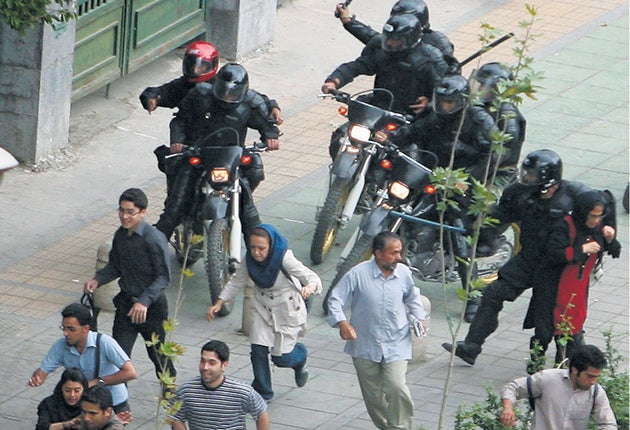
There were fears last night that the wife of Iran's opposition leader Mirhossein Mousavi had been arrested after a defiant statement that protesters should not buckle despite being in a situation she likened to martial law.
Zahra Rahnavard, who came to prominence by campaigning alongside her husband (a double act unprecedented in Iranian politics), criticised the presence of armed forces in the street and insisted that the opposition had a constitutional right to hold demonstrations. The regime should not suppress it "as if martial law had been imposed", she said.
In the message posted on her husband's website, she also demanded the immediate release of people detained since the election. But before the day was out, there were reports – which could not be confirmed because of the media clampdown – that she herself had been detained.
Meanwhile Ayatollah Ali Khamenei reiterated his hardline stance that the result of the disputed election would stand. "I had insisted and will insist on implementing the law on the election issue," he said. "Neither the establishment nor the nation will yield to pressure at any cost."
The Ayatollah's demand that public protest end means that the opposition leader must either call on his supporters to stay off the streets or be seen as mounting a direct challenge to the spiritual leader. Last night there were reports of prolonged violent clashes outside the parliament building. Witnesses described the Basiji militia charging in with batons and the police using teargas to disperse the crowd as helicopters flew overhead.
One of the President Mahmoud Ahmadinejad's main supporters in parliament, Ali Shahrokhi, the chairman of the judiciary committee, has called for Mr Mousavi's arrest, saying "his viewpoint and his illegal statements, which have encouraged and provoked public opinion are considered to be a crime. This... is illegal and should be dealt with firmly."
Mr Mousavi's legal adviser, Ardeshir Amir Arjomand, is already under arrest along with hundreds of others held since protests swept the country after Mr Ahmadinejad was declared the landslide winner of the 12 June election. A significant proportion are women. As well as opposition figures, journalists and ordinary members of the public, people who were close to regime have also been taken.
Some of those detained have been dragged off the streets in broad daylight. Others have been seized in night raids after they were identified as targets using photos taken during the daytime marches. A few have been released, but most remain missing.
Amnesty International warned yesterday that those arrested risked being tortured and urged the authorities to allow detainees access to their families, lawyers and medical treatment. "Anyone detained solely for their peaceful expressions of their views regarding the outcome of the election should be released immediately and unconditionally," it said.
Those arrested include Fazeh Hashemi, an MP and daughter of the former president Ali Akbar Rafsanjani, along with four relatives. Ebrahim Yazdi, a former foreign minister and aide to the "Father of the Revolution", has also been detained along with Muhammed Travassali, former mayor of Tehran; Behzad Nabavi, a past figure in the revolution who negotiated with the US during the 1979-81 embassy hostage crisis; and Mohammed Ali Abatabi, advisor to the former president Mohammad Khatami.
The exact number in detention remains unclear. The state prosecutor's office puts the figure at about 550, but, according to some officials inside Tehran's main prison, Evin, nearly 1,000 people have been brought in. Those taken to Evin say they have been forced to make filmed confessions and implicate members of political parties.
Some of the detainees initially taken to Evin have been moved to other prisons including Gohardasht, 12 miles west of Tehran; Prison 209, run by VEVAK, the secret service; and Prison 59, under the control of the Revolutionary Guards. It is in the latter two places that there have been the most persistent reports of mistreatment.
Hana, a 17-year-old student in Tehran, told – through a friend – of her family's concerns about her 20-year-old brother, who was arrested during a demonstration at the end of last week. "He was hit on the head when he was taken away by the police, there was a lot of blood," she said. "We know people who saw him in Evin and they said his face was very swollen and he had bad pain in his head. We have now heard that he's been moved to the Revolutionary Guards prison. We cannot find out what has happened to him."
Another woman, whose husband was arrested, said: "It is a very difficult situation. We have heard that he has been beaten and they are asking him to confess to things he has not done, things he does not even know about."
The day at a glance
* Hundreds of protesters, vastly outnumbered in clashes with riot police, are attacked with batons and tear gas.
* Election candidate Mohsen Rezaie withdraws objection over results.
* Foreign Minister Manouchehr Mottaki withdraws from a forthcoming G8 meeting and raises prospect of downgrading relations with the UK.
* Mousavi camp confirms arrest of 25 employees of a newspaper he owns.
* Opposition candidate Mehdi Karroubi complains to state TV over blaming protesters for violence.
Join our commenting forum
Join thought-provoking conversations, follow other Independent readers and see their replies
Comments