Olmert bows to pressure and announces resignation
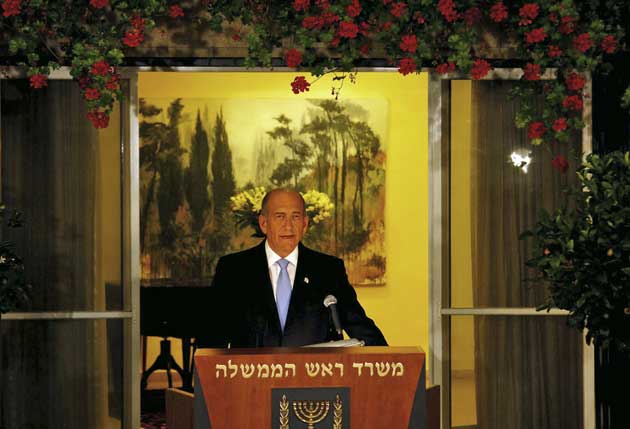
Ehud Olmert finally bowed to the steadily mounting pressure arising from corruption and fraud allegations against him last night by announcing his resignation after his party chooses a new leader in just over six weeks.
In a dramatic televised address just two days ahead of his fourth successive formal interview with police over the latest allegations, the Israeli Prime Minister declared that he would not run in the Kadima party leadership contest fixed for 17 September and would leave office as soon as a new leader was chosen.
Insisting that he had taken the decision in the interests of the country, he complained in his prime-time address that he had not been granted as Prime Minister "the right to be innocent until proved guilty". He added: "I will step aside properly in an honourable and responsible way, and afterwards I will prove my innocence."
The announcement plunges the rarely stable Israeli polity into a new period of turmoil and unleashes what is likely to be a hard-fought contest for the Kadima leadership, with Israel's popular Foreign Minister Tzipi Livni and the hard-line former defence minister Shaul Mofaz starting as clear favourites. Whoever wins the contest will then have the far-from-easy task of forming a workable coalition in order to avoid being forced into a general election which, the polls suggest, would be won by the right-wing Likud party led by former prime minister Benjamin Netanyahu.
Mr Olmert, who has not so far been indicted on any criminal charge, is being investigated over suspicions that he used payments from a US businessman, Morris Talansky, for personal use during his time as Mayor of Jerusalem and industry minister; and that he made multiple claims for travel expenses, pocketing the surplus for family holidays.
Last night's announcement was a painful surrender for Mr Olmert, a lawyer and one-time right-winger, who moved to the Israeli political centre and has proved himself a world-class political survivor in the face of a string of corruption investigations and last year's Winograd report, which excoriated his handling of the 2006 Lebanon war.
But even Mr Olmert's formidable skills proved too much to withstand a series of blows in recent months – the highly publicised and colourful testimony given in open court by Mr Talansky, detailing the premier's taste for expensive hotels and cigars; the threat to break up the coalition by Defence Minister and Labour leader Ehud Barak, which helped to precipitate the September leadership contest in Kadima; leaks (bitterly contested by Mr Olmert's allies) of the content of the criminal investigation; and an accusation by the Attorney General Menachem Mazuz that Mr Olmert was creating difficulties for the investigators.
Mr Olmert declared last night: "I was forced to defend myself against relentless attacks from self-appointed 'fighters for justice' who sought to depose me from my position, when the ends sanctified all the means."
Mr Olmert had earlier gone out of his way to pledge in his address that he would continue working for peace "as long as I am in my position", and to insist that talks with Palestinians and Syria are "closer than ever" to achieving understandings.
But while there was speculation in Israel that his resignation could damage the new series of negotiations with Syria on a possible handover of the Golan Heights, and the negotiations with the moderate West Bank Palestinian leadership, a Livni premiership, at least, might not necessarily make them any more difficult than they already are.
Ms Livni's centrality in the talks with Palestinians was underlined by her presence at a trilateral meeting convened this week by the US Secretary of State Condoleezza Rice with Ahmed Qureia, Mr Abbas's lead negotiator.
It was not immediately clear whether Mr Olmert's promise not to run or "intervene" in the Kadima leadership contest precluded him from carrying out a reported threat to help Mr Mofaz's candidacy over Ms Livni.
Among other candidates expected to stand are the Housing Minister Meir Shetreet, and Avi Dichter, Interior Minister and a former head of the domestic intelligence agency Shin Bet.
The consequences of Mr Olmert's announcement could open up a series of permutations for a possible future government. Mr Barak's desire to return to the highest office and project himself as the real rival to Mr Netanyahu is hampered by his relatively low opinion-poll rating and the fact that he is not a Knesset member. But he could still play a crucial role as a potential coalition partner, although Mr Mofaz, if he were to win the Kadima leadership, might seek to form a coalition with the right-wing parties, possibly including Likud.
Who will be Israel's next prime minister?
Tzipi Livni, 50
Former Mossad agent, now Foreign Minister and the most popular politician with the Israeli public. A strong proponent of negotiations with the West Bank-based Palestinian Authority. Remains hardline on excluding Hamas and rejecting any "right of return" for Palestinian refugees. Called on Olmert to resign after the Winograd report on Lebanon war – but failed to strike home by resigning herself. Almost certainly the most electable Kadima candidate.
Ehud Barak, 66
Labour leader, Defence Minister, and prime minister from 1999 to 2001. Could be a kingmaker but less likely to emerge as a prime minister. Seen as a security strongman, and sceptical about negotiations with the Mahmoud Abbas-led Palestinian Authority, but advocated current ceasefire with Hamas. Was Israeli PM at the Clinton-brokered Camp David peace talks in 2000. Was highly successful in persuading Israeli public Yasser Arafat was to blame for collapse of the talks.
Benjamin Netanyahu, 59
Prime minister between 1996 and 1999. Leading right-wing challenger to Ariel Sharon, first within Likud where he opposed disengagement from Gaza, and then as leader of the opposition after Sharon formed his new Kadima party in late 2005. Netanyahu's party crashed to defeat in the March 2005 election, won by Sharon's successor Ehud Olmert, but he has gained popularity as Mr Olmert's has declined. Polls show Likud as the single biggest party if there was a general election today.
Shaul Mofaz, 60
Iranian-born right-winger who defected with Sharon from Likud to Kadima. Notably hardline Chief of Defence Staff and then Defence Minister. Now Transport Minister, he was accused of advancing leadership interests by threatening attack on Iran. Brings many of the old wheeler-dealing skills of Likud to his candidacy as a Kadima leader. Likely to project himself as a figurehead for Jews from Muslim countries against the traditional Ashkenazy ascendancy.
Join our commenting forum
Join thought-provoking conversations, follow other Independent readers and see their replies
Comments
Bookmark popover
Removed from bookmarks