Outrage as Israel bombs UN
Aid workers allege use of banned white phosphorus as Hamas security leader dies in bombing raid on house
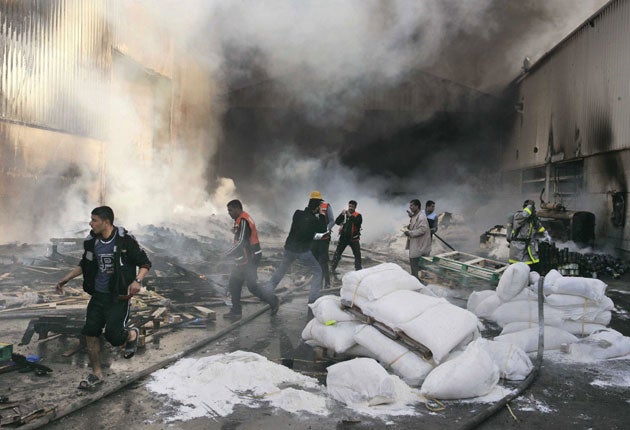
Israeli tanks thrust deep inside Gaza City last night as ferocious fighting raged in dense residential areas with terrified families fleeing along streets echoing with gunfire, although many others were trapped in their homes.
Israeli shelling set fire to the UN headquarters, a hospital, a school and a building used by the media, leading to widespread international protests and renewed calls for a ceasefire in the conflict which has so far cost 1,073 Palestinian and 13 Israeli lives. A senior Hamas leader, the Interior Minister Said Seyyam who was responsible for thousands of security agents, was killed in an Israeli raid which flattened his brother's home.
Three members of UN staff were injured when three Israeli shells hit the headquarters, setting it on fire. Thousands of tonnes of desperately needed food and humanitarian supplies were destroyed and about 700 refugees given shelter in the building had to be evacuated. UN officials said the shells were white phosphorus, believed to have been responsible for burns suffered by some Palestinian civilians.
The UN secretary general, Ban Ki-moon, on a peace mission to the region, said: "I conveyed my strong protest and outrage to the Defence Minister and Foreign Minister and demanded a full explanation."
The Israeli Prime Minister, Ehud Olmert, apologised for the shelling but claimed Hamas fighters had opened fire from the centre. "It is absolutely true that we were attacked from that place, but the consequences are very sad and we apologise for it," he said. "I don't think it should have happened and I'm very sorry."
John Ging, the director of operations for the UN relief agency, UNRWA, in Gaza described the Israeli claim about a Hamas presence as "nonsense". He added: "It's a total disaster for us." Mr Ging said the UN had warned the Israelis the compound was in danger from shelling that had begun overnight, and provided them with GPS co-ordinates to prevent an attack.
The Al-Quds hospital was also hit by shellfire when Israeli tanks moved further into the city. A tower housing the Reuters agency and other media outlets was also hit. The International Federation of Red Cross and Red Crescent Societies said the damage caused to the Al Quds hospital is "completely and utterly unacceptable based on every known standard of international humanitarian law".
The hospital is in the Tal Hawa district, a packed residential area. Streams of people fled from the fighting, carrying what belongings they could on foot, by car, and, in some cases wheelbarrows after homes were demolished and set ablaze. Mahmud Tejan Hussein drove away with seven members of his family. "Bullets started hitting our house and I decided that we must get away from here. There are Israeli tanks in the area now and we might get blocked off if we wait. But I do not know where we are going to go. We wanted to go to the UN office, but that has been attacked. Wherever we go, the fighting will follow us."
Musah Mohammed, 36, who stayed at his home in an apartment block, said: "We cannot go out. There is shooting in the street. My mother is ill and she is old; we cannot leave her here. People are shouting to each other from balconies crying that they need help. We have no electricity and very little food and water. We are very afraid; we do not know what will happen next." It was unclear whether the escalation was a final push before a ceasefire, as peace talks continued yesterday in Cairo where Israel's chief negotiator Amos Gilad arrived to hear the Hamas response to an Egyptian initiative.
Mark Regev, the spokesman for the Israeli Prime Minister, said a "momentum" was building up on the talks. "Ultimately, we want to see a long-term sustainable quiet in the south, a quiet that's going to be based on the total absence of all hostile fire from Gaza into Israel, and an internationally supported mechanism that will prevent Hamas from rearming," he said.
US Secretary of State Condoleezza Rice told Mr Olmert by phone that Washington would sign an agreement on measures to stop Hamas from rearming after a ceasefire. The Egyptian proposals call for an immediate ceasefire, resumption of humanitarian aid, an Israeli pullout and the reopening of the border between Israel and Gaza under international supervision.
Join our commenting forum
Join thought-provoking conversations, follow other Independent readers and see their replies
Comments
Bookmark popover
Removed from bookmarks