Police pour into Mosul to protect Christians from sectarian killings
One of the world's oldest Christian communities is being forced to flee the Iraqi city in their thousands, writes Patrick Cockburn
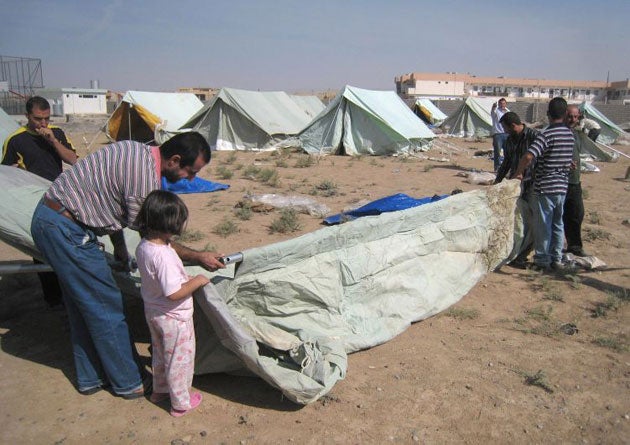
The Iraqi government was yesterday rushing 1,000 police to Mosul to try to stop a murderous campaign against Christians which has forced thousands to flee the northern city.
Officials say about 4,000 people have taken flight in the past week to escape the killings being carried out by Islamic extremists intent on wiping out one of the oldest Christian communities in the world. "The violence is the fiercest campaign against the Christians since 2003," said the provincial governor of Mosul, Duraid Kashmula. "Among those killed over the last 11 days were a doctor, an engineer and a handicapped person." At least three houses belonging to Christians were blown up in the Sukkar district of Mosul, regarded as a bastion of al-Qa'ida in Iraq, on Saturday night.
Since 28 September, at least 11 Christians have been killed in the mostly Sunni Muslim city that lies on the river Tigris some 200 miles north of Baghdad. Most of the refugees fleeing the violence are moving to Christian villages, schools and monasteries elsewhere in the Nineveh province.
"We left everything behind us. We took only our souls," said Ni'ma Noail, a middle-aged Christian civil servant, who has taken refuge with his three children in a church in Bartila, a Christian village east of Mosul. "Relatives in other cities and friends in Mosul, including Muslims, advised me to leave after recent events."
No Christians in the city feel safe. Last week the owner of a pharmacy was shot dead by a man who claimed to be a plain-clothes policeman and asked for his identity card. Traditionally there have been more Christians in Mosul than in any other Iraqi city. Police say they have found the bullet-riddled body of seven other Christians this month, including a day labourer killed on Wednesday.
The Christian community in Mosul claims to have been founded by St Thomas. Many belong to the Chaldean or Assyrian churches but, even before the present wave of killings, the number of Christians in the city had dropped from 20,000 to 10,000. In March, the Chaldean archbishop of Mosul, Paul Faraj Ranho, was kidnapped and his body was later found in a shallow grave.
The Iraqi Prime Minister, Nouri al-Maliki, said he will do everything to guarantee the safety of Christians whose community in Iraq, which numbered 800,000 five years ago, is now down to 250,000. "Two national police brigades were sent to Christian areas in Mosul and churches were surrounded and put under tight security," said an Interior Ministry spokesman, Abdul-Karim Khalaf.
The sectarian killings in Mosul are a setback to the Iraqi government's effort to persuade the 4.2 million Iraqis who have fled their homes since the fall of Saddam Hussein that it is now safe to return. Of these, two million are refugees within Iraq and a further 2.2 million took refuge abroad, mostly in Syria and Jordan. So far only 20,000 families, or 120,000 individuals, have returned, according to Abdul-Khaliq Zanqana, a member of the Iraqi parliament's displacement and migration committee.
Some Iraqis living abroad have been coming back this year after hearing Iraqi government and US claims of improved security and living conditions but often do not stay long. "My father came back from Syria where he has been living for three years," said Sami Hamoud Khalas, a 39-year-old Sunni taxi driver from west Baghdad. "But he went back after a couple of weeks because of the lack of electricity, checkpoints everywhere and because it is still dangerous."
Security is better than it was in 2006-07 when 3,000 bodies, often mutilated by torture, were turning up every month. But it is still very poor compared to any other country in the world. There are few mixed areas left in Baghdad. It is very dangerous for people to try to reclaim their house if it was in a Sunni area and they are Shia, or vice versa.
One Shia family which returned to their old Sunni neighbourhood in west Baghdad found it stripped of furniture, electrical plugs and even taps. "They decided to sleep on the roof of their house," recalls Menas Mohammed Ibrahim, a secondary school teacher. "But in the night some Sunni came and cut off the husband's head, threw it off the roof and told his wife and children: 'This will happen to any more of you Shia who try to come back.'"
Returning Sunni and Shia often do not reclaim their homes but rent accommodation in a part of Baghdad where their community predominates. The city remains divided by concrete blast walls and checkpoints which increase security but paralyse ordinary activities.
Iraqis are generally cynical about efforts by their government to persuade them that normal life is resuming. Most of the senior members of the government live in the heavily fortified Green Zone protected by US troops and with a permanent electricity supply and clean water. "They say security is good but they hide behind their concrete barriers," said Salman Mohammed Jumah, a 31-year-old primary school teacher. "They do not know what is happening on the ground. They only go out in their armoured convoys."
Join our commenting forum
Join thought-provoking conversations, follow other Independent readers and see their replies
Comments