Quartet 'creating power vacuum' in Middle East
The international community is "losing its grip" on the Middle East peace process and failing to improve the appalling living conditions for Palestinians, a group of leading NGOs charges today.
The international Quartet – consisting of the United States, European Union, United Nations and Russia – is accused of creating a "vacuum of leadership" as the aid agencies complain that "visible progress" in the Middle East has "failed to materialise".
The report says that despite the Quartet saying in June that such progress was vital to building confidence in the negotiating process, it has failed to press home its own calls on Israel for a freeze on settlement building, an improvement in the movement of Palestinian people and goods, and a revival of the collapsed economy in Gaza.
On settlements it says there has been a "marked failure to hold the Israeli authorities to their obligation under the [internationally agreed] road map and international law". It urges the Quartet to go "beyond rhetoric" and take "concrete steps" in the face of a "marked acceleration" in settlement building since Israeli-Palestinian negotiations were kick-started by the Annapolis summit last year.
The report, deliberately issued on the eve of a Quartet meeting tomorrow in New York, seeks to expose a growing gap between the stated policies of the international community on the Israel-Palestinian conflict and what it has delivered in practice.
It says that on about half of the 10 specific recommendations which the Quartet has made in recent months "there has been either no progress or an actual deterioration". It says that "clearly a new approach is warranted" and questions whether there is a future for the Quartet unless there is a "swift and dramatic improvement" in its performance.
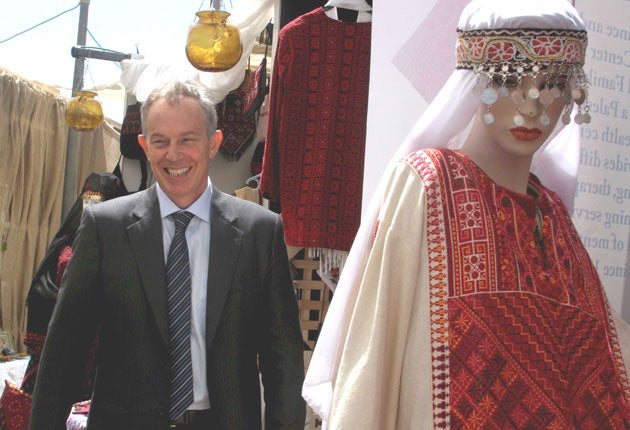
The report also gives a distinctly cool review to the progress made by Mr Blair since his appointment as envoy. Its argument that the international community has "failed" in its objective of creating "a new reality" for Palestinians by removing restrictions on movement and access is largely reinforced by a new UN report saying that there has been a net increase of 3.3 per cent in roadblocks on Palestinian movement since April this year.
While the UN's Office of Coordination of Humanitarian Affairs and the NGOs' report acknowledge that, as Mr Blair's office said yesterday, "some key" checkpoints and roadblocks have been lifted, the OCHA report says 65 per cent of main routes to the most populated areas, are blocked or controlled by an Israeli military checkpoint. But while acknowledging that Mr Blair was "very successful" in raising funds at last year's Paris conference, the NGOs' report complains this has not yet "succeeded in driving the prompt delivery of projects nor improved the lives of Palestinians".
Saying that he has had "isolated successes" in implementing agreed private-sector projects, the report says "the Quartet Representative's approach to focus on short-term economic solutions, while the long-term problems of closure and settlement expansion remain, dooms these types of projects to failure."
The report acknowledges the "modest" success in securing permission from Ehud Barak, Israel's Defence Minister, for a $20m (£11m) cash transfer last month into Gaza for salaries to be paid and accepts that the Blair-earmarked north Gaza sewage project may be completed, provided that Israel allows another 70 iron pipes in before the winter rains. But it strongly laments the Quartet's failure to fulfil its goal of kick-starting economic activity in Gaza by relaxing the Israeli imposed embargo on commercial imports and exports through its crossings.
It says that "scant progress" has been made in fulfilling most of a "precise list" of measures put by Mr Blair to Israel to ease the life of ordinary people in Gaza. The report does not mention current efforts by the Palestinian security services to assume more control and responsibility in the northern West Bank city of Jenin, strongly advocated by Mr Blair and regarded by some local observers as the most potentially far-reaching project of its kind.
But it does acknowledge that "the improvement in law and order in the West Bank is one of the few areas in which the Quartet's efforts have led to some progress".
Moderate Palestinian leaders, including Salam Fayyad, the Ramallah-based Prime Minister, have expressed increasing frustration that the advances made on security by the Palestinian Authority have not been matched by efforts by Israel to meet their own obligations under phase one of the road map. Israel has acknowledged the progress made on law and order – for example in Jenin and Nablus – by security forces, but they say they have a long way to go in curbing militant factions like Hamas.
For its part, the report raises concerns over reports of "heavy-handed policing" and "documented human rights abuses" by security forces. Successive reports by human rights organisations, including Amnesty and Human Rights Watch, have criticised the Fatah-dominated security forces in the West Bank and their Hamas counterparts in Gaza for repressive methods used against adherents of the other group.
Mr Blair's office insisted yesterday that in the West Bank, "the downward slide of the past few years has been halted", and pointed to the creation – acknowledged in the NGO report – to the new frequency allocated to the new Wataniya mobile phone network.
But while saying that Israel had taken "welcome steps", it added: "Much more could and should be done to take advantage of the momentum provided by Palestinian and donor efforts. We have made some progress, but we need much, much more."
Failing to deliver: The key issues
Settlements: Israel not being held to account for continued expansion of the illegal settlements. The international community has spoken out about settlements 18 times and yet settlement expansion is accelerating and taking a drastic toll on Palestinian daily life.
Access and Movement: Negligible impact on stated goal of improving Palestinians' ability to move freely in their own territory, to work, reach schools or access basic services. Instead there has been a net increase in the number of checkpoints, the extent of the barrier and restricted roads.
Gaza: Despite the cessation of violence in Gaza, the blockade remains and there is no improvement in the stricken economy. Eight out ten of Gaza's population remains dependent on aid and emergency relief projects have stalled.
Security: Modest success made by Palestinian authorities in improving law and order in the West Bank. Israel has conceded that progress has been made on security in cities of Jenin and Nablus. But continued human rights abuses by Hamas and Fatah in Gaza and West Bank respectively.
Join our commenting forum
Join thought-provoking conversations, follow other Independent readers and see their replies
Comments
Bookmark popover
Removed from bookmarks