Quartet opens door to ending Hamas isolation
The big powers have formally acknowledged for the first time that the policy of isolating Hamas through an economic blockade of Gaza is not working.
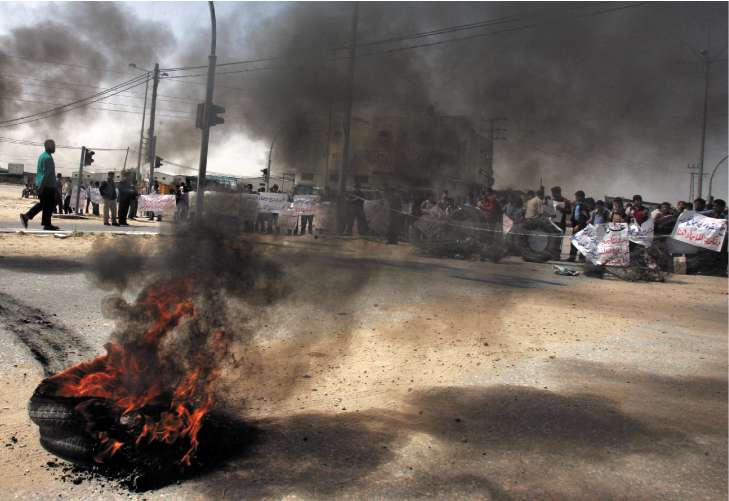
In a statement issued after talks at foreign minister level in London, the Quartet for Middle East peace opened the door to Egypt to find a "new approach" for Gaza, which was seized by the militant Islamic Hamas movement in June last year. The blockade, which was intended to provoke Palestinians into rejecting the Hamas leadership, has in fact proved counter-productive, and caused a humanitarian catastrophe for the majority of the 1.5 million population of the Gaza Strip.
"Principals strongly encouraged Israel, the Palestinian Authority and Egypt to work together to formulate a new approach on Gaza that would provide security to all Gazans, end all acts of terror [and] provide for the controlled and sustained opening of the Gaza crossings for humanitarian reasons and commercial flows," said the Quartet.
At a separate meeting in London, the permanent members of the United Nations Security Council plus Germany came up with a new package of incentives to break the deadlock over Iran's nuclear programme, after Tehran rejected earlier initiatives. However details were only to be unveiled after the proposals had been presented to Iranian authorities.
The Quartet meeting was attended by the United States, Russia, the EU and the UN, which sent the UN secretary general Ban Ki-moon. Tony Blair was also present as the Quartet's envoy.
The endorsement of the Egyptian role comes after Egypt brokered a ceasefire agreement with smaller Palestinian militant factions earlier this week, including Islamic Jihad, which has claimed rocket attacks on Israel from Gaza.
Ismail Haniyeh, the Hamas Prime Minister, said the deal represented a united Palestinian position.
"We would not accept new [Israeli] conditions ... The ball is now in the Israeli court and if they decide on rejection, I think that neither we as a people nor Egypt will accept the closure of the crossings or the continuation of the siege," said Mr Haniyeh.
The Quartet has previously urged Israel to consider handing over control of the Gaza border crossings to the West Bank-based government of Mahmoud Abbas, but had not formally endorsed the Egyptian efforts.
Israel has said it would only agree to a truce with Palestinian militants in Gaza if cross-border rocket attacks on Israel and arms smuggling into the territory ended.
Asked whether an agreement was close on reopening the border crossings with Gaza, an Israeli embassy official replied: "Of course not."
There were some suggestions yesterday that the enhanced Egyptian role might be part of a bigger strategic picture which according to one, possibly far-fetched, scenario, could eventually lead to Egypt recovering control over Gaza.
However that would run counter to the vision of the Annapolis peace drive for a "two-state" solution as defined by the US President George Bush, whose prospects have been languishing despite his continued insistence that he hopes to realise his vision before the end of his term.
The US Secretary of State Condoleezza Rice attended the Quartet meeting and was holding talks with the Palestinian Prime Minister of Fatah, Salam Fayyad, and the Israeli Foreign Minister Tzipi Livni, before heading to the region today.
However expectations of a breakthrough at this point in the US electoral calendar remain low.
Yesterday's Quartet meeting was followed by a donors' conference at which Arab states were encouraged to follow through on financial pledges in order to prevent a fiscal crisis for the Palestinian Authority next month.
Join our commenting forum
Join thought-provoking conversations, follow other Independent readers and see their replies
Comments
Bookmark popover
Removed from bookmarks