Robert Fisk: 'They snipe at us then run and hide in sewers'
Our writer was given exclusive access to the Assad Generals accused of war crimes as they seek to defeat the rebels in Aleppo
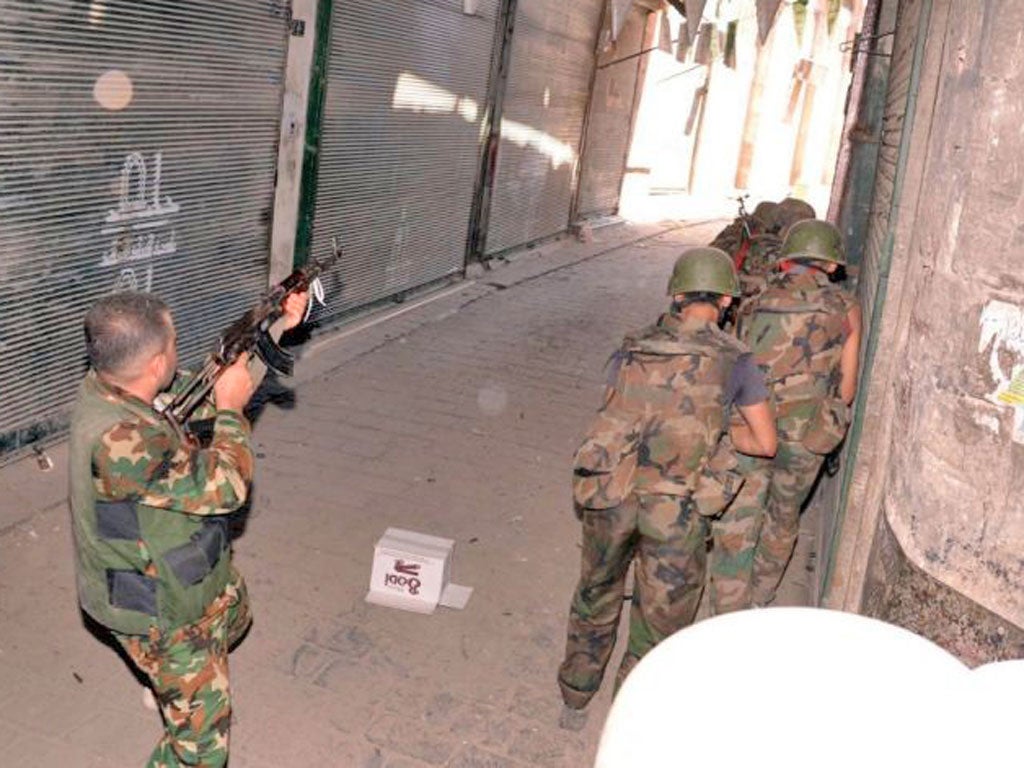
Mortars crashed into the middle-class streets around us and a T-72 tank baked in the heat under a road viaduct, but Bashar al-Assad's most senior operational commander in Aleppo – a 53-year-old Major-General with 33 years in the military and two bullet wounds from last month's battles in Damascus – claims he can "clean" the whole province of Aleppo from "terrorists" in 20 days. Now that is quite a boast, especially in the Saif el-Dowla suburb of the city, where sniper fire snapped down leafy streets. For the battle of Aleppo is far from over.
But this was a strange sensation, to sit in a private house, commandeered by the Syrian army – 19th-century prints still on the walls, the carpet immaculate – and talk to the Generals accused by Western leaders of being war criminals. I was, so to speak, in "the lair of the enemy", but the immensely tall, balding General – his officers adding their own impressions whenever they were asked – had much to say about the war they are fighting and the contempt with which they regard their enemies. They were "mice", the General said – he would not give his name. "They snipe at us and then they run and hide and in the sewers. Foreigners, Turks, Chechens, Afghans, Libyans, Sudanese." And Syrians, I said. "Yes, Syrians too, but smugglers and criminals," he said.
I asked about the rebels' weapons and the clutch of conscripts staggered into the room under the weight of rockets, rifles, ammunition and explosives. "Take this," the General said, grinning as he handed me a two-way radio, a Hongda-made HD668 taken two days ago off a dead Turkish fighter in Saif al-Dowla a few hundred metres from where we were sitting. "Mohamed, do you hear me?" the radio demanded. "Abul Hassan, did you hear?" The Syrian officers roared with laughter at the disembodied voice of their enemy, perhaps in the same block of buildings. We took this ID from the "terrorist", the General said. "Citizen of the Turkish Republic" was printed on the card, above a photo of a man with a thin moustache. Born – Bingol (Turkey) 1 July 1974. Name: Remziye Idris Metin Ekince. Religion: Islam.
So, suddenly, we had a name for one of the mysterious "foreigners" who – at least in popular Baathist imagination – staff the "terrorist" army the Syrian military is fighting. And a lot of other names with far larger significance. As I prowled around the weapons – all captured within the past week, according to the Syrian officers – I found sticks of Swedish explosives in plastic covers, dated February 1999 and manufactured by Hammargrens, whose office address was printed as 434-24 Kingsbacka in Sweden; the words "made in USA" was also marked on each stick.
There was: a Belgian rifle, an FN from the town of Herstal, manufacturer's code 1473224; a set of hand grenades of uncertain provenance numbered HG 85, SM8-03 1; a Russian sniper scope; a 9mm Spanish-made pistol – model 28 1A – manufactured by a Star Echeverria SA Eibar Espana; an ancient automatic rifle; a Soviet sub-machine-gun of 1948 vintage; a mass of Russian rocket-propelled grenades and launchers; and box after box of medical supplies.
"Every unit of the terrorists has a field ambulance," an intelligence officer said. "They steal medicines from our pharmacies but bring other packets with them." True, it seems. There were painkillers from Lebanon, bandages from Pakistan, much of the stuff was from Turkey. Interesting to know who the Spanish, Swedish and Belgian manufacturers originally sold their guns and explosives to. The haul went on and on, a newly out-of-date Visa card under the name of Ahed Akrama, a Syrian ID card in the name of Widad Othman – "kidnapped by the terrorists," another officer muttered – and thousands of rounds of ammunition. The General agreed that weapons may have been taken from dead Syrian troops or soldiers who had been captured. Army defectors existed, he said, but they were "drop-outs, soldiers who had failed their basic tests who were motivated only by money". This is what they say under interrogation, he said.
It wasn't difficult to work out just how the fighting in Aleppo is developing. Walking the streets for more than an hour with a Syrian army patrol, individual snipers would shoot from houses and then disappear before government soldiers arrived. The army had shot dead one man with a sniper's rifle who fired from the minaret of the El-Houda mosque. The Salaheddine district had been "liberated", the Syrian officer said, and the Saif el-Dowla district was only two blocks from a similar "liberation".
At least a dozen civilians emerged from their homes, retirees in their 70s, shopkeepers and local businessmen with their families and, unaware that a foreign journalist was watching, put their arms round Syrian troops. One told me he had stayed in his home as "foreign" fighters used his courtyard to fire on government soldiers. "I speak Turkish and most were speaking Turkish but some of the men had long beards and short trousers like the Saudis wear, and had strange Arab accents."
So many Aleppo citizens talked to me, out of earshot of soldiers, about armed "foreigners" in their streets along with Syrians "from the countryside" that the presence of considerable numbers of non-Syrian gunmen appeared to be true. While much of the city continues its life under occasional mortar fire, tens of thousands of civilians displaced by the fighting between the Free Syrian Army and what the government always calls the "Syrian Arab Army" are now housed in vacant dormitories on the Aleppo University campus. And President Assad's enemies are never far away.
Returning to the city centre yesterday afternoon, I discovered five Syrian soldiers – exhausted, with sharp, tense eyes – walking back to their barracks with a civilian called Badriedin. He had alerted the soldiers when he saw "10 terrorists" in Al-Hattaf street and the government troops had killed several of them – their bodies taken away on motor scooters, Badriedin said – and the rest escaped. The soldiers were high on their story, how they had been outnumbered but fought off their enemies. Even the operational commander of all Aleppo told me that a major battle was beginning in an area containing a mosque and a Christian school where his men had surrounded a large number of "terrorists". "The Syrian army doesn't kill civilians – we came here to protect them, at their request," he said. "We tried to get civilians out of the area where we have to fight, with loudspeakers we give lots of warnings."
I prefer the words emblazoned on the T-shirt of young man who said he was trying to reach his apartment in the snipers' zone to see if it had survived. They read: "You see things and you say 'Why?' But I dream things that never were, and I say 'Why not?' – George Bernard Shaw." Not a bad motto for Aleppo these days.
Join our commenting forum
Join thought-provoking conversations, follow other Independent readers and see their replies
Comments