Sacked by text, the Indian workers who built Dubai
They were treated as slave labour by their Arab paymasters. But at least they had a job – until now
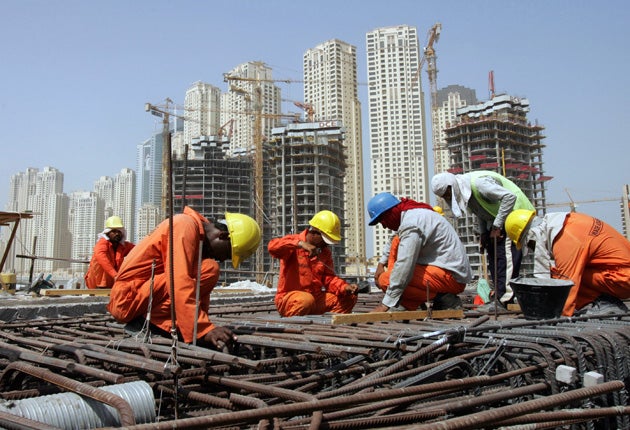
There was no need to panic, insisted the minister. The Indian government was closely monitoring the fall-out from the crisis in Dubai but was not expecting a flood of migrant workers returning home. The current problems would likely soon blow over.
But Sajid and many of his colleagues from the north Indian city of Meerut would take issue with the comments of Vayalar Ravi, the minister of overseas Indian affairs. Having returned from Dubai to India for the Muslim holiday of Eid, dozens of them have received text messages abruptly telling them their jobs no longer exist and that they should not return to the Gulf.
"It was early morning when I received a text from my office telling me I need not bother returning to Dubai," said Sajid, who had been working making tiles. "My contract has been discontinued and my work permit stands terminated. [My office] said my dues will be sent through the post and my belongings will be duly returned."
As news from Dubai continued to send stocks and spirits tumbling – yesterday it was revealed that Dubai World, the heavily indebted property arm that last week asked for extra time to pay back more than $60bn, was not guaranteed by the emirate's government – the shock waves were also resonating through the communities responsible for providing Dubai and other cities in the Gulf with much of its low-cost labour.
There are millions of poor, impoverished labourers from South Asia in the Gulf region. Indeed, the long-enjoyed boom that saw cities such as Dubai carve out a new niche for excess and opportunity was built on the backs of such migrant workers, who are often treated as little more than bonded labour. Drawn from India, Pakistan and Bangladesh and often paying hundreds of dollars to a middle man to secure a job, these workers – on arrival in the Gulf – find conditions are often atrocious and that they have virtually no rights. Many have complained of being prevented from leaving.
The upside of the hardship for the large numbers of South Asians who make their way to the Gulf – Indians are said to make up more than 40 per cent of the population of Dubai alone – is the amount of money that gets sent home in remittances. Figures suggest that in 2007, Indians living in the Gulf sent a total of $27bn to their families.
For some states, the money sent home is a considerable slice of the total economy. In Kerala, for example, such remittances make up around 22 per cent of the state's income.
Speaking from Thiruvananthapuram, the state's finance minister, Thomas Isaac, said he believed that even if the Dubai crisis did not rock India in its entirety it would affect Kerala "very much". "Half of the workforce in the United Arab Emirates are Malayalis [people from Kerala] and it seems certain that the construction activity in Dubai is going to take a hit," he said. "The impact is that the Dubai real estate market will decelerate."
Mr Ravi, the central government minister, did not agree. Having spoken with Indian consulates in the Gulf, he said authorities believed that while the Dubai World crisis would have international implications, it would not lead to large job losses for migrant workers. He said, however, that despite such an assessment, the government was planning to announce a comprehensive package to rehabilitate those Indian workers who do return from the Gulf. "It will take some more time to operationalise the fund," he added.
But for Sajid and his friends in Meerut, in the state of Uttar Pradesh, the harsh reality has already struck.
Another migrant labourer who had lost his job in Dubai, Noor Mohammed, wept as he told the Times of India: "We had wanted to save money to get our families to the UAE. Our dreams lie shattered."
Slaves and skyscrapers: The workforce feeling the heat
*The UAE's huge construction boom of recent years has been fuelled largely by south Asian migrant construction workers, who work in the grimmest of circumstances. Human Rights Watch estimated in 2006 that at least half a million migrants are paid a little over £100 a month for their work in a country where the average per capita monthly income is close to £1,300. There is no indication that their circumstances have improved since. Migrants can end up working 12 hours a day or longer, six days a week, in fierce heat. In 2005, the Indian Consulate registered 971 deaths of its own nationals, at which point it was told to stop counting. Suicide among the men is rife, with 100 or more of them dying by their own hands in 2007. Such conditions come as a grim surprise for newcomers lured by agencies with promises of lavish pay, only to find their passports confiscated, wages slashed and huge debts owed. And they form a sharp contrast to the lives of the wealthy western ex-pats in finance, IT and tourism – 50,000 to 150,000 of them, on vast tax-free salaries.
Thomas Mendelsohn
Join our commenting forum
Join thought-provoking conversations, follow other Independent readers and see their replies
Comments
Bookmark popover
Removed from bookmarks