Secrets of Iraq's death chamber
Prisoners are being summarily executed in the government's high-security detention centre in Baghdad. Robert Fisk reports
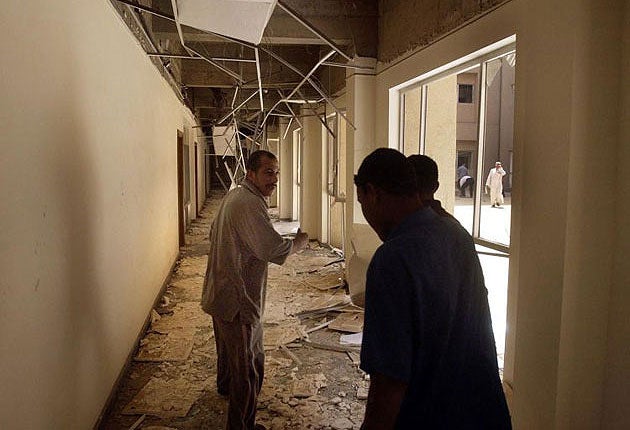
Like all wars, the dark, untold stories of the Iraqi conflict drain from its shattered landscape like the filthy waters of the Tigris. And still the revelations come.
The Independent has learnt that secret executions are being carried out in the prisons run by Nouri al-Maliki's "democratic" government.
The hangings are carried out regularly – from a wooden gallows in a small, cramped cell – in Saddam Hussein's old intelligence headquarters at Kazimiyah. There is no public record of these killings in what is now called Baghdad's "high-security detention facility" but most of the victims – there have been hundreds since America introduced "democracy" to Iraq – are said to be insurgents, given the same summary justice they mete out to their own captives.
The secrets of Iraq's death chambers lie mostly hidden from foreign eyes but a few brave Western souls have come forward to tell of this prison horror. The accounts provide only a glimpse into the Iraqi story, at times tantalisingly cut short, at others gloomily predictable. Those who tell it are as depressed as they are filled with hopelessness.
"Most of the executions are of supposed insurgents of one kind or another," a Westerner who has seen the execution chamber at Kazimiyah told me. "But hanging isn't easy." As always, the devil is in the detail.
"There's a cell with a bar below the ceiling with a rope over it and a bench on which the victim stands with his hands tied," a former British official, told me last week. "I've been in the cell, though it was always empty. But not long before I visited, they'd taken this guy there to hang him. They made him stand on the bench, put the rope round his neck and pushed him off. But he jumped on to the floor. He could stand up. So they shortened the length of the rope and got him back on the bench and pushed him off again. It didn't work."
There's nothing new in savage executions in the Middle East – in the Lebanese city of Sidon 10 years ago, a policeman had to hang on to the legs of a condemned man to throttle him after he failed to die on the noose – but in Baghdad, cruel death seems a speciality.
"They started digging into the floor beneath the bench so that the guy would drop far enough to snap his neck," the official said. "They dug up the tiles and the cement underneath. But that didn't work. He could still stand up when they pushed him off the bench. So they just took him to a corner of the cell and shot him in the head."
The condemned prisoners in Kazimiyah, a Shia district of Baghdad, are said to include rapists and murderers as well as insurgents. One prisoner, a Chechen, managed to escape from the jail with another man after a gun was smuggled to them. They shot two guards dead. The authorities had to call in the Americans to help them recapture the two. The Americans killed one and shot the Chechen in the leg. He refused medical assistance so his wound went gangrenous. In the end, the Iraqis had to operate and took all the bones out of his leg. By the time he met one Western visitor to the prison, "he was walking around on crutches with his boneless right leg slung over his shoulder".
In many cases, it seems, the Iraqis neither keep nor release any record of the true names of their captives or of the hanged prisoners. For years the Americans – in charge of the notorious Abu Ghraib prison outside Baghdad – did not know the identity of their prisoners. Here, for example, is new testimony given to The Independent by a former Western official to the Anglo-US Iraq Survey Group, which searched for the infamous but mythical weapons of mass destruction: "We would go to the interrogation rooms at Abu Ghraib and ask for a particular prisoner. After about 40 minutes, the Americans brought in this hooded guy, shuffling along, shackled hands and feet.
"They sat him on a chair in front of us and took off his hood. He had a big beard. We asked where he received his education. He repeatedly said 'Mosul'. Then he said he'd left school at 14 – remember, this guy is supposed to be a missile scientist. We said: 'We know you've got a PhD and went to the Sorbonne – we'd like you to help us with information about Saddam's missile project'. But I said to myself : 'This guy doesn't know anything 'bout fucking missiles.' Then it turned out he had a different name from the man we'd asked for, he'd been picked up on the road by the Americans four months earlier, he didn't know why. So we said to the Americans: 'Wrong gentleman!' So they put the shackles on him and took him back to his cell and after 20 or 30 minutes, they'd bring someone else. We'd ask him where he went to school and he told us he had never been to school.
"Wrong person again. It was a complete farce. The incompetence of the US military was astounding, criminal. Eventually, of course, they found the right guy and brought him in and took his hood off. He was breathing heavily, overweight, pudgy, disoriented, a little bit scared."
On this occasion, the Americans had found the right man. The British and American investigators asked the guards to remove the man's shackles, which they did – but then they tied one of the man's legs to the floor. Yes, he had a PhD.
Again, the official's testimony: "We went through his history, what he'd worked on – he was obviously just a minor functionary in one of Saddam's missile programmes. Iraqi scientists didn't have the knowledge how to make nuclear missiles nor did they have the financial support necessary. It just remained in the dreams of Saddam."
The scientist-prisoner in Abu Ghraib miserably told his captors that he'd been arrested by the Americans after they'd knocked on his front door in Baghdad and found two Kalashnikov rifles a woman's hijab, verses from the Koran and, obviously of interest to his captors, "physics and missile textbooks on his bookshelves." But this supposedly valuable prisoner was never charged or previously interviewed even though he admitted he was a rocket scientist.
"I don't know what happened to him," the former official told me. "I tried to tell the UK and the US military that we've arrested this man but that he's got a wife, children, a family. I said that by locking up this one innocent person, you've got 50 men radicalised overnight. No, I don't know what happened to him."
For many of the investigators working for the Anglo-American authorities in Baghdad, the trial for the crime for which the Iraqi dictator was himself subsequently hanged was a fearful experience that ultimately ended in disgust. Through captured documents, they could see the dark, inner workings of Saddam's secret police. The idea of the Saddam trial was less to bring members of the former regime to justice than to show Iraqis how justice and the rule of law should operate.
"It was exhilarating to see Saddam being cross-examined," one of the court investigators said. "The low point was when he was executed. What drove me on was seeing how Saddam dealt with his victims – I was looking at a microcosm of all the deaths that had taken place in Iraq. But when he was executed, it was done in such a savage way."
Saddam Hussein was hanged in the same "secure" unit at Kazimiyah where Mr al-Maliki's people, in an echo of Saddamite Baathist terror, now hang their victims.
Iraq The death penalty
*The death penalty in Iraq was suspended after Saddam Hussein was deposed in 2003. It was reinstated by the interim government in August 2004.
*The United Nations, the European Union and international human rights organisations all spoke out against the reintroduction.
*At the time, the government claimed the death penalty was a necessary measure until the country had stabilised. Amnesty International claims that "the extent of violence in Iraq has increased rather than diminished, clearly indicating that the death penalty has not proved to be an effective deterrent."
*Saddam, left, his half-brother Barzan al-Tikriti and Iraq's former chief judge Awad Hamed al-Bandar were hanged at the end of 2006 for their part in the killings of 148 people in the mainly Shia town of Dujail in 1982. Illicit videos of all three executions later became public. Saddam's body could be seen on a hospital trolley, his head twisted at 90 degrees. Barzan – Iraq's former intelligence chief –was decapitated by the noose. Officials said it was an accident.
*According to Amnesty, there were at least 33 executions reported in Iraq last year. About 200 people were estimated to have been sentenced to death.
Join our commenting forum
Join thought-provoking conversations, follow other Independent readers and see their replies
Comments