Settlement by stealth belies promises of restraint
Hillary Clinton has praised Israel for its policy on settlers but, the displacements go on
Maysaa Al-Kurd has lived all her life in the home her family moved into in 1956. The pomegranate tree standing in the garden was planted by her father when she was still an infant nearly half a century ago. But that hardly reassured her yesterday when she heard the Jewish settlers break into the next-door extension building her brother Nabil built to house his family in 2001.
"I heard the door opened by force," she said. "And then I heard one of them say: 'This furniture belongs to whom?'" Later she saw "with my own eyes" a settler breaking a television set. Outside, a refrigerator, cushions and household furniture, apparently removed by the intruders, stood for several hours in the pouring rain. Inside, broken glass could be seen above a stove.
What Ms Kurd, of the inner-city East Jerusalem neighbourhood of Sheikh Jarrah, was hearing at about 10.30am yesterday was the latest in an accelerating series of highly charged and organised moves by settlers into the city's Arab sector. Armed with a court order saying they own the property, the settlers – about 40, according to Ms Kurd – decided to break in just four days after Hillary Clinton, the US Secretary of State, dismayed Palestinian and other Arab leaders by praising the Israeli Prime Minister Benjamin Netanyahu's "unprecedented" promise of "a restraint" in illegal settlement activity.
Mrs Clinton sought on Monday to "clarify" her remarks by acknowledging that Mr Netanyahu's proposals fell well short of the settlement freeze the US had earlier called for. And, while Mr Netanyahu has offered temporarily to halt authorisations of new settlement building in the West Bank, he has resolutely set his face against any slowdown in East Jerusalem. The UN says that 194 people were forcibly displaced from their homes in East Jerusalem by evictions and demolitions between January and July of this year. Israel insists it annexed the Arab sector of Jerusalem after the Six-Day War in 1967, but this is rejected by most of the international community who endorse Palestinian aspirations for it to be the capital of a future state. In Amman, the British Foreign Secretary David Miliband expressed "concern" over events at the Kurd house and added: "The current situation is obviously particularly tense in respect of Jerusalem."
Since a 2001 court order the rooms invaded by the settlers have been closed and used only to store furniture. But for Ms Kurd, whose property is one of at least 24 that settlers are hoping to acquire in this sensitive neighbourhood, their sudden arrival only intensified her fear of losing her home. "We are all worried for the future," she said, "not just in Sheikh Jarrah but in all East Jerusalem."
Only last week about a hundred Israeli security personnel arrived to remove a nearby protest tent that the Palestinian Ghawi family had been sleeping in since being evicted in August. That move came 24 hours after bulldozers levelled the homes of six families across East Jerusalem on the grounds they did not have the proper permit. Human rights activists say it is exponentially harder for Palestinians than Israelis to obtain permits.
Another elderly member of Ms Kurd's extended family, Mohammed al- Kurd, died after being evicted last August from his home and moving into a similar tent to the Ghawi family's. Like other of his relatives, he had refused to pay rent to the post-1967 Jewish owners, partly, some diplomats say, because they still dispute the historic right of ownership.
Maysaa al-Khurd said that her "life and blood" was in the house. Asked about the settlers' argument that they have a right to the land because Yemenite Jews lived there before 1948, she added that her own family were 1948 refugees from what was now Israel. "My family are all from Haifa. Can I go there and say I own the house and I have the key? Can I tell the people there that is my house? They will kill me."
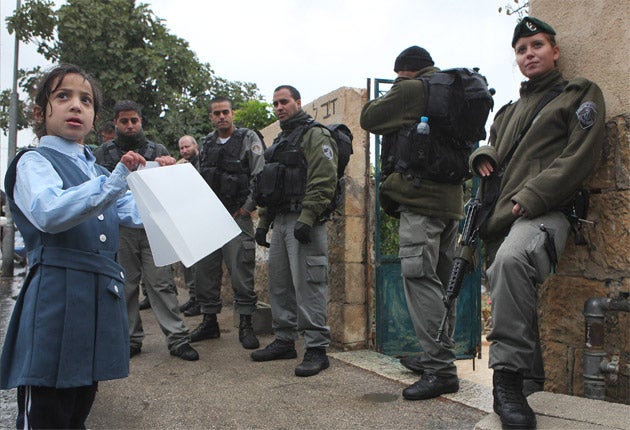
Police stood guard outside the Sheikh Jarrah house while settlers occupied the adjacent building but eventually left on police advice. However two security guards employed by them were still there at the end of the day.
Although the house and its land was allotted to the Palestinian family in 1956 by the UN Relief and Works Agency and Jordan – then in control of the West Bank and East Jerusalem – the Israeli authorities expropriated numbers of properties in the area as state land after 1967. In some cases – apparently including this one – the land was later transferred or sold to companies or organisations representing settlers. None of the departing settlers would speak to reporters, but Adnan Husseini, the Palestinian Authority governor of Jerusalem, said: "The changing position of the American administration led to this."
Nabil al-Kurd, a father of four children, was summoned from work by his family when the settlers arrived. He was later told by police the settlers would be ordered to stay away pending 10 days in which Mr Kurd could lodge an appeal.
Join our commenting forum
Join thought-provoking conversations, follow other Independent readers and see their replies
Comments