Shia call on Mehdi Army to take up arms again in Iraq
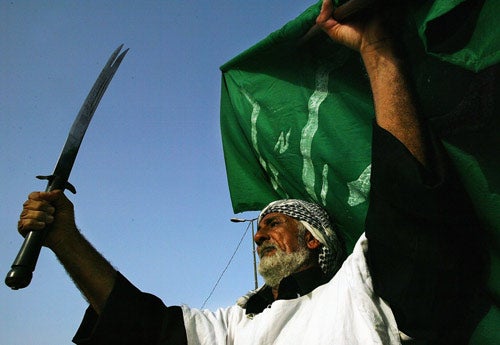
In the alleys of the ancient district of al-Salaikh in Baghdad, a Shia family fought a fierce gun battle with Sunni militiamen who tried to stop them reoccupying their house from which they had been forced to flee months earlier.
The Shia family got the worst of the fighting and, after suffering seven dead, sent a desperate message asking for help to the Mehdi Army, the powerful Shia militia of the Shia cleric Muqtada al-Sadr that once would have rushed to defend them. On this occasion, however, the local Mehdi Army commander turned them down, saying: "We can do nothing because we are under orders not to break the ceasefire."
It is this six-month ceasefire, declared on 29 August last year by Mr Sadr, which American commanders say is responsible for cutting much of the violence in Iraq. But the ceasefire will expire in the next few weeks and political and military leaders loyal to Mr Sadr are advising him not to renew it.
They complain that state security organs, in effect controlled by their Shia rivals in the Islamic Supreme Council of Iraq (ISCI), are using the truce to attack them, particularly in and around the southern city of Diwaniya from which 300 Sadrist families have been expelled. The Sadrists also complain that US troops and the Iraqi army are targeting Mehdi Army leaders and al-Qa'ida has once again started bombing Shia civilians as they did last Friday when two bird markets in Shia districts were attacked, killing 99 people.
Salah al-Ubaidi, the spokesman for Mr Sadr, said a committee of Sadrist legislators said: "They don't want the ceasefire to remain. They want it lifted because of oppressive acts by security forces in Diwaniya".
Mohammed, the head of a Sadrist district office in Baghdad, said that in Diwaniya the security forces "have started arresting the wives and daughters of our men who have fled. There is low morale there as we do not help them because of the ceasefire".
The Sadrist movement is the only real mass movement in Iraq and is the voice of the poor Shia, who make up much of the Iraqi population. It was created by Mr Sadr's revered father, Mohammed Sadiq al-Sadr – assassinated with two of his sons on the orders of Saddam Hussein in 1999 – and revived by Muqtada in 2003.
Mr Sadr surprised his followers by calling a total ceasefire in August last year after clashes with ISCI-backed security forces in Kerbala. He said he wanted to purge his movement of criminal gangs and anti-Sunni death squads. "Muqtada wanted the Mehdi Army to have a good reputation," said Mohammed. "We vet people now in a way we didn't before. Police come to us and say, 'this criminal says he works for you' and sometimes we say 'yes' and sometimes 'no'."
The Sadrist ability to enforce the ceasefire is impressive given the movement's previous reputation for being so decentralised that it was out of control. "Sadr's followers are strong, patient and stick to their work," said Mohammed. "But we are militarily weak because of the freeze on action."
This claim of weakness is a little exaggerated. The Sadrists probably still control about half of Baghdad and 80 per cent of Shia areas. Often they can get what they want because nobody wants them as an enemy. When 12 Mehdi Army men with weapons, and without papers giving them the right to carry them, were arrested by Interior Ministry officials in Palestine Street, the local Sadrist leader Sheikh Abbas Rubaie called the ministry and said: "Release them by six or you know what we will do." Minutes later they were back on the streets.
Nobody knows what Mr Sadr will decide. One Sadrist said: "Even people close to Muqtada do not know what is happening in his mind." Safar, with close links to the Mehdi Army, said its leaders "informed the marji'iyyah [the senior Shia clerics] to tell [the Prime Minister] Nouri al-Maliki that if his government does not stop arresting their leaders they will end the ceasefire".
One person who believes the truce will continue is the Iraqi politician Ahmad Chalabi, who has always had good relations with Mr Sadr. He said: "Muqtada and the Sadrists have benefited from the ceasefire. Despite what people say, it has done them good because it makes them look reasonable – something they badly needed."
Though they have closed their military offices, the Sadrists have a dense network of social and cultural activities and often provide the only assistance for poor families. Their help wins them strong support because a recent report by aid agencies said 43 per cent of Iraqis live in "absolute poverty".
The Iraqi government claimed at the end of last year that many of the 2.2 million Iraqis who have fled abroad are returning because of improved security. But a report by the UN High Commission for Refugees says that, on Iraq's border with Syria, where 1.5 million Iraqis live, only 700 Iraqis travel to Iraq every day and 1,200 go to Syria.
Join our commenting forum
Join thought-provoking conversations, follow other Independent readers and see their replies
Comments