Special report: Palestinian bid for statehood divides a people
And in taking his case to the UN, Abbas defies both the US and Israel
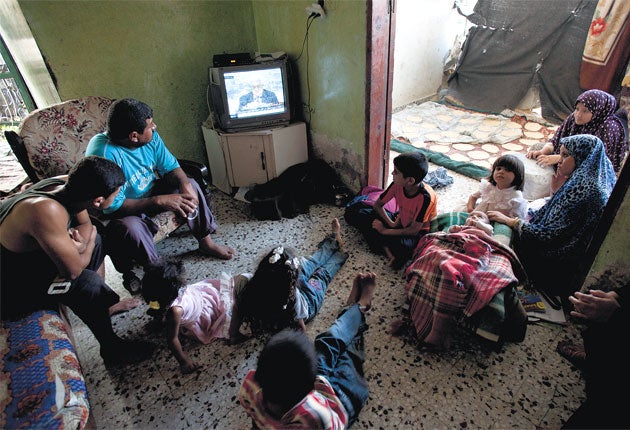
Both men had watched the live TV broadcast in which Palestinian President Mahmoud Abbas explained on Friday evening why he is defying the wishes of Israel and the US by taking his case for statehood recognition to the UN this week. But it was rapidly apparent from the vigorous argument yesterday between Subha Mahmoud Abu Hashi, 65, and Mahmoud Abu Rizel, 29, in the narrow main shopping street of the Balata refugee camp, how different their takes on it had been.
The older man was convinced that Mr Abbas had shown statesmanship worthy of the late Egyptian president Anwar Sadat, who negotiated the 1979 peace treaty with Israel. For the younger, "this was not at the level of a president. It was not Gamal Abdel Nasser and it was not Yasser Arafat, who when they talked the people listened. It was a very ordinary speech."
Mr Abu Hashi liked the fact that the Palestinian President had stressed the importance of negotiations, and felt that in the current absence of substantive talks the UN move was another important step forward.
"In 1988, when the Palestinians declared a state nobody recognised us," he said. "Now we have international recognition. Sadat got Israel out of Sinai by negotiations. King Hussein made a treaty with negotiations. The only way is negotiations; violence didn't bring anything."
Mr Abu Rizel interrupted in tones dripping with sarcasm. "Of course you're absolutely correct. So the aggression of of Israel's [Jewish West Bank] settlements will continue." He added: "I do believe that what has been taken from you by force can only be restored by force." To which Mr Abu Hashi retorted: "Listen, I respect your view, but let me ask you a question. I have a knife, you have a plane. Can I defeat you?
But if the debate over the best means of advancing the Palestinians' struggle for nationhood mirrored more general differences of opinion – even confusion – about the UN initiative here yesterday, the Palestinian leadership are adamant about their determination to seek full membership through the UN Security Council, despite the clear intention of the US to use its veto if they do. Israel's Prime Minister, Benjamin Netanyahu, accuses the Palestinians of acting "unilaterally" and has repeatedly urged them to opt for direct negotiations instead. But Nabil Shaath, a senior member of the Palestinians' UN delegation, was dismissive yesterday of the last-ditch efforts by the US and international Middle East envoy Tony Blair to persuade Mr Abbas to accept a formula for resumed negotiations that might avert the looming critical stand-off in New York.
In Ramallah yesterday, he said the formula failed to meet the minimum requirements – including the settlement freeze demanded by the Palestinians – for the "real, credible" negotiations he hoped the UN move would help to advance. And he accused the US of acting like a "strategic ally of Israel" and Mr Blair of sounding more like an "Israeli diplomat" than a "neutral interlocutor".
Mr Shaath's choice of words left room, at least in theory, for the Palestinians to switch tracks and seek "non-member state" status through the UN General Assembly, where they would have a built-in majority, but this is a course also adamantly opposed by the US and Israel. But some diplomats believe that one possibility is that the Palestinian leadership will stick with the Security Council application, but that it may be held up for – conceivably – many months during consideration by a Security Council committee.
Mr Shaath appeared unmoved by Congressional threats to withhold $500m a year funding from the Palestinian Authority in retaliation for the UN application, saying that he expected Arab states to make up the difference if necessary. And he strongly rejected the idea of a return to armed uprising, declaring: "Benjamin Netanyahu would love to make the world believe that Israel is threatened. We are not going back to violence – it's too costly for us and the Israelis."
The issue of violence, which Mr Abbas also strongly rejected in his address on Friday, has a special resonance in Balata, which was a hotbed of militancy after the outbreak of the second intifada. And, for its population of the families of those who during the war of 1948 were driven from or fled their homes in what is now Israel, the issue of refugees is a particularly key "core issue" between the two sides.
Construction worker Mohammed Ibrahim, 43, a former Fatah militant imprisoned by Israel, said: "If the Americans use their veto [in the Security Council, against the recognition bid], there will be an explosion not just by the Palestinians but through the Middle East." But chemical engineer Nasser Jaber, 28, disagreed, saying that Mr Abbas had made a "good move" and that he had no wish to return to armed conflict. "There was a big number of dead in the intifada. A very high price was paid, and without concrete gains."
Mr Jaber's support for Mr Abbas was echoed broadly if not unanimously by Balata residents yesterday, several of whom echoed Mr Abbas's emphasis in his speech on the World Bank's seal of approval for the two-year state building programme carried out by the Palestinian Authority and its Prime Minister, Salam Fayyad.
Nour Adeen Hefnawi, 21, said: "At the moment we have to go to the Arab League for help, but if we are in the UN we can go directly to them ... it's better."
But Mr Hefnawi was also highly critical of European countries – despite the greater warmth of at least some of them to the UN initiative – for not doing more to stand up to the US and Israel. "We have been under occupation for 63 years and the Europeans did not make a move. If your friend is wrong, must you follow him?"
Shoe shop owner Ibrahim Khalil Sharayia, 65, was defiant: "This is an opportunity given to Israel. But if it rejects it now, in the future they will ask for peace and the Palestinians will not accept it. The Arab world is changing and in time Israel will ask for peace and the Arab world will reject it."
Join our commenting forum
Join thought-provoking conversations, follow other Independent readers and see their replies
Comments