The families of Gaza profit from bunny business
Cuddly, clean and nutritious, cottontails are solving the Palestinian food crisis. Donald Macintyre reports
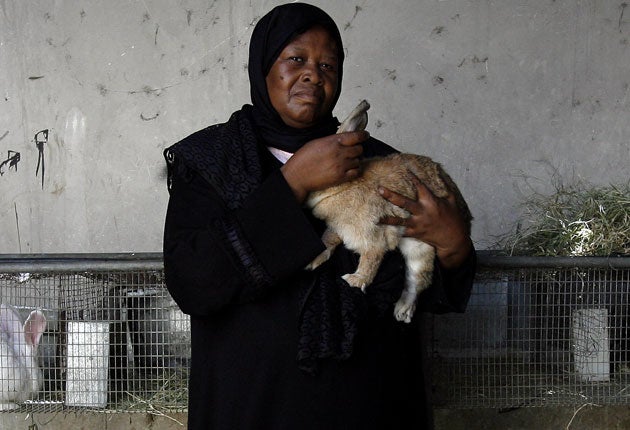
The shrapnel holes in the wall behind her underline why Subheya Motawe, her husband and their 15 children were forced to escape from their four-room home in this central Gaza village last January. With no time to grab most of their possessions, Mrs Motawe, 52, had the presence of mind to at least take the most valuable one before fleeing: a pregnant female rabbit. After the family returned home at the end of the Israeli military's assault on Gaza, the doe gave birth to a healthy litter. Which was just as well since most of the family's other 24 rabbits were casualties of Operation Cast Lead – either directly because of bombardment or indirectly because Mrs Motawe hadn't been able to leave the house to get feed or clean water for them. With the new offspring, Mrs Motawe had the nucleus she needed to make a fresh start.
For rabbits have become an unlikely siege-beating lifeline for some of the poorest families in Gaza. Relatively cheap to feed and famously reproductive, the fluffy creatures are helping families like the Motawes to survive the desperate shortage of income – and nutritious food – imposed by the economic collapse of a Gaza under blockade.
A "steadily rising trend" of chronic malnutrition in Gaza since the beginning of the Israeli blockade imposed when Hamas seized full control of the territory in June 2007, was revealed in a report by the International Red Cross and Red Crescent in November. It pointed to an unhealthy shift towards "low cost, high energy" foods such as cereals, sugar and oil at the expense of dearer but more nutritious foods such as meat, fish, cheese, fruit and vegetables.
It was in this context that Care International began a pilot scheme to supply 70 "vulnerable" families with two hutches, four months' worth of feed and-at the ratio regarded by experts as optimal for breeding – four females and one male rabbit apiece. Mrs Motawe says she was "excited" to be among the first to benefit. Having been faced with debts and potentially crippling education costs for such a large household, she says: "It is a good way to provide income for the family."
Rabbits breed quickly and repeatedly – a single female can give multiple births up to six times a year. Mrs Motawe: "I like feeding them and caring for the soft little babies. Rabbits are so quiet and calm, when I come early in the morning to water them and clean the cages. No bad smell."
But there is little sentimentality in the Motawe family about the rabbits. "The children help me look after them." But she adds: "They know they are going to be eaten." Food pellets for the rabbits are supplemented with the grass the family collects and the idea is that after an initial start-up cost of around £180 for the "kits" supplied by Care, the small business becomes self-financing, providing some meat for the owners – Mrs Motawe likes to make rabbit stew with chard leaves and garlic – but also generating income – rabbits currently sell in Gaza markets for around 80 Israeli shekels (£12.75) each.
After Operation Cast Lead, Care carried out a needs survey which established that 65 per cent of households regarded food as their most important need. Crops suffered during the fighting because it was often too dangerous for farmers to tend them and roads have been damaged, making it hard to get what food there is available into the towns.
With the help of a £650,000 grant from the British Department for International Development to ease Gaza's post-war food and farming problems, the project – which includes training in small farm management – is now being extended to another 100 "conflict affected" families.
Care's Palestinian agricultural expert in Gaza, Anas Mussalam argues that the rapid reproductive cycle of rabbits, which begin mating as early as six months after birth, makes the beneficial impact on poor Gazan families especially rapid. "I really do believe this is one of the best of all agricultural projects," he says. As efficient converters of low cost feed – including grass – rabbits will produce on average four times more meat than a cow using the same amount of feed. And an 11lb doe bearing 30 young in a year weighing 120lbs when weaned is producing almost 1,000 per cent of her own body weight in offspring – compared with a 1,000lb cow, which will produce in the same period a calf weighing only 40 per cent of her own bodyweight. But that's quite apart from the nutritious value to humans of the low-cholesterol, high-protein rabbit. "It's cheap," says Mr Mussallam, himself an enthusiastic rabbit eater, "and it's delicious."
Join our commenting forum
Join thought-provoking conversations, follow other Independent readers and see their replies
Comments