UN says Israel should face war-crimes trial over Gaza
Report also censures Hamas but accuses Israelis of punishing entire population of the Palestinian Strip
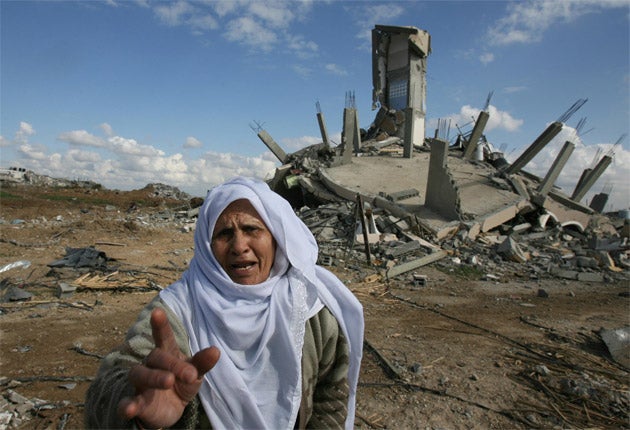
Israel targeted "the people of Gaza as a whole" in the three-week military operation which is estimated to have killed more than 1,300 Palestinians at the beginning of this year, according to a UN-commissioned report published yesterday.
A UN fact-finding mission led by the Jewish South African former Supreme Court Judge Richard Goldstone said Israel should face prosecution by the International Criminal Court, unless it opened fully independent investigations of what the report said were repeated violations of international law, "possible war crimes and crimes against humanity" during the operation.
Using by far the strongest language of any of the numerous reports criticising Operation Cast Lead, the UN mission, which interviewed victims, witnesses and others in Gaza and Geneva this summer, says that while Israel had portrayed the war as self-defence in response to Hamas rocket attacks, it "considers the plan to have been directed, at least in part, at a different target: the people of Gaza as a whole".
"In this respect the operations were in furtherance of an overall policy aimed at punishing the Gaza population for its resilience and for its apparent support for Hamas, and possibly with the intent of forcing a change in such support," the report said. It added that some Israelis should carry "individual criminal responsibility."
The 575-page document presented to yesterday's session of the UN Human Rights Council in Geneva was swiftly denounced by Israel. The foreign ministry spokesman Yigal Palmor said the UN mission had "dealt a huge blow to governments seeking to defend their citizens from terror", and that its conclusions were "so disconnected with realities on the ground that one cannot but wonder on which planet was the Gaza Strip they visited".
The Gaza war began on 27 December 2008 and ended on 18 January 2009.
The UN report found that the statements of military and political leaders in Israel before and during the operation indicated the use of "disproportionate force", aimed not only at the enemy but also at the "supporting infrastructure". The mission adds: "In practice this appears to have meant the civilian population."
The mission also had harsh conclusions about Hamas and other armed groups, acknowledging that rocket and mortar attacks have caused terror in southern Israel, and saying that where launched into civilians areas, they would "constitute war crimes" and "may amount to crimes against humanity".
It also condemned the extrajudicial killings, detention and ill-treatment of Palestinian detainees by the Hamas regime in Gaza - as well as by the Palestinian Authority in the West Bank - and called for the release on humanitarian grounds of Gilad Shalit, the Israeli corporal abducted by Gaza militants in June 2006.
While the Israeli government refused to co-operate with the inquiry - or allow the UN team into Israel - on the ground that the team would be "one-sided", Cpl Shalit's father, Noam, was among those Israeli citizens who flew to Geneva to give evidence.
That said, the much greater part of the report - and its strongest language - is reserved for Israel's conduct during the operation. Apart from the unprecedented death toll, the report says that "the destruction of food supply installations, water sanitation systems, concrete factories and residential houses was the result of a systematic policy by the Israeli armed forces". The purpose was "to make the daily process of living and dignified living more difficult for the civilian population".
The report also says that vandalism of houses by some soldiers and "the graffiti on the walls, the obscenities and often racist slogans constituted an overall image of humiliation and dehumanisation of the Palestinian population". Hospitals and ambulances were "targeted by Israeli attacks."
Amid a detailed examination of most of the major incidents of the war - albeit an examinations carried out five months after the incidents took place - it says that:
* The first bombing attack on Day One of the operation when children were going home from school "appears to have been calculated to cause the greatest disruption and widespread panic".
* The deaths of 22 members of the Samouni family sheltering in a warehouse were among ones "owing to Israeli fire intentionally directed at them", in clear breach of the Geneva Convention.
* The firing of white phosphorus shells at the UN Relief and Works Agency compound was "compounded by reckless regard of the consequences", and the use of high explosive artillery at the al-Quds hospitals were violations of Articles 18 and 19 of the Geneva Convention. It says that warnings issued by Israel to the civilian population "cannot be considered as sufficiently effective" under the Convention.
* On the attack in the vicinity of the al-Fakhoura school, where at least 35 Palestinians were killed, Israeli forces launched an attack where a "reasonable commander" would have considered military advantage was outweighed by the risk to civilian life. The civilians had their right to life violated as under Article 6 of the International Covenant on Civil and Political Rights (ICCPR). And while some of the 99 policemen killed in incidents surveyed by the team may have been members of armed groups, others who were not also had their right to life violated.
* The inquiry team also says that a number of Palestinians were used as human shields - itself a violation of the ICCPR - including Majdi Abed Rabbo, whose complaints about being so used were first aired in The Independent. The report asserts that the use of human shields constitutes a "war crime under the Rome statute of the International Criminal Court."
Join our commenting forum
Join thought-provoking conversations, follow other Independent readers and see their replies
Comments
Bookmark popover
Removed from bookmarks