US intervenes in Iraq election row as feared militia waits in wings
Proposed deal would see incumbent and rival split prime ministerial term
The United States is trying to resolve the growing crisis over the formation of a new Iraqi government, with a deal between current prime minister Nouri al-Maliki and his main rival Iyad Allawi under which each man would hold the post of prime minister for two years at the head of a coalition government, The Independent has learned.
Fearful of growing political turmoil that would make it difficult or embarrassing to withdraw its remaining combat troops by August this year, as President Barack Obama has pledged, Washington has arranged talks about a joint government. The proposal is for Mr Maliki and Mr Allawi to split the four-year prime ministerial term, according to Dr Mahmoud Othman, who is a veteran member of the Baghdad parliament.
This weekend's threat by the anti-American cleric Muqtada al-Sadr to send his much-feared Mehdi Army militia back onto the streets in the wake of Friday's bomb attacks has only served to underline the growing crisis in Iraq since the inconclusive general election last month.
Mr Sadr said he would only reactivate his Shia militiamen under government control "to be formal brigades in the Iraqi army or police to protect shrines, mosques, markets, houses and cities". But the return of the Mehdi Army would weaken the government and terrify Sunni Arabs in Iraq because of the role it played in the sectarian slaughter of 2006-7.
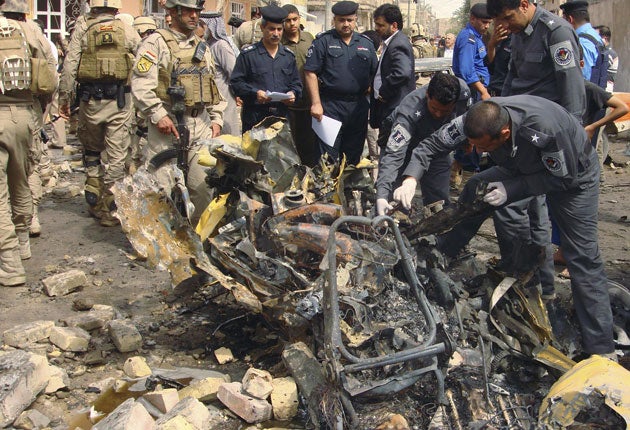
The bombings last Friday were the most deadly since the election, killing 72 people and aimed exclusively at Shia civilians. The apparently co-ordinated attack, which occurred over a two-hour timespan and included at least 10 bombs and roadside devices, were in revenge for the assassination of the two top al-Qa'ida leaders in an air strike.
The Islamic State of Iraq, the umbrella group operated by al-Qa'ida, confirmed yesterday that Abu Omar al-Baghdadi and Abu Ayyub al-Masri had been killed. A statement said: "After a long journey filled with sacrifices and fighting falsehood and its representatives, two knights have dismounted to join the group of martyrs. We announce that the Muslim nation has lost two of the leaders of jihad."
Despite the death of the two men, the organisation demonstrated with the Baghdad bombing that it still has the ability explode car bombs all over the capital, including the well-guarded Shia slum of Sadr City. Al-Qa'ida in Iraq is fanatically Sunni and has seldom targeted US troops, concentrating its efforts on attacks on the Shia community to which 60 per cent of Iraqis belong.
Iraq is looking increasingly unstable because of the efforts of Nouri al-Maliki, the Prime Minister, to cling to power despite doing poorly in the 7 March poll, in which he came second to the former prime minister Iyad Allawi. Mr Allawi's political bloc won 91 seats in the 325-seat parliament compared to 89 for Mr Maliki's coalition.
Alleging fraud, Mr Maliki has secured a recount of the vote in Baghdad and is believed to be hoping to secure an extra four seats. This would make his political group the largest in parliament and give him the right, as front runner, to try to form a new government.
But one Iraqi political leader, who did not want to be named, said that fraud was more likely in a recount by hand than it was in the original poll. He insisted: "If Iyad Allawi's supporters and the Sadrists lose seats because of the recount they will never accept this." Furthermore the recount in Baghdad is sparking demands for recounts in the rest of the country which are likely to be divisive and further delay the formation of a new government.
The main obstacle to Mr Maliki and Mr Allawi forming a government together is that Iraqi politics remains divided along sectarian and communal lines between Sunni and Shia Arabs and the Kurds.
Mr Allawi himself is Shia but his al-Iraqiya bloc is almost entirely Sunni from western and northern Iraq. Mr Maliki depends on the Shia community which is unlikely to agree to share power with a group whom it sees as made up of Sunni Baathists who oppressed the Shia for so long.
The most obvious partner for Mr Maliki's State of Law party is the Iraqi National Alliance, which won 70 seats in the election and is made up of Shia religious parties. The problem here is that the Sadrists, the largest party in the INA, are adamant that Mr Maliki step down as prime minister.
The US is meant to withdraw all its remaining military forces by the end of 2011 under the terms of a Status of Forces Agreement signed by President Bush before he left office.
Join our commenting forum
Join thought-provoking conversations, follow other Independent readers and see their replies
Comments