Brown hit by US-EU split over stimulus
France and Germany lead refusal to sanction further spending to ease recession
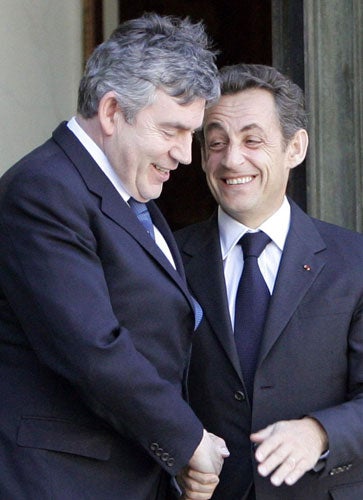
Gordon Brown's hopes of brokering a global deal to fight the economic crisis suffered a setback yesterday when EU leaders rebuffed calls from the UK and the US for them to spend their way out of recession.
At a two-day summit in Brussels, other EU leaders lined up behind Germany and France in opposing a further fiscal stimulus, saying governments should see whether their existing measures worked before considering more public spending rises and tax cuts. Their stance put them at odds with Barack Obama, who wants Europe to go further.
Yesterday the German Chancellor Angela Merkel said: "It is not time to look at more growth measures. I disagree with this idea completely. The existing measures must work, they must be allowed to develop."
The transatlantic split left Mr Brown awkwardly in the middle as he prepares to chair a crucial summit of 20 world leaders in London on 2 April. He is sympathetic to the US demands for Europe to go further but may now find it difficult to achieve a trade-off under which America backs immediate moves to tighten regulation of the financial system in return for Europe stimulating its economy.
The Prime Minister will next week launch a final diplomatic push to try to secure a groundbreaking "global new deal" at the G20 London summit. He will travel to Strasbourg, New York and South America, where he will attend a centre-left conference along with other G20 leaders.
Yesterday Mr Brown joined the French President Nicolas Sarkozy for a "light" fish lunch at the Elysée Palace. Their informal talks were described as "very constructive" by British officials, despite recent tensions over M. Sarkozy's protectionist instincts, which run counter to Mr Brown's warnings that "economic nationalism" would deepen the crisis. The French President had other things on his mind during yesterday's lunch: a nationwide strike against his economic policies. Although he gave Mr Brown a warm welcome, later in Brussels he lined up behind Ms Merkel, a woman with whom he normally has little in common, on the matter of a further boost to EU economies.
Reflecting the EU consensus, Jose Manuel Barroso, the European Commission president, said: "Let's not start discussing a new plan before implementing the plan we have agreed. If so, the message we send to our public is that our plan is not enough. That is not going to create confidence."
David Miliband, the Foreign Secretary, insisted there was no "division" between Europe and America and no need to choose between a spending boost and reforms to the financial system. "The effective response to this economic crisis is to get the right kind of macro-economic stimulus and the right kind of regulation," he said. British officials pointed to an agreement by G20 finance ministers last weekend to take "whatever action is necessary until growth is restored" as a sign that a further spending boost could follow.
Over a working dinner in Brussels last night, Mr Brown proposed a ban on any new protectionist measures; EU countries to make up to $100bn (£70bn) of extra loans to the International Monetary Fund (IMF) so it could bail out at-risk states; and a global shake-up of financial regulation, including a crackdown on tax havens and policing of hedge funds, in line with Wednesday's proposals by Lord Turner of Ecchinswell, chairman of the Financial Services Authority.
Today the summit is expected to agree to boost the IMF's funding. But the EU's attempt to put on a united front was threatened by an unseemly squabble over how to share out a $6.7bn fund for building projects in Europe such as offshore wind farms and broadband networks.
The summit's communiqué will gloss over the differences with the US but they are not far beneath the surface. Vladimir Spidla, the Czech Employment Commissioner, said: "We've been told to listen to the US in the past and look where it got us. It's there that the crisis started after all. Frankly, it's the Americans who need to reform and who should Europeanise."
Paul Krugman, the American economist and Nobel Prize-winner, said in Brussels: "Even the US is not doing enough to fight the crisis and Europe is doing a bit less than half. It's very inadequate. The GDP decline in Europe looks set to be somewhat bigger than in the US, but fiscal stimulus here is much smaller and the European Central Bank has been much less active here than the [US] Federal Reserve. This is not enough."
Graham Watson, leader of the Liberal Democrat group in the European Parliament, said: "The Franco-German opposition is a hurdle but a lot will depend on what happens. But if it becomes necessary to go further, I am sure we'll see some rethinking in Berlin and Paris."
Join our commenting forum
Join thought-provoking conversations, follow other Independent readers and see their replies
Comments
Bookmark popover
Removed from bookmarks