London G20 meeting rejects plan to cap bankers' bonuses
But a new 'clawback' scheme means they can be forfeited if deals later prove unsuccessful
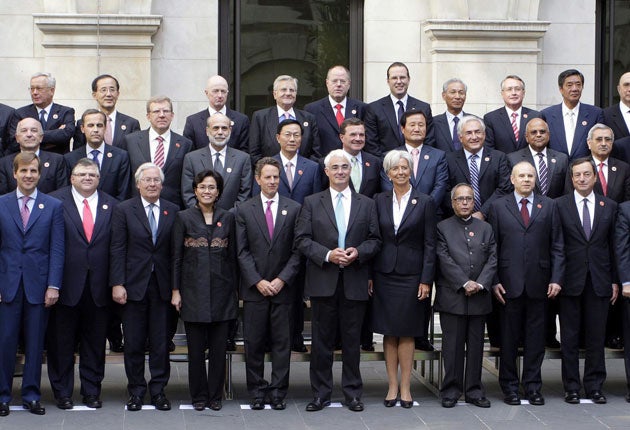
Bankers blamed for the global financial crisis will see their pay packages limited under a blueprint for steering the international economy towards recovery, it emerged yesterday.
But finance ministers from both rich and developing countries failed to agree a controversial French-German plan to impose a cap on the amount financial sector workers can receive in bonus payments in future.
Although the cap proposal was thrown out in the face of objections from the Americans and the British, the G20 agreed a "clawback" scheme to ensure that bonuses are linked to the long-term success of deals and could be forfeited if they fail to deliver over a period of years.
Ministers also pledged to keep in place stimulus measures to boost the global economy, warning that the fledgling recovery which provided the backdrop to their meeting was by no means assured.
A joint communiqué issued by the ministers said fiscal and monetary policy will stay "expansionary" for as long as is needed to reduce the chances of a double-dip recession after the worst financial crisis since the Second World War.
"Financial markets are stabilising and the global economy is improving, but we do remain cautious about the outlook for growth and jobs," said the Chancellor, Alistair Darling, who hosted the London meeting.
"We agreed we would continue to implement our necessary support measures – including monetary and fiscal policies – consistent with price stability and long-term fiscal sustainability till recovery is secured."
The International Monetary Fund has said the global economy is beginning a sluggish recovery from its worst recession since the war, raising its estimate for global economic growth in 2010 to 2.5 per cent, from an April projection of 1.9 per cent.
"The financial system is showing signs of repair," said the US Treasury Secretary, Timothy Geithner. "Growth is now under way. However, we still face significant challenges ahead."
But, despite the unity displayed in the joint communiqué, there were significant divisions behind the scenes. Before the summit, Germany and France had pushed for more discussion of a so-called "exit strategy" from the massive stimulus measures, arguing that spending measures have taken government debt to dangerously high levels. However, they backed away from the issue in London. But both nations maintained demands for action on bonuses to curb the excessive risk they claim propelled the world into crisis.
On the eve of the summit, the French Finance Minister, Christine Lagarde said guaranteed bonuses were not acceptable – a hard-line position that conflicted sharply with the stance taken by Mr Darling. When he was confronted with the revelation that the new head of the bailed-out bank RBS's retail branch network, Brian Hartzer, was given a "golden hello" of 1,990,000 free shares worth nearly £1m when he joined from an Australian bank last month, the Chancellor said: "In terms of signing-on bonuses, I am afraid they are part and parcel [of the banking industry]."
After the summit, Mr Darling said the new clawback measures would make sure that institutions "are focused on long-term sustainability and strength". He said there must be no more cases in which "people are rewarded for reckless behaviour".
The Financial Stability Board, an international body established at the London summit of G20 leaders in April, was given the task of drawing up practical proposals for implementation at the leaders' meeting in Pittsburgh on 24-25 September.
The US had tried to put the focus of the London meeting, a preparatory gathering for the leaders' summit, on its proposal for a new international accord to increase banks' capital reserves. The US wants to establish stronger international standards for the reserves banks are required to hold to cover potential loan losses.
Going into the meeting, Mr Geithner wanted to reach agreement on an accord by the end of 2010, with implementation by the end of 2012. The communiqué did not directly address that plan, but called for rapid progress in developing stronger prudential regulation, including a requirement that banks hold more and better capital once recovery is assured.
Gordon Brown won support for his push to take tougher action against tax havens, with the G20 agreeing to a March 2010 deadline to start sanctions against those places that refuse to comply with new transparency rules agreed at the G20 leaders' summit in London earlier this year.
The G20 also reaffirmed its commitment to reform of the World Bank and the IMF to give developing countries a great say on those bodies.
Join our commenting forum
Join thought-provoking conversations, follow other Independent readers and see their replies
Comments