Trade talks fail over US farm feud
Wednesday, 30 July 2008
AFP/Getty Images
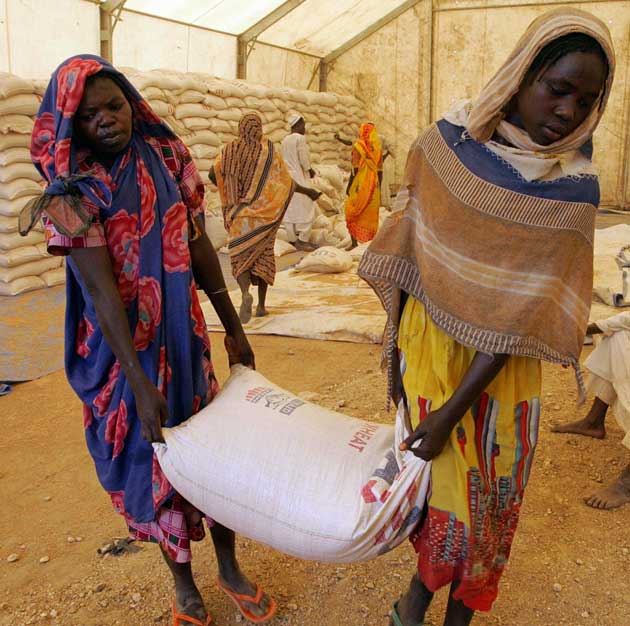
Christian Aid said no deal was better than a bad deal for poor countries such as Sudan
Nine days – and seven years – of painful negotiations to boost the world economy by bulldozing obstacles to free trade have collapsed in Geneva.
Hopes of a confidence-building breakthrough on trade in food, industrial goods and financial services between rich, poor and developing nations foundered on a dispute between China, India and the US. Although there was some talk of fresh negotiations in September, the so-called "Doha" round of trade talks, launched in 2001, appeared to be dead in the water.
The talks broke down after the US failed to resolve a dispute with China and India over a proposed system to defend poor farmers in developing nations from a surge of food exports from richer countries. The issue – regarded as minor when the talks began – came to crystallise growing suspicions between rich and poor, the developed and the developing, about the balance of risks and benefits in the package.
The failure was greeted with relief by some – and with intense alarm by others. With the world economy wounded by high oil prices and the banking crisis, there were fears that the collapse of the talks could undermine business confidence and tip the world towards recession. "It was hanging on a thread," said the Brazilian Foreign Minister Celso Amorim. The thread didn't hold."
Peter Power, spokesman for the EU trade commissioner Peter Mandelson, said the failure was a "massive blow to confidence in the global economy". In a blog written before the final collapse, Mr Mandelson spoke of his "disbelief" that such important negotiations could be torpedoed by what he saw as a relatively technical dispute.
Similar views were expressed in the US and Europe. "I think it's a strong negative and it really follows on the heels of a retreat from globalisation and trade that were really the building blocks for the prosperity of the last several decades," said Michael Darda, chief economist at MKM Partners in the US.
Third World aid pressure groups said the collapse signalled a willingness by poorer countries to stand up to the West. "No deal is better than a bad deal," said Matthew Coghlan, of Christian Aid.
The much-anticipated showdown between Mr Mandelson and the French President Nicolas Sarkozy was not the principal cause of the collapse. Some officials suggested last night that the immediate main sticking point was a row between Washington, Delhi and Beijing.
India joined with China in demanding a toughly worded "special safeguard mechanism" to allow developing nations to protect poor, peasant farmers. The US negotiator Susan Schwab objected to wording which, she claimed, would allow poorer nations to protect their agricultural markets unfairly. Some officials pointed to breakthroughs on issues which had destroyed negotiations in in 2003 and 2005. They spoke of a fresh attempt to revive the Doha round in the autumn.
However, Phil Goff, the New Zealand Trade Minister, said that the US elections would, in effect, freeze negotiations for at least 12 months. He said that it would probably be for a "new generation" to resume the talks.
The EU and US had agreed, in principle, to open up their farm markets to produce from Latin America, Asia and Africa. Brazil, China, India and other developing nations had agreed to accept more manufactured goods and financial services from the wealthy world. Some European governments, and pressure groups, said the EU conceded too much. All of these concessions are now suspended.
-
Print Article
-
Email Article
-
Click here for copyright permissions
Copyright 2008 Independent News and Media Limited

It is proably good the deals collapsed as we have realised we live in different ecnomic times. The economc consensus is finnished extreme free trade does not work. It has lead to famine and death, where nations export food while their own people starve.
Allow countries to protect their own people followed by free trade, with the surplus on food.
Allow countries to subsidise their farming industries to ensure food security. I support private ownership of farms but not with extreme free trade.
The current labour lead has a good record on aid for Africa. So this is great stick to beat the tories with. He gave a stackload of cash to aid relief.
Posted by Dirty Euro | 31.07.08, 11:59 GMT
The PM saved millions of lives with his aid relief policies in Africa.
I support the EU and the USA subsidising their food industries we do not need to be dependent on other nations. for our food like we are on energy Africa should subsidise their food industries. Like we do our.
Posted by Dirty Euro | 31.07.08, 11:49 GMT
Mandy unelected
Brown unelected
Zanu Labour
Posted by ian | 30.07.08, 17:22 GMT
Trade talks fail over US farm feud
USA has an immeasurable land and there are areas that are not developed.
If USA can still rule us on the maize turning into the biogas, they have the land. If the US says Microsoft will not export the Vista to the Yelloland, we will not ask DHL to go there. If USA tells us that IMF is only giving loan to the ones they name, we will go try to knock the doors of other banks that are, too, going down the tube. We are all pegged indirectly to the US dollars whether we like it or not. Our wallets are also designed to fit the dollar bill not big not small.
Tell me who is the head of the trade when you see the above?
Firozali A. Mulla DBA
P.Box 6044
Dar-Es-Salaam
Tanzania
East Africa
Posted by Firozali A.Mulla DBA | 30.07.08, 15:10 GMT
We have to keep talking and listening and find an agreement that creates equality for all. There are too many lives being lost and too many people living in desperation through near starvation while I and the vast majority of those reading this article throw away food and drink daily in a reckless thoughtless manner. I take the action of writing this to confirm my intention to live a peaceful world with equality for all and prosperity for all. Any comments ideas of making this a reality sooner rather than later are welcome.
Thanks
Posted by Jason | 30.07.08, 11:25 GMT
I watched US Presidential Candidate John McCain's economic spokesperson lat night on the news. The McCain position she articulated is unregulated free trade. Clearly the McCain position is to buy American prosperity by disenfranchising the rural poor in Asia.
Posted by robert chapman | 30.07.08, 10:56 GMT
How disappointing that this article relays the political comments of the interested parties but includes no meaningful information on the proposals being negotiated. Luckily, we can see from the statement that the EU and US are disappointed that there was no agreement, and the statement that China and India were not, that the proposals favoured the EU and US and not China and India. As the proposals favoured the most powerful economies we can, by extension, assume that they did not favour third world and developing economies.
Posted by C Taylor | 30.07.08, 10:46 GMT
Of course the EU has suspended concessions towards the third world- its Agricultural Policy which is little more than a bribery fund for the EU's elite - barely supports its own farmers, how can it possibly be expected to make allowances for those in the third world? With the EU's very future at stake, I dont expect it to ever agree to a level playing field as far is trade is concerned.
Posted by RM | 30.07.08, 10:31 GMT