UN drugs chief sticks to punitive policy despite major failings
International efforts to tackle the "global threat" of illicit drugs must be "rejuvenated" in accordance with a 50-year-old convention despite a series of major failings, the head of the UN drugs and crime agency has told The Independent.
This week, Yury Fedotov acknowledged that global opium production increased by almost 80 per cent between 1998 and 2009, and the international market for drugs is now worth as much as $320bn (£199bn) a year – making it the world's 30th-largest industry.
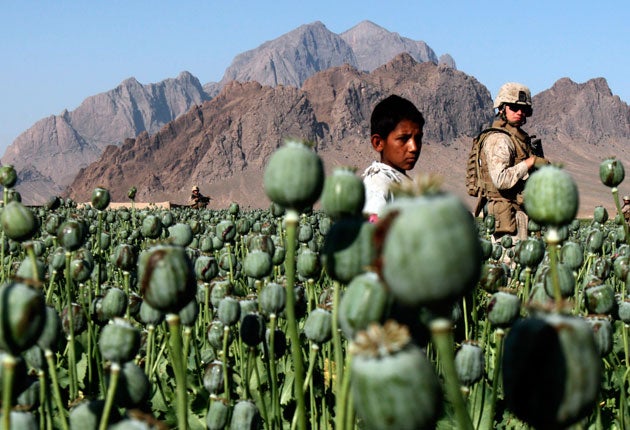
In the face of such daunting statistics, Mr Fedotov, the new executive-director for the UN Office on Drugs and Crime (UNODC), said the Single Convention of 1961 – the first international treaty to lay the framework for global drug-control systems – is still the most appropriate mechanism for tackling what he described as the "global, hydra-headed threat" of drugs and crime. He called on member states to "re-dedicate" themselves to the convention to take a tougher line against drug traffickers and "the drug threat originating from Afghanistan".
Champions of drug-policy reform agree that trafficking is a major global problem, but some worry that a call to invigorate the convention could be interpreted as a call to reinforce punitive approaches to drug problems – one of the biggest criticisms of the 1961 pact. "We all have to acknowledge the key convention is now 50 years old," said Mike Trace, chairman of the International Drug Policy Consortium (IDPC), a global network of NGOs.
"It was drafted in a time when our understanding of drugs problems was very limited.
"Strategies to strengthen repressive measures in source countries like Afghanistan, prohibition and the punishment of drug users have all been employed in the past, and none of them have been able to create the situation we want – which is to stifle the supply of illegal substances and stop young people from wanting to use them."
Peter Sarosi, drug policy expert for the human rights organisation the Hungarian Civil Liberties Union, said: "The continuing focus on criminal justice and prohibition has already proved to be ineffective." His group protested outside the UN building this week to raise awareness of the undesirable side-effects of drug prohibition.
Mr Fedotov argued that drugs and crime "share the same blood supply" but said he did not see the Single Convention as "punitive".
He said: "It's a preventive convention. Its main purpose is to protect people's health."
A former Russian ambassador to the UK, Mr Fedotov came under fire for his links to the Russian government when he was appointed as the UN drugs chief last year. Groups such as the IDPC highlighted Russia's status as the world's largest heroin consumer with a rapidly growing number of HIV cases.
As the Russian drugs tsar, Viktor Ivanov, confirmed this week, Moscow remains averse to implementing several UN-endorsed harm-reduction treatments – such as needle-exchange programmes, which are proven to reduce HIV infection rates. Instead, the government prioritises a hard-line approach to trafficking and Afghanistan's drug cultivation.
When asked about Russia's drug problem, Mr Fedotov said allegations concerning the treatment of drugs users in Russia were exaggerated. "There may be some shortcomings but it is not very different to what happens in other countries," he said.
He said he understands the need for the UNODC to advocate "a comprehensive package of intervention for injecting-drug users" as well as drug-prevention and education measures.
Mr Trace of the IDPC praised Mr Fedotov for admitting that there are problems with the current system. Mr Fedotov’s predecessor, former UN drugs chief Antonio Maria Costa, declared “undeniable success” in 2009.
“That doesn’t mean that Mr Fedotov or the member states have any intention of fundamentally changing our structures,” said Mr Trace. “But it is very encouraging that they seem to be more open to a proper review process.”
Join our commenting forum
Join thought-provoking conversations, follow other Independent readers and see their replies
Comments
Bookmark popover
Removed from bookmarks