US and Iran holding 'secret' talks on nuclear programme
Iran and the United States have been engaged in secret "back channel" discussions for the past five years on Iran's nuclear programme and the broader relationship between the two sworn enemies, The Independent can reveal.
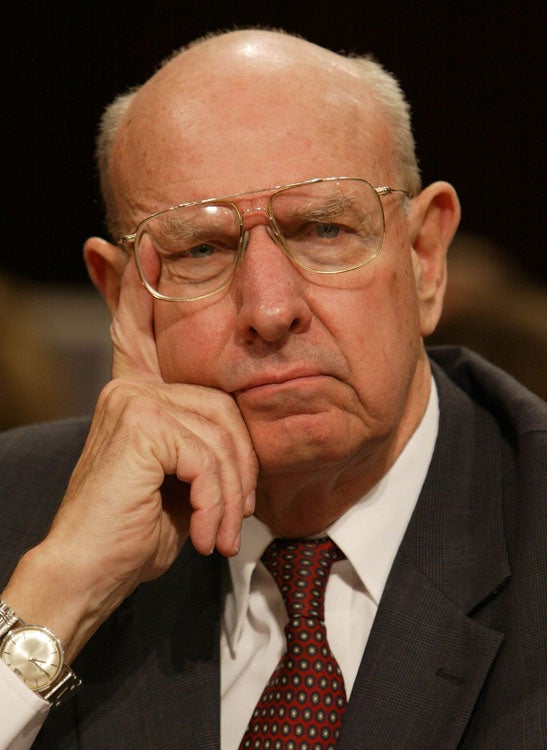
One of the participants, former senior US diplomat Thomas Pickering, explained that a group of former American diplomats and experts had been meeting with Iranian academics and policy advisers "in a lot of different places, although not in the US or Iran".
"Some of the Iranians were connected to official institutions inside Iran," he said in a telephone interview from Washington. The group was organised by the UN Association of the USA, a pro-UN organisation. Its work was facilitated by the Stockholm International Peace Research Institute, a government-funded think-tank chaired by the former chief UN weapons inspector for Iraq, Rolf Ekeus.
While the nuclear issue was "prominent", Mr Pickering said, "we discussed what's going on domestically in both countries and wide-ranging issues" affecting the US-Iran relationship. Although none of the group members was from the US or Iranian governments, he said that "each side kept their officials informed". The Bush administration "did not discourage us," he added.
Mr Pickering declined to go into greater detail for fear of jeopardising future meetings of the group of about a dozen Americans and Iranians, although the number of participants varies. Back- channel talks have often provided crucial impetus in solving the world's most intractable disputes. They usually only become public in case of agreement, as seen with Northern Ireland and the Oslo accords on the Middle East, or failure, as in the case of an Israeli-Syrian informal channel.
The revelation about the existence of an Iran-US back channel coincides with the recent publication by three of its American members, including Mr Pickering, of proposals aimed at overcoming the deadlock between Iran and the West over Tehran's nuclear ambitions. The initiative addresses the crunch issue of Iran's right to enrich uranium on its own soil while providing guarantees that the nuclear fuel will not be diverted for military purposes.
Mr Pickering spoke of a "rather positive" reaction to the plan, which provides for an international consortium to jointly manage and run uranium enrichment on Iranian soil.
However, the Bush administration has not responded, and remains wedded to its current policy of sanctions aimed at forcing Iran to halt uranium enrichment in line with UN demands, while offering the opportunity to enrich uranium outside the country through a Russian consortium. A Foreign Office spokesman said Britain was "aware" of the proposals but did not have an official response. The Iranian government, according to Mr Pickering, has let it be known that "they would not respond unless it was offered officially".
In arms-control circles the plan has gained traction "because he's so respected," said George Perkovich of the Carnegie Endowment for International Peace, referring to Mr Pickering, who is a former US undersecretary of state. The initiative, co-signed by the UNA-USA president William Luers, a former diplomat, and Jim Walsh, a nuclear expert from the Massachusetts Institute of Technology, was first aired at the end of February in The New York Review of Books where it has generated further discussion.
Mr Pickering says that he and his colleagues decided to act now because US policy was "stuck", in the light of Iran's refusal to bow to the UN demand to halt uranium enrichment, despite the imposition of economic sanctions. Prospects for face-to-face US-Iran talks are therefore blocked, he says, arguing that the case is urgent because Iran is continuing to install centrifuges at its main enrichment plant in Natanz.
But other experts point out that with the 3,000 centrifuges at Natanz spinning at only 20 percent of capacity because of technical problems, there is time for the West to play a waiting game.
James Acton, a nuclear specialist at King's College London Department of War Studies, said the challenge would be to prevent Iran obtaining a clandestine route to a nuclear weapon thanks to the technical know-how that would be obtained from foreign partners.
Mr Pickering said: "It can be feasible if governments wish to make it so, technically and financially. But it will take a lot of negotiation."
Some analysts pointed out that a breakthrough was unlikely so long as George Bush was in the White House and Mahmoud Ahmadinejad holds the presidency of Iran, where elections are scheduled for next year. "Why would Iran go for it now? They feel like they've won, there are not enough sanctions, and there is no threat of war," said Mr Perkovich.
Calling Iran's bluff?
The Luers-Pickering-Walsh initiative gives Iran the opportunity to prove that its nuclear intentions are peaceful by yielding to the Iranians' key demand for a uranium enrichment programme on Iranian soil. The enrichment activities would take place under the supervision of a jointly managed international consortium. The plan is the most detailed of its kind since 2005. Conditions to be negotiated with Iran would include:
*a UN Security Council resolution authorising the arrangement and specifying that if Iran breaks the agreement, member states would be authorised to take punitive action;
*Iran would be barred from producing highly enriched uranium, which is weapons grade fuel, or reprocessed plutonium, which can be an alternative route to producing a bomb;
*Iran would implement the stringent inspection measures in the Additional Protocol to the nuclear non-proliferation treaty;
*Iran would commit itself to building only "safe" light-water reactors.
Join our commenting forum
Join thought-provoking conversations, follow other Independent readers and see their replies
Comments
Bookmark popover
Removed from bookmarks