A C Grayling: What would Breivik be without a gun?
The global arms trade inevitably leads to the sort of atrocity inflicted on Norway. The killing machine has to be stopped
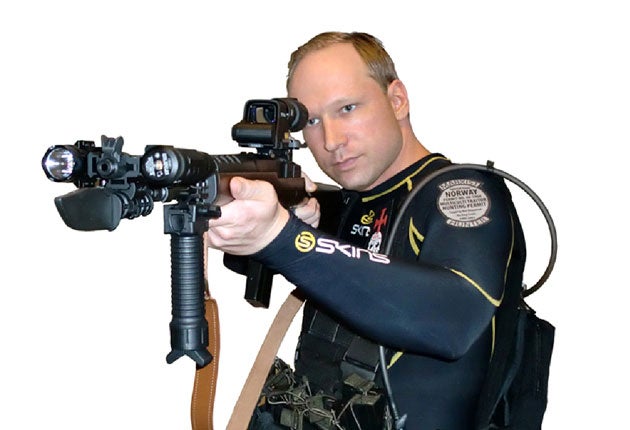
In discussion of the atrocity in Norway last week, there is one subject which has been notable by the almost total silence about it: guns. In response to recurring massacres in American high schools and British villages, in response to footage from Africa and Afghanistan showing ragged, untrained young men brandishing automatic small arms, in response to a man coolly murdering dozens of youngsters in an hour-and-a-half, funfair-like shooting spree on a Norwegian island, where is the outrage at the fact that the world is awash with small arms, that people are making money legally and without blemish to their reputations out of the manufacture and sale of instruments purposely designed to kill?
It is said that you can get a Kalashnikov in the Horn of Africa in exchange for three small children. But before the sale of children for weapons, and before the mayhem and death that results from the use of those weapons, there is the arms trade in a wide range of handguns and high-powered automatic rifles. Every one of these instruments is designed and created for the express purpose of killing. The irresponsible argument of the American gun lobby – that it is not guns that kill, but the people who handle them – is the first point to contest: if Anders Behring Breivik had carried only a knife or a wooden club, he would have been severely restricted in the harm he could do. The same would have been true at Hungerford and Dunblane, at Columbine High School and Kent State University; the agonies of Darfur and Helmand would be vastly less; in fact the world would be a different and happier place if guns were few and their possession a matter of strict official control.
Our world stands on its head in most things, but in nothing more so than the fact that a crazy person can buy a gun, an extremely dangerous device, in an American or Norwegian shop, but "drugs" are prohibited and policed at vast expense to society. Indeed, the ironies are still greater: because drugs (excluding some of the most dangerous and harmful, such as alcohol and nicotine) are criminalised but the gun trade is not, the gangs who smuggle the drugs shoot each other with the guns, and not infrequently shoot the policemen who chase them also. This is a stark example of the irrationality of our arrangements. Ban guns and put heroin under the same licensing regulations as alcohol – fools will continue to abuse both, harming mainly themselves: the abuse of guns harms others, and too often too many others – and at a stroke billions of dollars and thousands of lives (think Mexico) would be saved.
Guns should be the subject of worldwide outrage. Their manufacture and sale should be a human-rights abuse, on which we pour vilification and horror. They should be illegal for all but properly constituted, trained and controlled agencies of governments, provided of course that the governments in question are themselves properly constituted and controlled by democratic means in asociety where the rule of law obtains.
Human-rights agencies with representation at the UN in Geneva, such as the one I belong to (the International Humanist and Ethical Union), should begin campaigning for the manufacture and sale of small arms to be universally outlawed, and governments (such as the British government) which have responsible attitudes to gun control should be urged to join the campaign.
There are easy ways to deal with the need by farmers to control rabbits, and game-park keepers to cull overpopulated herds: if there are genuinely no alternatives to the use of guns in such cases, a small range of suitable guns could be borrowed, under strict licence and for short periods, from the authorities for the express purpose in hand, but not allowed to remain in the community otherwise. If we can legislate for car-seats for children, we can legislate to keep highly dangerous killing instruments out of public hands.
"Highly dangerous killing instruments": language matters: let us no longer use the word "gun" but that phrase "highly dangerous killing instrument", and perhaps perceptions will change. No doubt weapons manufacturers and lobbyists everywhere would regard with equal outrage the idea of severely limiting the number of highly dangerous killing instruments in public circulation, their existence being permitted only under official lock and key. What would these lobbyists argue in opposition? That highly dangerous killing instruments are for sport, for hunting (this last will not wash: killing things for sport? That is itself disgusting), for the fun of loud noises?
Americans with views not too far removed from those of Anders Behring Breivik say that they "need" their guns to "defend their freedoms", meaning against the tyranny of government and federal taxes. They should be reminded that it is the ballot, not the bullet, that is meant to do that job for them.
In fact, there are no good arguments in favour of the existence of highly dangerous killing instruments, and millions of excellent arguments against them, these being each human being, and indeed each elephant and tiger, shot to death by them. The Norwegian tragedy should be absolutely the last straw for civilised humanity on this subject, no further excuses allowed.
Join our commenting forum
Join thought-provoking conversations, follow other Independent readers and see their replies
Comments
Bookmark popover
Removed from bookmarks