Andreas Whittam Smith: Prince Charles and the looming constitutional crisis
My doubts stem from the bombardment of letters to which he subjects ministers
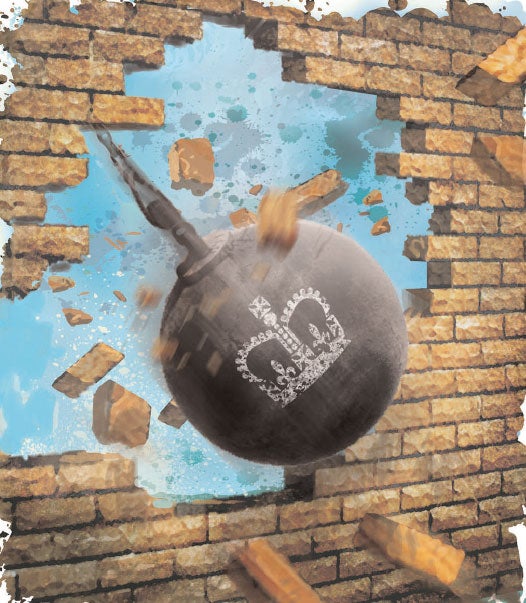
When he becomes King, Prince Charles could well cause a constitutional crisis. For he is likely to find irksome the convention that the sovereign must act on the advice of ministers alone. This doctrine is at the heart of Britain's uncodified constitution.
What gives rise to these doubts is the regular bombardment of memos and letters to which the Prince subjects government ministers. These cover issues close to his heart such as the built environment, architecture, housing, agriculture and the protection of the environment.
This week it has emerged, for instance, that Prince Charles has written directly to ministers in eight Whitehall departments over the past three years. What are known as the Prince's "black spider" memos because of his hand-writing have landed on desks at Food and Rural Affairs, International Development, HM Treasury, Foreign and Commonwealth Office, Work and Pensions, Education and Skills, Communities and Culture, Media and Sport.
Now, notwithstanding the fact that government ministers rule, the British head of state is not to be an inert object, incapable of holding opinions and constrained to address only polite enquiries about the weather to the prime minister of the day. The famous description of the monarch's right to be consulted, to encourage and to warn given by Walter Bagehot nearly 150 years ago, still holds good. Indeed the three rights are often broadened out to embrace also the requirement to be informed and right to give advice.
Thus it can well be argued that the apprentice sovereign, in his exchanges with government departments, is doing no more than consulting, encouraging and warning. Yet contemplate the situation when Charles becomes King. He will presumably continue to meet the prime minister at regular weekly audiences. It is these occasions that Bagehot had in mind when describing the monarch's rights to engage in meaningful dialogue. However the question is whether Charles as King would go further and continue to lobby individual government departments about matters that concern him. How likely is this? The way in which the Prince aggressively worked recently to torpedo proposals by the architect Richard Rogers for the development of Chelsea Barracks in London gives some indication of the vigour with which he fights for what he considers to be right – an admirable trait in normal circumstances. In the event the owners of the site, the Qatar royal family, felt it right to withdraw their planning application. The Prince had prevailed.
Moreover there is something in the manner in which the Prince pursues his public policy objectives – the relentlessness more than anything else – that suggests he is one of those types who believe that they have been given special insights of a spiritual nature. And this in turn, such people assume, imposes a sacred duty to act.
Am I imagining things or do I correctly detect a hint of this in the final sentences of his speech to the Climate summit in Copenhagen on Wednesday? "Over more than three decades, I have been privileged to talk with some of the world's most eminent experts on climate change and environmental issues and to listen to the wisdom of some of the world's indigenous people. The conclusion I draw is that the future of mankind can be assured only if we rediscover ways in which to live as a part of Nature, not apart from her."
If Charles were to continue to send a stream of memos to government departments from the throne, I wonder what Sir William Heseltine, the former Private Secretary to the Queen, would have thought. For Sir William wrote to a newspaper in 1986 to state that, "Whatever personal opinions the sovereign may hold or may have expressed to her Government, she is bound to accept and act on the advice of ministers."
In fact Sir William was doing no more than repeat the terms of the memorandum addressed to George V when he ascended the throne in 1910. It was sent by the Prime Minister, HH Asquith. It observed: "The part to be played by the Crown has happily been settled by the accumulated traditions and the unbroken practice of more than 70 years. It is to act upon the advice of Ministers who for the time being possess the confidence of the House of Commons, whether that advice does or does not conform to the private and personal judgement of the sovereign."
In fact the origins of the doctrine go straight back to the Glorious Revolution. For it was the leading men of the time, represented by the Bishop of London and six peers, who issued an invitation to the protestant William of Orange on 30 June 1688 pledging their support if he brought a force into England from Holland against the catholic James II.
Notions of the divine right of kings had no purchase on the English mind. And the Convention that was called to formulate new constitutional arrangements after James had fled to France made it plain that what might be called the establishment-in-Parliament finally called the shots, asserting that it was, "inconsistent with the Safety and Welfare of this Protestant Kingdom to be governed by a Popish Prince."
Moreover at their coronation, William and Mary swore that they would govern according to, "the statutes of parliament agreed upon and the laws and customs of the same". Previous kings of England had sworn to uphold the law made by their ancestors.
From then onwards Parliament was in charge. It exerted its control through its powers of taxation, generally levied for no more than a year at a time so that the monarch would have to come back regularly to parliament for fresh supplies. By these means Parliament forced William to send his Dutch troops home when he would dearly have liked to have kept them.
Lastly the Act of Settlement of 1701 embedded parliamentary control beyond doubt – though the legislation is sometimes called into question today because it requires that the monarch must, "join in communion with the Church of England as by law established."
Nonetheless sovereigns retained substantial political influence until the widening of the franchise starting with the Reform Act of 1832. After that it was plain that monarchical power, however restricted, lacked legitimacy and it was this development that Asquith had in mind when in 1910 he referred to accumulated traditions and the unbroken practice of more than 70 years.
What I fear that Charles would do, as King, would be to make speeches that could be construed as critical of aspects of Government policy that touched on his concerns. Of course in these circumstances ministers would still govern and Parliament would still be Parliament. But at the very least, confusion in the public's mind would have been created.
For by speaking out, Charles would have crossed into a no-go area, vigorously defended by Parliament for over 300 years. And that would be a crisis because Parliament would then be forced to spell out the doctrine of ministerial supremacy more clearly than had been thought necessary in the past.
Mind you, Parliament could well borrow from the powerful language of their 17th century predecessors and state that it was, "inconsistent with the Safety and Welfare of this Democratic Kingdom to be governed by an Opinionated Prince."
Join our commenting forum
Join thought-provoking conversations, follow other Independent readers and see their replies
Comments
Bookmark popover
Removed from bookmarks