Andrew Buncombe: Indians won't tolerate corruption forever
Notebook
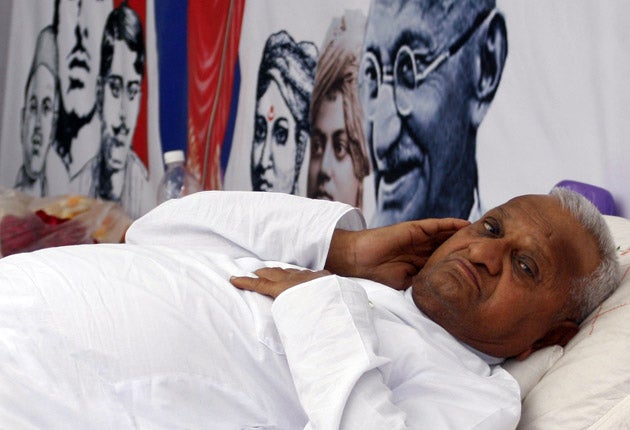
The middle-classes in India have, in recent days, been getting very stirred up by an elderly man in a traditional white hat who almost brought the government to a spluttering halt by going on a hunger strike.
Anna Hazare is not Gandhi. And though he claims to be a Gandhian, a dedicated follower of the Great Soul who helped India secure its independence from Britain, it has been pointed out that some of his beliefs – such as cutting off the hands of criminals – are rather closer to those of the Taliban. In the village where he lives in the western state of Maharashtra, the social activist has effectively banned alcohol and cable television because he believes them to be evil. Some within the media and political classes have chosen to sneer at him and some have claimed his protests were undemocratic.
But that did not stop the youthful and educated middle-classes of India flocking to him as if he were the Pied Piper when he made a stand on the issue that has increasingly becoming a political fireball in this country: corruption. In the aftermath of last year's Commonwealth Games scandal and more recently, outcry over the allegedly fraudulent auction of 2G spectrum that saw India lose out on up to £23bn, no political party or popular leader can afford to ignore the mounting anger.
The people who poured out to sit with the 71-year-old Hazare outside of Delhi's Jantar Mantar – an 18th-century observatory that has become the location for demonstrators of all hues – may technically have been hypocrites. Many, if not most, will have paid bribes to get their children into a good school, to arrange the lease on their apartment, or else to a magistrate to obtain a legal document they required. The poorer among them – and it is always the poorest in India who proportionally who have to pay out the most in bribes – will have had to hand over money to the police or dodgy officials. But it was precisely for that reason, because they know all too well about the impact of corruption on their daily lives, that they turned out to support Hazare, as he sought to ensure activists, and not just politicians, were included in the membership of a new anti-corruption panel.
As it was, I recently happened to take part in a business forum where the panel was asked whether they believed there were any parallels with what was happening in India to the far larger, more fundamental protests taking place in the Arab world. The most interesting response was from a respected female TV reporter who said the authorities in Delhi had tried to ignore the protests for the first couple of days and then – apparently genuinely fearful of things getting out of hand in a Tahrir Square sort of way – decided they had better act. Quickly the government acceded to Hazare's demands and, in a clever piece of politics, diluted the impact of his protest by ensuring the issue got bogged down in a row about procedure.
But the man with the white hat is not going away. He is planning a national tour to meet people across India who are angry and fed up about the levels of corruption within the country and the way it is halting development and ruining lives. India's politicians are always quick to boast of possessing the world's biggest democracy. But if people make the effort to vote and nothing changes – if the corruption gets worse before their eyes – then those politicians need to pay attention. India has not seen the last of Anna Hazare.
Will Ms Singh deliver a bestseller?
To a recent book event in the city with the charming Daman Singh, one of the three daughters of India's unusually shy and retiring prime minister, Manmohan Singh. Ms Singh is the author of two novels, the most recent being The Sacred Grove, which tells the story of a14-year-old boy through the eyes of the teenager. The father of the book's main character is a senior official in a small town who not only receives preferential treatment from those around him but is somewhat authoritarian to his child.
Ms Singh was a good enough sport to reveal she must have used some of her own experiences from childhood when she wrote the novel. She also revealed she is working on a biography of her parents and has alreadysat down with them and carried out several interviews as part of her ongoing research. Her father's attitude about the project had been typically low-key, she said, whereas her mother was enthusiastic and encouraging.
Ms Singh said she doubted whether she was going to get any especially juicy details or gossip from her parents about their lives. Yet with an eye for possible publicity that any ambitious author must have, she added: "Of course, it would be better for the book if there were some."
This city's Chief Minister protests too much
The authorities in Delhi have been outraged over a recent report in The Lancet that claimed the presence of a so-called superbug in the city's water supplies. The city's chief minister, Sheila Dikshit, says tests have proved the claim are false, (though chlorine tablets have been handed out by officials as a precaution). The esteemed medical journal previously angered city officials in an article last year that named the bug it had discovered NDM-1, short for New Delhi metallo-beta-lactamase-1.
Ms Dikshit and her colleagues said the city was being unfairly associated with harmful bacteria. It's fair to say that many people I've spoken to about this issue have rolled their eyes at both Ms Dikshit's purported anger and her reassurances that all is well with the city's water. After all, Delhi Belly got the name for a reason.
Join our commenting forum
Join thought-provoking conversations, follow other Independent readers and see their replies
Comments
Bookmark popover
Removed from bookmarks