Andrew Grice: Capturing the public mood is one thing – keeping it is quite another
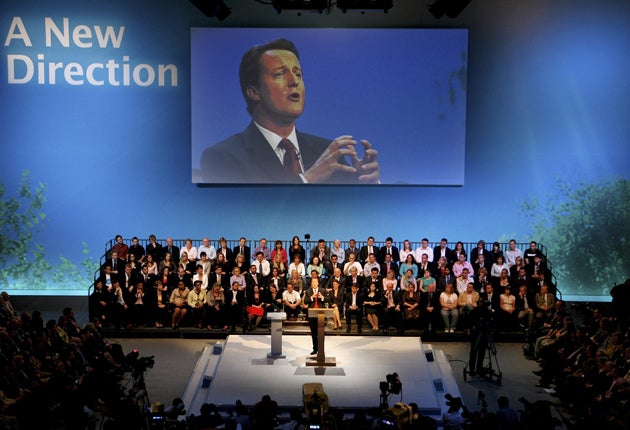
In his first speech to the Conservatives' annual conference after becoming party leader, David Cameron endorsed gay marriages. He didn't know how Tory activists would react. Some old farts sat on their hands, stony-faced. But after a pregnant pause, applause began to ripple around the hall.
It was a big moment; the new Tory leader showed that he could take his party with him on his modernising crusade. Mr Cameron was dragging it into the real world. This week's fascinating British Social Attitudes annual survey shows that the number of people who believe that same-sex relationships are "always" or "mostly" wrong has fallen from 75 per cent to 36 per cent since 1975.
A cynic might accuse Mr Cameron, who previously opposed Section 28, of following rather than leading public opinion. But the Tory leader is out of tune with the public mood on marriage: 45 per cent of people think it makes "no difference" to children whether their parents are married or living together.
Mr Cameron is impaled on a hook of his own making after promising to reward marriage in the tax system. It is a policy in which he passionately believes. But his passion is not shared by all his senior colleagues, including the man who must find up to £4.9bn for it when the cupboard is not only bare but has already been carted off to the pawnbroker. George Osborne, the shadow Chancellor, is Mr Cameron's closest ally but is a metropolitan man, while Mr Cameron's instincts are more in tune with those of shire Tory traditionalists than we sometimes realise.
Overall, the attitudes survey brought cheer to the Tories. For the first time in 20 years, the Conservatives are supported by more people (32 per cent) than Labour (27 per cent). The proportion of people who believe governments should redistribute income from the better-off to the less well-off has fallen from 51 to 38 per cent since 1994, while the number who support higher tax and spending has dropped from 62 to 39 per cent since 1997.
So if you were building an identikit ideal politician, you would combine social liberalism with economic conservatism. Enter, stage right, Mr Cameron. This week's survey has sparked a lively behind-the-scenes debate in Labour circles. I resolved not to write about Mr Blair today as there will be enough of him on other pages, but you can't keep him out of it. Some ministers blame him for shifting Labour, and the country, too far to the right, saying Gordon Brown is now paying the price.
Certainly, Mr Blair was desperate to slay the Old Labour dragons – supporting public ownership, high tax and spending, trade union power and nuclear disarmament, and being anti-business and anti-American (the latter "correction" explaining the whole Iraq episode, in my view). Did he at first follow and then lead public opinion? Did he overshoot the runway, allowing Labour to miss a historic opportunity to entrench its values? A major government-ordered study this week, showing that the gap between rich and poor is now greater than at any time since the Second World War, only sharpened Labour's debate.
Intriguingly, the number of people describing themselves as Labour supporters dipped in 2007, when Mr Brown succeeded Mr Blair. Was that because the new Prime Minister was out of sync with the country, or was it because he was seen as a dangerous leftie compared with Mr Blair?
My hunch is that there's a more prosaic explanation: the passage of time. Margaret Thatcher captured the public mood when she came to power in 1979, but was out of touch with it when booted out by her own party in 1990. The country never really bought shares in Thatcherism, and demand for higher spending and redistribution of wealth grew.
New Labour may have satisfied the public's limited demand for change after 1997 with its cautious approach, ever mindful of those old dragons – too cautious, some ministers say, with hindsight. The financial crisis should have helped a centre-left party, but it had extolled the virtues of "light touch" City regulation to remind voters it was not Old Labour. "We could have put up the top rate of tax to 50p two years ago instead of waiting until this April," one Cabinet minister told me. "We are behind the curve."
On the face of it, the attitudes survey suggests that Labour needs a miracle to cling on to power at this year's election. Yet a closer look at the small print gives Labour a few crumbs of comfort: 81 per cent of people want more health spending and 72 per cent favour a bigger education budget. Two-thirds of voters still think the Government has a responsibility to reduce the gap between rich and poor.
Nor should the Tories think the public share their thirst for deep spending cuts. The most popular view, held by 50 per cent, is that spending and taxation levels should stay as they are; only eight per cent support cuts.
Perhaps the public's real thirst is simply for some kind of change, because they tire of the political establishment whichever party is in power. It happened in 1997 and it may well be repeated this year. If the Tories win and are true to their word when it comes to cuts in spending, they could become very unpopular very quickly. In a few years, most of us might be lefties again.
Join our commenting forum
Join thought-provoking conversations, follow other Independent readers and see their replies
Comments
Bookmark popover
Removed from bookmarks