Andrew Grice: Delegates limp in to Brighton in search of a guiding hand
Inside Politics
Labour gathers for its last annual conference before the general election in a sorry state. When cabinet ministers admit that, it must be true – and highly significant.
Peter Hain, the Welsh Secretary, will admit candidly in one of the opening speeches tomorrow that "party members [are] sullen and reluctant or too embarrassed to campaign, all of us [are] continuing to behave as if a Tory win is inevitable".
Asking Labour whether it really wants to win, he will tell delegates they might just as well wrap up the conference on day one, go home, put their feet up and wait for David Cameron to walk into 10 Downing Street if they don't have the will to fight back.
Sensible Labour folk admit the Brighton conference provides the last real springboard for Labour to get back in the game. "We are fighting for our very lives," Lord Mandelson told a recent cabinet meeting. Although others round the table echoed his rallying cry, his real point was that many Labour people, some ministers included, are not fighting because they have given up hope of winning next year. "Ministers sound like administrators happy to run their departments but don't act like party politicians," one Labour official moaned. "Anyone would think the election was years away."
Mr Hain will offer Labour delegates a ray of hope: if Labour could only get up off its knees now, it could make the next election more like the 1992 contest than the 1997 landslide.
He senses that next year's could yet be decided at the very last moment, in the privacy of the polling booth. Labour's task, he believes, is to change the question in people's minds from "Are you fed up with Labour?" (a no-brainer) to "Do you really trust the Tories with your jobs, mortgages, families and pensions?" (more open).
It makes sense. Labour strategists say voters like Mr Cameron but do not yet trust his party, offering Labour a rare chink in his armour. "We have got to make the election about them, not us," a Brown ally agreed. Just as the Tories did in 1992, when they ruthlessly attacked Neil Kinnock and demolished John Smith's tax-raising "shadow Budget". It worked, and John Major won. Labour might just achieve a hung parliament by doing the same now, the argument runs.
But this strategy may have a fatal flaw: Mr Brown himself. "We can't expect the media to focus on the Tories' policies when he keeps dropping the ball," said one senior Labour MP, a Brownite. He described as "disastrous" the PM's handling of MPs' expenses, the Lockerbie bomber, the Gurkhas' row and his belated acceptance of the need for spending cuts.
If only he could avoid such unforced errors, then "not flash, just Gordon", the man of substance, could have real appeal again, ministers believe.
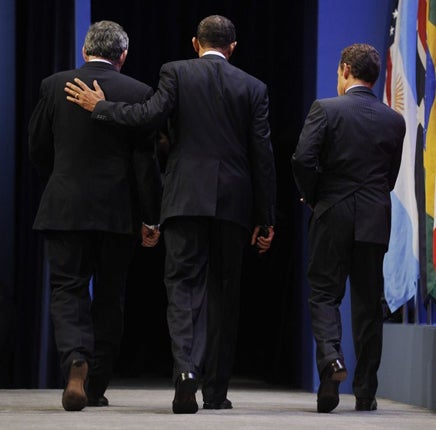
I watched Mr Brown in action at this week's United Nations and G20 meetings, where he showed his usual mastery of detail and was more influential than the headlines about "snubs" by Barack Obama suggested. Like some of his exhausted aides, who struggle to keep up with his frantic pace, I wondered why he doesn't show the same assuredness on the domestic agenda. "He won't get any credit for saving the world when all the public see are balls-ups at home," one minister said. Mr Brown was visibly frustrated in the US that his sterling work on the international stage was overshadowed by distractions at home – the row over Baroness Scotland's housekeeper, renewed sniping at his leadership and even questions about his health.
Labour will rally behind Mr Brown this week. The danger is that the looming inquest into the expected defeat breaks surface. It is already starting to, as shown by John Prescott's explosive attack on Harriet Harman in this newspaper today.
Mr Brown's all-important conference speech on Tuesday must address the country while somehow giving his demoralised party hope. He will get personal and show that he "gets it" by acknowledging the hardship that people have suffered over the past year.
This is a last-gasp attempt to recreate the coalition of the working and the now "squeezed" middle classes that swept New Labour to power in 1997. "We have got to put the band back together again," said one Brown aide.
It won't be easy. Tony Blair often took Labour's core vote for granted, believing it had nowhere else to go, and put his energies into wooing Middle Britain. Now Labour has arguably lost both.
There is tension over Mr Brown's attempt to get credit for steering Britain through the economic storms. Some ministers think he wastes his time, saying voters rarely give thanks, and certainly won't to a man to whom they have stopped listening. The only course, the critics say, is to move on and offer a forward strategy.
The Prime Minister wants to "take ownership of the recovery" but is not prepared to allow the Tories to blame the recession on him. He believes he got the "big decisions" right – Northern Rock, rescuing the banks, the fiscal stimulus – while Mr Cameron got them wrong. "People should judge their politicians on the big judgement calls, not the price of food in the Commons canteen," said one Brown aide, referring scathingly to the Tory leader's plan to cut the cost of politics.
Mr Brown's hope is that voters agree with him and judge it a "big choice" election. His performance over the next week will start to tell us whether the man of substance who saved the world can now save his party from what looks like an inevitable defeat.
A risky week: Where are Labour's banana skins?
Political success makes party conferences packed, disciplined and dull. Failure reduces attendance figures, but increases the fun. The Labour conference, which opens in Brighton tomorrow, should be fun.
There will in fact be two conferences running in parallel. The theme of the official conference will be how Labour can win the next election. That will take place in the conference hall. The theme of the unofficial conference, in the bars and corridors, will be "What the hell will we do when we lose?"
In the official conference, no one will say "Charles Clarke has a point, you know." No one will even say "Charles Clarke". Everyone will have total confidence in Gordon Brown, Alistair Darling, Peter Mandelson, Harriet Harman and the increasingly visible Sarah Brown.
Its centrepiece will be Gordon Brown's speech, after lunch on Tuesday, which they hope will dominate that night's news. The finale will be a rallying call by Harriet Harman, left, in the Thursday morning slot that John Prescott used to fill. It could be a poignant moment: delegates will know that she could be the last government minister to speak from their podium for many years.
The stars of the unofficial conference will be James Purnell, who recently quit the Cabinet, and Jon Cruddas, one of the Government's more thoughtful and persistent critics, who should draw a packed house at the Fabian Society's meeting tomorrow.
Most conferences produce memorable disasters, but frustratingly for those who like to be on the scene, no one can predict where or when. Who could have foreseen David Miliband's photocall with a banana, centre, in Manchester last year?
One event with high disaster potential is the fringe meeting organised by The Sun on Monday. Its title is "Do You Know There's a Bloody War On?" The main speaker will be the recently promoted Defence Secretary, Bob Ainsworth, right. The audience will include soldiers' families.
In Labour's heyday, you could spend all evening downing champagne in reception after reception. Those days are slipping away. The Daily Mirror Wednesday blow-out is no more. The Independent hosts a debate, but not a party. But the New Statesman, The Guardian, the Fabians, the Irish embassy and others are playing host – and where there is free drink, there is always the possibility that something will go horribly wrong.
Andy McSmith
Join our commenting forum
Join thought-provoking conversations, follow other Independent readers and see their replies
Comments