Anthony Seldon: Our education system is collapsing into a form of mass indoctrination
Schooling is a once-in-a-lifetime opportunity, which allows the young to blossom into the unique human beings they are. Universities should refine this process
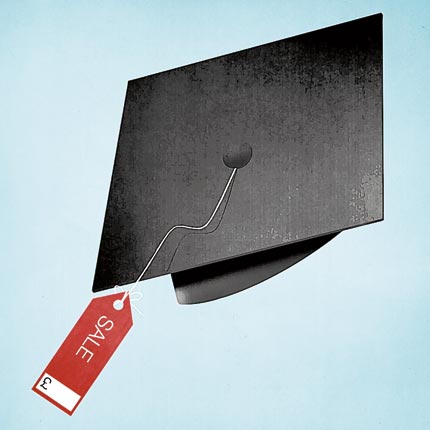
Education, education, education could be David Cameron's and Nick Clegg's mantra as easily as it was Tony Blair's, and John Major's before. Indeed, in one of his best jokes, Major lamented the fact that Blair had stolen his top three priorities, although "I didn't necessarily have them in the same order".
Genuine education has never been more necessary than now, and Education Secretarry Michael Gove must take heed, because the true mantra of the past 13 years was "instruction, instruction, instruction". Under a succession of Education Secretaries, some good, many not, education in schools, and indeed universities, has become more formulaic as the tyranny of exams has been allowed to become overly dominant.
A liberal education has too often been replaced by an indoctrination of the young in the answers they need to memorise and regurgitate for exams. It is so all pervasive that we simply do not see any longer what has happened, and the education establishment – teachers, academics, administrators and those in the quango penumbra – does not acknowledge the impoverishment rather than the flowering of the lives of our young people.
This sad story extends far beyond the shores of Britain: in the emerging superpowers in the East, students sit inert in large school and university classrooms, passively absorbing material dictated to them by grey men and women, which they repeat in their essays and dissertations, straining every sinew to produce the "right" answer. The creative, the imaginative or individual response is marginalised, and the whole process of education with schools and universities becomes mechanised and industrialised: mass-production factories of the mind.
Schools and universities across the world should be places of engagement and delight: instead, students, especially in prosperous countries, often resent and shun schools, while they take university for granted, thinking insufficiently why they are there and how privileged they are. Parents should be actively engaged in and full of gratitude for the schools that their children attend: instead, they are too often indifferent and even unco-operative. Teaching should be a profession which the brightest and most energetic should aspire to and fight to join: instead, it is hard to encourage top graduates to apply.
Let us pause for a moment and consider what education can and should be. Schooling is a once-in-a-lifetime opportunity, which should allow the young to blossom into the unique human beings that they are. Universities should refine this process, being sensitive to the emergence of the whole young person into the fullness of life.
At the heart of all good education should be the opportunity for each child to discover who they are, how they should relate to others, and what they love about life. By asking these questions, the young will stand the best chance of learning how to live with themselves and with others in a state of harmony, and they will be helped to realise what kind of career, activities and relationships are most likely to fulfil them later in life.
It is an extraordinarily subtle process that requires patience, time and love, as well as an atmosphere free of bullying and cynicism, in which the young are able to explore themselves and others in an atmosphere without fear. If a child is scorned for their singing or dancing, for their poetry or answers in class, they will go into a shell, and discover that it is safer to conform than to risk being creative. They will learn that it is not safe to be an individual.
In the past 50 years Britain has produced barely any great education thinkers. It has sired some "monsters" such as Cyril Burt and Hans Eysenck, who promoted the idea that intelligence tests and "IQ" was the only reliable way of valuing human beings. Education in Britain would do much better to listen to two Americans, and one émigré to that country. Howard Gardner of Harvard University has developed the notion that individuals possess not one intelligence, their IQ, but "multiple intelligences". My own school bases its entire education around an adaptation of his model; we have developed our own octagon, and try in class and outside to develop all eight aptitudes of each young person: the logical and linguistic, the creative and the physical, the personal and the social, the moral and the spiritual.
Martin Seligman of Pennsylvania University has developed the field of positive psychology, with many profound lessons for schools in helping their young to develop the resilience they will need to face life. Ken Robinson emigrated to Los Angeles, disillusioned by the failure of government to listen to him on creativity. It commissioned a report, All our futures: Creativity, Culture and Education, and then dropped it. Education, like life, is nothing without creativity. It is what makes us human. Creativity is what distinguishes a mass-production factory from a flourishing and vibrant institution.
In Britain, GCSEs and the new style A-levels bear heavy responsibility for the impoverishment of our young. A better system exists in the International Baccalaureate exam, which operates on three levels, and which is available to every school in Britain: the primary years programme for children aged five to 11, the middle years programme, for children aged between 11 and 16, and the diploma, for 16- to 18-year-olds. The diploma is taken by some 150 state and independent schools in Britain, but the other two are still a rarity – my own school has just started the middle years programme. All three IB programmes are based on developing the whole child, in an international context, with an inter-disciplinary and philosophical approach, and in a way that challenges each child to think rather than regurgitate "correct" answers.
Universities are slow in this country to adjust to the IB, highly though they prize those who graduate from it, whom they consider to be more independent minded. Universities could play a leading role in valuing a school curriculum that is broad, deep and intellectually rigorous. Understanding and rewarding IB students, who have had a far more testing two years than their A-level colleagues, would be a good start.
The new coalition Government has it in its hands radically to transform education, and to turn out young people universities and employers relish, and who go on to lead fulfilling, honest and productive lives. Some time ago I called for a new "great debate" on education. The country waits. Michael Gove could go down as the greatest Education Secretary in 100 years if he placed education, not instruction, back into the heart of schools and universities.
Anthony Seldon is Master of Wellington College. His next book is 'Brown at 10'
Join our commenting forum
Join thought-provoking conversations, follow other Independent readers and see their replies
Comments
Bookmark popover
Removed from bookmarks