Ayad Jamal Aldin: Iran: the truth the UK cannot admit
Official denials of involvement in kidnapping should not mask Tehran's growing power, says a leading Iraqi politician
While we celebrate the safe return of the British computer expert Peter Moore, released two and a half years after being taken hostage in Baghdad, let us not delude ourselves that the negotiations that brought about his release bode well for the development of a peaceful Middle East.
Despite official denials, what many suspected from the start is becoming clear to all: Mr Moore was taken not by Iraqi criminals looking for a ransom, but by politically motivated forces with a bigger agenda. Those forces are Iranian: their agenda is to make Iraq a state that is Iran in all but name.
We must ask who benefits from this outcome. As Mr Moore is restored to his family, those in Iraq who support Iran and the Islamic fundamentalism that it exports are preparing a reunion of their own. The price for Mr Moore's release is the freeing of Qais al-Khazali, the 26-year-old cleric who is prominent in the Righteous League, a militant group that is backed by Iran.
Al-Khazali was in American custody. He has been handed over to Iraq and is expected to be released shortly. Soon, a key proponent of Iranian fundamentalism will be free to muster further support on the streets of Iraq. This is the unhappy deal that has been done.
The Foreign Office says there is "no evidence" of direct involvement by the Iranian government. I disagree, and so do others. On Friday General David Petraeus, the head of US Central Command, told a press conference in Baghdad: "I am on the record as having said that our intelligence assessment is that he certainly spent part of the time, at the very least, in Iran." Further, an Iraqi government minister told journalists that the operation to kidnap Mr Moore and his bodyguards was beyond the ability of Iraqi militias. They interviewed a former Iranian Revolutionary Guard who said the kidnap was carried out by the al-Quds brigade of the Revolutionary Guards.
It is no surprise to hear the Foreign Office play down the suggestion. Given the diplomatic relations they seek to maintain with Iran, there is no advantage in making the allegation. To accuse a nation of complicity in kidnap would escalate matters a great deal, the last thing they would want to do when they have the life of the fifth hostage, Alan McMenemy, to consider. Assuming he is still alive, we must hope keenly for his release.
Nor should we wonder why Sami al-Askari – an Iraqi MP who advises the Iraqi Prime Minister Nouri Maliki and who was involved in obtaining Mr Moore's release – has insisted that his talks with the kidnap group took place inside Iraq. What the Iraqi government says about its relations with Iran and how government members behave towards Iran are very different things.
Those of us who warn of the increasing influence of Iran on Iraqi politics have been accused of making trouble. The trouble is not of our making: we speak out because we can see it coming. Too few people are in a position to speak the truth about Iran and its influence. Those, such as myself, who are in a position to do so, should do so.
Behind Iraqi government rhetoric is a reality of increasing Iranian influence. Mr Maliki's Dawa party is a party created in Iran. Its senior members will never forget the loyalty they owe that state, which gave them sanctuary in the days of Saddam Hussein. The Prime Minister cannot take a stand against Iran because his party has been manufactured by the Iranians and financed by Tehran. They are linked intellectually, religiously, and ideologically.
We have, as a result, a neighbour that supplies militias, violent factions and terrorism with weapons and logistical support – and does so not just with impunity but with the tacit support of many in the Iraqi government. The consequences of that become clearer every day.
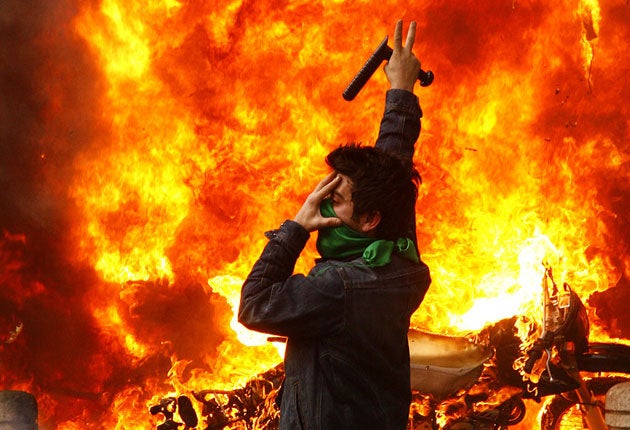
Of course, Iran has problems of its own. The power of modern communications means it cannot suppress news of the demonstrations that are taking place against its leadership. The killing of Seyed Ali Mousavi, the nephew of Mir Hossein Mousavi, the opposition leader, has added fuel to the fire. I believe that the Iranian people are of a free race that can achieve positive change in Iran. Thirty years ago, they succeeded in their revolution against a mighty regime, without tanks or weapons, through demonstrations only. It's a great nation, they have free people, philosophers and revolutionaries. They do not need anyone else's help. Besides, external interference will only strengthen the Iranian government.
So change may come, but in the meantime we have to deal with Iran as it is. Governments around the world have been preoccupied, quite naturally, with Iran's development of a nuclear capability. But there is a still greater danger. It lies in Iran gaining control of Iraqi oil and, with it, a region capable of destabilising not only the Middle East but also the world. The mullahs of Iran believe they can wield power over Iraq. If they are right, then the last American soldier to withdraw from Iraq will leave behind an Iranian colony, controlled by the Revolutionary Guard.
With the elections only two months away it is vital for the future of Iraq that there is an opportunity to vote for a political party that is prepared to stand up to these foreign influences and protect the sovereignty of Iraq. That is why I formed the Ahrar party.
Ayad Jamal Aldin, a Shia cleric, is the leader of the secular Ahrar party in Iraq ( www.ahrarparty.com)
Join our commenting forum
Join thought-provoking conversations, follow other Independent readers and see their replies
Comments
Bookmark popover
Removed from bookmarks