Bruce Anderson: History will vindicate George Bush
In their abuse, his critics demonstrate their own weak hold on reality
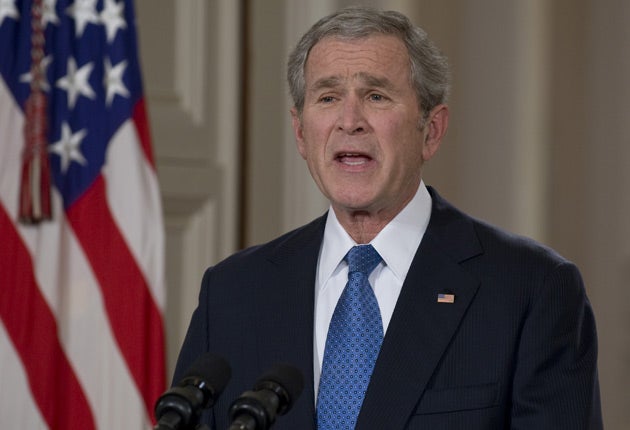
It is not difficult to make the case against George Bush. There have been mistakes. But in their abuse of him, many of his liberal critics demonstrate their own weak hold on reality. In trying to belittle him, they merely reveal their own littleness. George Bush is a much more considerable figure than the caricature version. As he has set great events in motion, it will be impossible to judge his Presidency for many years. It is not impossible that history will offer a partial vindication.
The outgoing President did have one problem, especially in Europe. He may have finished off his father's war against Saddam Hussein. He was not able to avenge his father's defeat at the hands of the English language. Although some of George Bush junior's speeches will rank high in the annals of political oratory, once he was without a text, he often went adrift. But this was not due to lack of ability.
Early on, a friend of mine on the National Security Council went to a Bush Cabinet meeting. He had heard the reports that George Bush was a constitutional monarch with Dick Cheney as his prime minister, so he was interested to see what would happen. He watched as Mr Bush ran proceedings like a strong chief executive, while Mr Cheney did not say a word.
But it all comes back to the Iraq War, which was a tragedy, for a reason worthy of a great tragedian. It was fought in a spirit of excessive idealism. After 11 September, the US Administration asked itself one repeated and agonised question. Why do these people hate us? The Bush team came up with their answer: because they live in failed states, which offer their young no hope in this world and thus leave them open to the temptations of fanaticism and a better deal in another world.
Baghdad was one of the foremost cities in the Muslim world. Iraq was a rich country with a large educated middle class. Yet it had become a police state and many of its ablest people had fled into exile. Moreover, Saddam had been trying to acquire weapons of mass destruction. We could not be certain that his quest had failed. So should we wait until the certainty of a mushroom cloud? It seemed that all the routes to progress in the Middle East and safety in the West led to Iraq.
There was one problem. Largely because of the malign influence of that fraud and tautology, international law, we have grown squeamish about regime change. As a result, the overwhelming desirability of regime change in Iraq had to be downplayed, and there was a further difficulty: the most unfortunate un-meeting of minds in recent public policy. After 2001, in both Washington and London, there was a split between those who knew Iraq, who were generally hostile to the War, and those who wanted war but usually knew nothing about Iraq. George Bush had little confidence in his Secretary of State, Colin Powell. Unable to sack Mr Powell, he made up for it by not listening to the State Department. Tony Blair never took much notice of his foreign secretaries.
As a result, the Arabists' expertise was disregarded and two vital conversations never took place. I will give the London version. Foreign Secretary: "There is no point in continuing this discussion. The PM has decided to go to war alongside the Americans, and that is that". Permanent Secretary: "All right, Foreign Secretary, but in order to give yourself any chance of success, you have got to do the following..." Foreign Secretary: "Now you're talking. I want a paper explaining all that on my desk by close of play tomorrow, and I will stand over the PM till he's read every word."
That never happened. Instead, the direction of events was left to the neo-conservatives, most of whom were dangerous idealists who believed that democracy was an infallible political antibiotic.
In that onrush of naivety, two crazy decisions were taken: to abolish the Iraqi army and to de-Baathise the civil service. In 1945, the allies were content to employ large numbers of former Nazi party members in the new West German bureaucracy. The practical arguments were equally strong in Iraq. There would have been one problem which had not been present in Germany; the army and civil service were Sunni power-centres, and the Shia would have demanded changes. But that could have been manageable. In a sullen and far from idealistic spirit, large parts of Iraq are now sort of working. But that could have happened much earlier had the mistakes not been made. If so, George Bush's ratings would be much higher.
His critics also insist that he should not have used the phrase "war on terror". That tells us a lot about their unwillingness to face up to a dangerous world. George Bush meant that America could not afford to relax until all terrorist organisations with a global reach had been defeated. That is not inflated rhetoric. It is common sense.
There was one unfortunate side effect of the war on terror: Guantanamo. At the time, it seemed a good idea: a cunning means of preventing American lawyers from undermining America's security. But the US prides itself on being a nation founded upon laws. It follows that a legal vacuum is only tolerable for a brief period. It has now dragged on for far too long. That said, anyone who denies that there are some exceedingly dangerous men in Guantanamo should be forced to live among them.
On the economy, and like Gordon Brown, George Bush could be accused of failing to fix the roof while the sun was shining. But two years' ago, it all seemed to be working. Growth was strong. Even after the Bush tax cuts, tax receipts were at record levels. A country with a young population, America did not have Europe's demographic weaknesses: too few earners and too many pensioners. Back in the days when sub-prime mortgage holders were just ordinary Americans trying to climb the ladder, there were grounds for hoping that the US could grow its way out of deficits and back to fiscal prudence. George Bush did not foresee the crisis. Who did?
It now looks as if there will be many more continuities between the Bush Administration and the Obama one than many of the new President's supporters had hoped. That is a tribute to George Bush. It will not be the last.
Join our commenting forum
Join thought-provoking conversations, follow other Independent readers and see their replies
Comments
Bookmark popover
Removed from bookmarks