Christina Patterson: It's time to ditch the dumbing down and start the wising up
Once you could say it was better to overestimate the public's mentality than underestimate it
He mentioned T. S. Eliot. He mentioned Swift. He even mentioned Tacitus and St Augustine. He mentioned Shakespeare. Of course, he mentioned Shakespeare. But he mentioned, unlike another politician last week, the Shakespeare he meant to mention, the one who'd actually written all those plays. And he mentioned a word you have to be quite careful about using in a public place, a word that can get you into quite a lot of trouble. He mentioned the word "intellectual".
The man who was known to millions as Pang Ding-hong, and also as Fat Pang, and who's known in this country as the Lord Patten of Barnes, and the Chancellor of Oxford University, and the former Chairman of the Conservative Party, and also as Chris, was speaking in Oxford. He was speaking at a conference on the future of the "creative industries". He was speaking about the BBC, which he now, as Chairman, oversees. He was speaking about what it should be "trying to do".
The BBC, he said, should uphold "its standards", its "democratic intelligence", and its "civility". It can, he said, "carry ideas and ambition" to "millions of people". Television, he said, was "the closest we get" to "the sort of collective experience that was created by Sophocles and Shakespeare". He was, he said, "unashamedly" of the view that "introducing people to good books, great paintings, or beautiful music" helped to "enrich them as individuals" and "improve the quality of civic life".
There was a time when you could talk about "introducing people to good books, great paintings, or beautiful music" and not think that this was something that should make you feel ashamed. There was a time when you could say, for example, that it was "better to overestimate the mentality of the public than to underestimate it", as the man who created the BBC once did say, and know that people wouldn't frown, but would nod their heads. And when you could quote the words Lord Reith said, and not have to add, as Chris Patten felt he had to, when he quoted them last week, that Reith "wasn't being elitist". And when saying that someone was "elitist" didn't mean that they were a snob.
That was a time when people who had read Eliot, and Tacitus, and Swift, and St Augustine, because they went to the kind of school where you got to read that kind of thing, and who then went to Oxford or Cambridge, and then got jobs in the media, knew that they'd been very, very lucky to get the chance to read the things they'd read. They knew they'd been lucky to see the things they'd seen, and lucky to learn the things they'd learnt, and thought that what they should do with the luck they'd had was share it. They didn't think that what they should do, if they'd had that kind of luck, was pretend they hadn't had it.
They didn't seem to feel that if you'd had the chance to read some of the best books that had ever been written, and see some of the best plays, and look at some of the best art, then the best thing to do was to make programmes, or produce newspapers or magazines, that made it look as if you hadn't. And that those programmes, or newspapers or magazines should make it look as if anything that anyone did was as interesting and important as anything done by anyone else. Or that it was better to have a programme about someone who didn't really know how to sing or dance than about someone who did, because if you had a programme about someone who did know how to sing or dance, who had, in fact, spent years learning how to sing or dance, then that might look "elitist".
These people, who had read Eliot, and Tacitus, and Swift, and St Augustine didn't think that what you should do, if you had a chance to speak to even more people than these writers did, was stick a camera in front of someone who quite fancied becoming a model, or swapping a husband, or cleaning a house. They didn't think that the things people wanted to see and hear about, when they sat down after a long day at work, were other people's meals, and curtains, and shoes. They didn't think that so many programmes would be about meals, or curtains, or shoes that when there was one that was set in a country house, which had a plot, though it wasn't one you could really believe, it would be greeted like a Shakespeare play.
But one day, someone did. Maybe they decided this because they'd done one of those courses that talked about "postmodernism", or done a thesis on how Coronation Street was just as good as Coriolanus, and thought it would make them look really clever if they said it was better. Maybe everyone else decided to copy them. Maybe that was when TV executives decided that the kind of drama you get when you have a camera crew in someone's home, and ask them to behave as normally as they can, even though with a camera you can't, was more interesting than the kind of drama you get when someone who's devoted their life to writing drama tries to turn life into art. Maybe that was when magazine editors decided that what was more interesting than news, or thoughts about the news, was the cellulite on celebrities' legs.
And maybe, when the country seemed to be getting richer, and standards of living, or at least standards of living that you measure by money, seemed to be getting higher, it seemed like a good idea to worry about celebrities' legs. It doesn't seem like quite such a good idea now. You can worry about celebrities' legs, of course. You can worry about which celebrities are getting fat, and which celebrities are getting thin. But at the moment there seem to be an awful lot of other things to worry about. There is, for example, the global economy, and the national economy, and globalisation, and banks. There's how we make a country that's been battered by storms as good as possible for as many of us as possible, and how we all manage as our incomes go down.
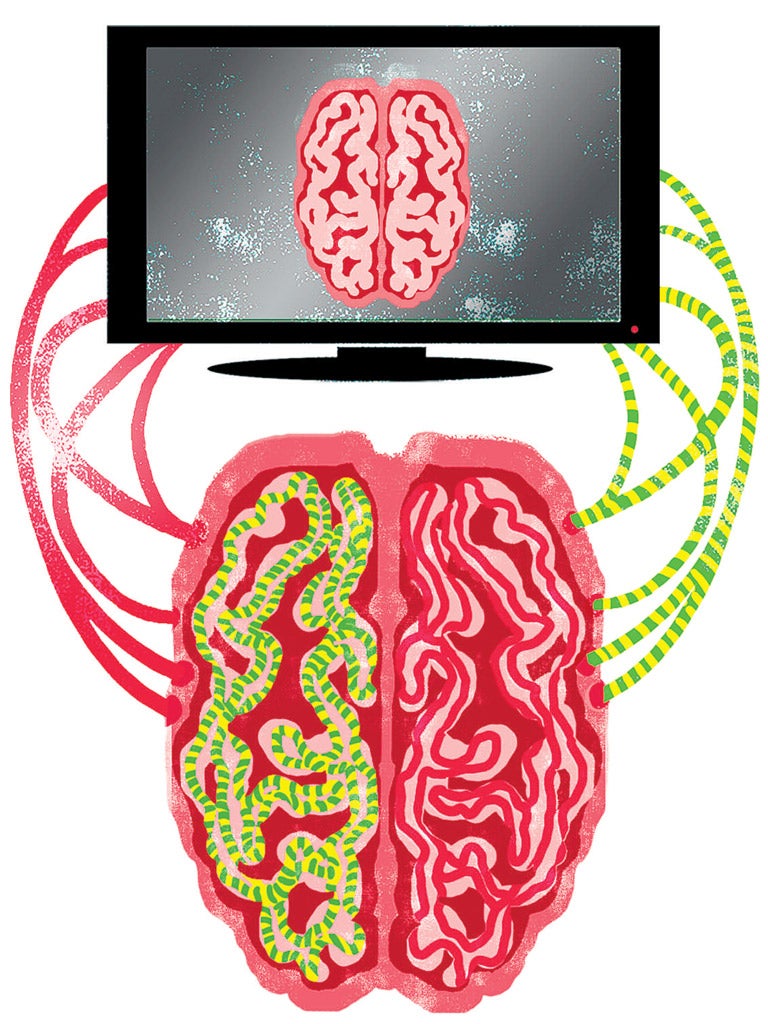
One thing that most people do, even if their income has gone down, is watch telly. They pay a licence fee, and after that it's free. They could sit there, after a long day at work, or after a day when they dream of going to work, and watch more people trying to cook, or bake, or sing. Or they could, at this time, which is probably one of the most interesting times ever to have been alive, watch programmes that acknowledge that they, like every other human being on this planet, have something that doesn't depend on their income, or their education. Something called a brain.
What the BBC needs to do, says Chris Patten, is "to explain, to interrogate, and to find artistic expression for the big ideas". It's time, in other words, and not just for the country's main broadcaster, to ditch the dumbing down and start the wising up.
Join our commenting forum
Join thought-provoking conversations, follow other Independent readers and see their replies
Comments