David C Anderson: Amanda Knox is a victim of Italian pride
The expert witness in another notorious trial says there were shocking failures in the investigation into Meredith Kercher's murder
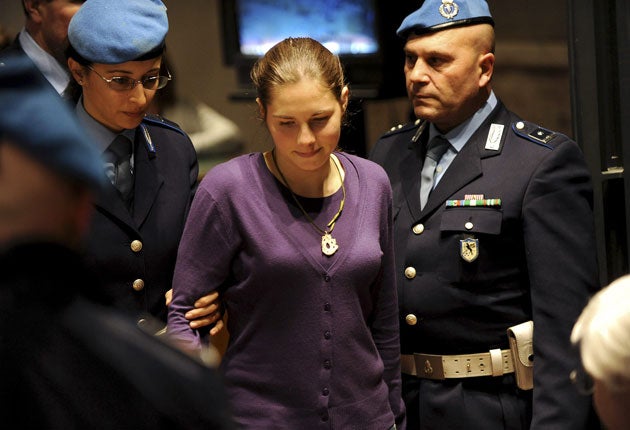
Next weekend, the appeal of Amanda Knox and Raffaele Sollecito against their conviction for the horrific murder of her friend Meredith Kercher in November 2007 will continue in Perugia, and not a moment too soon. To my mind, their conviction is a monstrous injustice, and one from which a number of people in the Italian justice system will not emerge well.
I am a retired English physician, endocrinologist and former professor of medicine and endocrinology in Manchester, and I now live in Umbria, in central Italy. My years in academic medicine gave me a healthy scepticism of uncontrolled authority; positions of power attract at least their fair share of flawed people, and, unchecked, they can do untold damage.
I am haunted by the memory of another case I was involved in, half a lifetime ago. This involved a blatantly wrongful conviction in Leeds, (by coincidence the same town in which Meredith Kercher had been to university) which, had I been a bit more suspicious and proactive, I might even have helped prevent. This case involved the horrific sexual assault and murder by stabbing of Lesley Molseed, an 11-year-old girl with heart disease.
I recall clearly the occasion when, just before Christmas 1975, two police inspectors visited me and said they believed the killer to be Stefan Ivan Kiszko. Kiszko was a 25-year-old patient I was treating for Klinefelter's syndrome, a sex chromosome disorder. The police asked me if such a man could produce sperm and I said no. Seven months later, I was called to Kiszko's trial in Leeds, but never cross-examined in court. The defence lawyers, it seemed, also believed Kiszko was guilty, and so offered no proper defence; indeed they wanted him to plead diminished responsibility from the testosterone injections I had initiated.
The vital piece of evidence, never provided, was that Lesley Molseed's clothes showed that the murderer had masturbated over her and left sperm which the police knew Kiszko could not have produced. Kiszko was tried, on evidence later shown to have been made up by the police, and by three teenage girls who testified they had seen him expose himself – and who, years later, admitted they had lied.
Kiszko always denied killing Lesley Molseed, and, 14 years later, the authorities reopened the inquiry by visiting me and presenting for the first time the vital evidence that had been suppressed in the original trial. As a result, Kiszko was eventually released, after 16 years in prison; meanwhile, taunted and repeatedly attacked by fellow prisoners as a sex killer, he had developed schizophrenia. Six months after release, at the age of 41, he died of a heart attack.
One MP described it as "the worst miscarriage of justice of all time", yet Kiszko's defence barrister, David Waddington, who had served him so badly, later became Home Secretary in the Thatcher government. The prosecuting barrister, Peter Taylor, became Lord Chief Justice. The real culprit, Ronald Castree, convicted after 30 years from semen DNA, is now serving a life sentence.
I see clear parallels between this case and the improbable conviction of Amanda Knox and Raffaele Sollecito, young lovers with no histories of violence. In the Kiszko case, the arrest and later conviction depended on confessions later retracted, dubious witnesses and suspect-driven investigations. The interviewing detectives seized upon every apparent inconsistency between his varying accounts of the relevant days as further demonstration of his likely guilt. Kiszko was coerced into confessing to the crime after two days of intensive questioning. Vital evidence was ignored. The police did not tell him of his right to have a solicitor present. Likewise, Knox and Sollecito were subjected to long interviews through the night of 5 November 2007. And among all the other irregularities, the failure to test DNA on semen stains found on the pillow on which Meredith Kercher's body was lying, was extraordinary.
The police in Perugia were looking for a fast resolution to this horrific crime. Like Kiszko, Amanda and Raffaele were outsiders. For some reason, the police and prosecutor knew a black man was involved, and it was they who, using prolonged interview techniques, got Amanda to falsely implicate Patrick Lumumba. Many questions surround Rudy Guede, who has also been convicted and was clearly at the crime scene, but it seems to me grossly unfair to blame Amanda for naming Lumumba, if this was suggested to her while deprived of sleep, during extreme interrogation in a foreign language by 12 police officers.
Any doubt over this, as well as over whether Amanda was lying when she said she was hit by a policewoman, could be eliminated by referring to the tape recordings that by law the police were required to make. These we have yet to see.
Neither Italian nor foreign media did the couple any favours. They seem to have triumphantly accepted reported idiosyncrasies in Amanda's behaviour as confirmation of her guilt. Those photographs that suggested she might be a wronged, frightened victim of appalling circumstance somehow didn't make it into the papers.
Fortunately, some of the most contentious issues are now being re-examined. My suspicion is that misguided investigations deflected effort from finding the real truth about Meredith Kercher's murder. I have enough confidence in justice in Italy to believe that Knox and Sollecito will soon be exonerated, their lives doubtless scarred but, it is to be hoped, not ruined, as Kiszko's was. But we should never underestimate the extent to which people in powerful positions will fight for their professional survival.
As a result of startling miscarriages of justice in England – including the Kiszko case – measures were taken to prevent the misuse of power ("abuse of process") by those in authority. In England there is now the Crown Prosecution Service, separate from the police, while the United States has rigorous Rules of Disclosure. Under these constraints, in both countries the case against Knox and Sollecito would never have made it to court. Italy, I fear, still lacks such safeguards.
Some good can still come of these young people's sufferings, if Italy reforms its system, to guard against abuse of process in the future. For this reason, I hope ultimately for a far-ranging and open public inquiry into this whole affair. It is at the root of democracy, surely, to hold to account those in authority. They, too, are fallible human beings, but they hold the power.
Join our commenting forum
Join thought-provoking conversations, follow other Independent readers and see their replies
Comments
Bookmark popover
Removed from bookmarks