David Usborne: President stings Israel with swipe at settlements
The view from Washington: White House shows willingness to ignore US Jewish lobby by risking confrontation with Netanyahu over Palestinian statehood
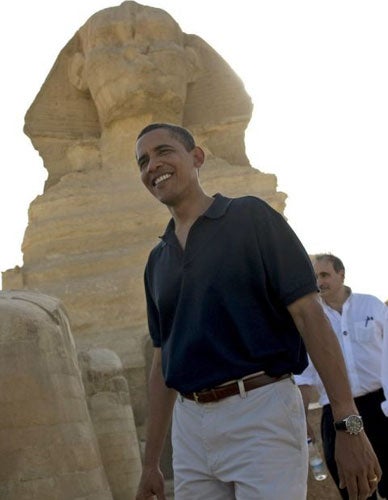
The cords that connect Israel to the United States were under unprecedented strain last night after Barack Obama risked the wrath of the Jewish lobby in the US by publicly chiding Prime Minister Benjamin Netanyahu as part of his long-awaited address to the Muslim world at Cairo University in Egypt.
While the 55-minute speech before an invited audience of politicians, opposition leaders, scholars and human rights activists was billed as an effort by the President to soothe grievances of Muslims in the Middle East and beyond towards America, particular attention was always going to be paid to his remarks on the Israeli-Palestinian conflict.
Full though it was with rhetorical embellishments, the speech was blunt and plain-spoken. And Mr Obama showed he is willing, perhaps more than any US president before him, to ignore the Jewish lobby domestically by getting firm with Israel. Thus he made public a festering and personal argument with Mr Netanyahu, who is refusing to heed his demands for a halt to all new settlements in the occupied West Bank.
Underlining the Muslim references in his own life, including his Muslim father and grandfather, and quoting from the Holy Koran twice in his speech (and from the Holy Bible once), Mr Obama said the US-Israeli bonds were "well known" and "unbreakable". Then, however, he said forthrightly that Washington "does not accept the legitimacy of continued Israeli settlements".
The speech was delivered while most Americans were sleeping and its full impact on the President's home soil will take time to percolate. However, there were rumblings of dissatisfaction from Jewish groups and also conservative Republicans who accused the President of apologising for an alleged past bias against Muslims and the Arab world.
"This is another Obama 'blame America first' moment," fumed John Bolton, America's ambassador to the United Nations under George Bush. He said the speech rested on a deluded premise that America had long suffered poor relations with all Muslim countries. He noted the long-standing alliance between the US and Saudi Arabia, a country Mr Obama visited on Wednesday. In truth, Mr Obama executed a familiar oratorical trick, admitting in one breath that the US may in the past have succumbed too easily to stereotypes about Islam, while in the next telling his audience that Islam needed to stop making the same mistake with America. "That same principle must apply to Muslim perceptions of America. Just as Muslims do not fit a crude stereotype, America is not the crude stereotype of a self-interested empire," he said.
He was forthright in saying that nothing he was saying detracted from the real horror perpetrated by the terrorists in the US on 11 September 2001. "America can never tolerate violence by extremists," he added.
As with many in his target audience, there will be sceptics in the US who doubt Mr Obama's words, however finely spoken, will change very much on the ground. Indeed, there were no policy initiatives in the Cairo speech. "If talking is going to resolve all the problems in the world, Obama got a good bit of that out of the way today," wrote the New York Post's reporter in Cairo. "He talked and talked and talked and talked. And then kept talking."
But from the outset the risk was there that the delicate alchemy of America's relationship with Israel would be upset – for better or for worse – by this address. Some would argue, indeed, that only by changing that relationship, by showing a new willingness to take Israel to task, can Mr Obama hope to heal rifts with Arabs and Muslims globally.
Mr Bolton suggested that the President went too far in Cairo. "When you criticise your strongest ally in an environment like that, it is intended to send a message to that ally," he said.
But there was balance built into the Cairo speech and indeed the President's travel schedule. He deplored Holocaust deniers and said that threatening Israel with destruction was "deeply wrong". This morning, meanwhile, he is to visit the former Nazi concentration camp in Buchenwald, Germany.
Even so, the Anti-Defamation League in New York was among those voicing nervousness about Mr Obama's new direction. "Regarding the Israelis and Palestinians, it would have been important to hear the President put the conflict into its proper historical perspective: six Arab nations attacked Israel from day one and the occupation of Palestinian land was a product of Israel's wars of self-defence," the group said in a statement. It conceded however, that the speech was "ground-breaking and honest".
At the conservative Heritage Foundation, its spokesman, Rory Cooper, was disdainful. "President Bush also expressed these sentiments and was met with indignation from the left when doing so," he said.
Allies of the President ran quickly to his defence, however. The "blunt, honest address was absolutely critical in signaling a new era of understanding" said Senator John Kerry. He added: "He shattered stereotypes on both sides, reminded the West and the Muslim world of our responsibilities, and reaffirmed one of America's highest ideals and traditional roles: that those who seek freedom and democracy, Muslim and non-Muslim alike, have no greater friend than the United States of America."
Join our commenting forum
Join thought-provoking conversations, follow other Independent readers and see their replies
Comments
Bookmark popover
Removed from bookmarks