Dominic Lawson: How can the state justify supporting homeopathy?
It's terrifying what chemists recommend when asked for 'a natural remedy'
As a group of Labour MPs brings Parliament into yet more disrepute by claiming immunity from prosecution for fiddling their expenses, we are at risk of forgetting altogether the good work which many backbench MPs do, work which is buried in obscurity even at the best of times.
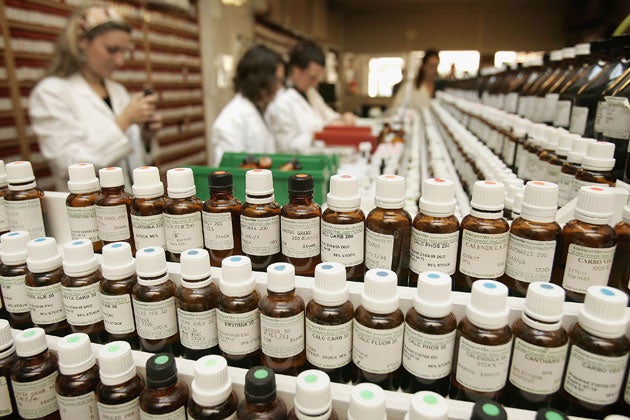
Yesterday, for example, the Science and Technology committee of the House of Commons met to conclude its inquiry into Alternative Medicine. Its members were courteous, polite even to a fault, a far cry from the aggressive made-for-TV grandstanding of the equivalent Congressional bodies in the US; but by the end of a few brief sessions, they had reduced to intellectual rubble the multi-million pound pseudo-medical lobby known as homeopathy – and left equally ragged the regulators and ministers who connive in its skilful mystifications of the public.
In the 18th-century, when Samuel Hahnemann developed the principles of homeopathy, it had one outstanding merit. At a time when doctors readily prescribed mercury as a cure-all, and leeching was standard practice – the days before penicillin, before antibiotics, before streptomycin – a form of medicine which consisted of nothing more than the ingestion of small amounts of water (ceremonially "treated") was much better for the patient than most of the alternatives.
For this to be true it was not necessary to believe Hahnemann's theory: that most illnesses were the manifestations of a suppressed "itch" (a kind of miasma or evil spirit) and that one cured this by somehow finding the substance which caused the "itch" and then diluting it in water. Nor was it necessary to believe, as homeopaths claim to do, that the more you dilute this substance in the water, the more effective the treatment ("the law of infinitesimals") – that, in fact, the appropriate dose is water which has not one molecule of active ingredient in it, but simply "the memory" of it.
Sorry, did I forget to mention the shaking? Yes, the key to this remedy, according to its practitioners, is to shake the water in such a way as to make it better remember the active ingredient that might once have been contained in it. There was a wonderful exchange about this between the Liberal Democrat MP Dr Evan Harris and Dr Peter Fisher, clinical director of the Royal London Homeopathic Hospital and Homeopath to Her Majesty the Queen, no less:
Dr Harris: The shaking is important?
Dr Fisher: The shaking is important.
Dr Harris: I would have thought (the water) would have less memory if you shook it. I can understand that if you left it alone it might form a memory.
Dr Fisher: This has been looked at and the answer is that it does not induce the same structural effects. You are inducing structural effects which may involve silica and which may involve dissolved oxygen molecules – it is not quite certain that you can show this water is different from water that is shaken without the stuff being in it.
Dr Harris: How much do you have to shake it?
Dr Fisher: That has not been fully investigated.
Dr Harris: A random amount of shaking?
Dr Fisher: You have to shake it vigorously but exactly how much you have to shake it, no. If you just gently stir it, it does not work.
Dr Harris: Does the Medicine and Healthcare Products Agency check how much it has been shaken before it approves it for treatment?
Dr Fisher: You would have to ask the MHRA, I do not know."
Evan Harris's reference to the MHRA is the sting in the tail of his satirical questioning. Why does this organisation, which is meant to guarantee the efficacy of the medicines it licenses, give its imprimatur to products which no double-blind test has ever validated? This is particularly relevant because about £10m a year is spent by the Government on such so-called medicines, via four NHS homeopathic hospitals. Normally, when there is some controversy about the efficacy of a form of medicine using public money, the National Institute for Clinical Excellence would investigate – but, strangely, it hasn't.
Still stranger was the reaction of the Health Minister, Mike O'Brien, when questioned by the Committee. He seemed to accept that the only provable benefit from homeopathic "remedies" was the placebo effect; but when asked if he personally approved of the idea of people being prescribed medicines which were known only to have that effect, he said "No". Invited then to reject outright the idea of NHS funds being diverted into such "remedies" the Minister replied, "There is a level of public interest and controversy, and there is a strong medical lobby in favour of homeopathy and there is also government funding." Which, as an argument, is at best circular and at worst an admission that this is nothing to do with best medical practice and everything to do with lobbying power and politics.
Perhaps the Health Minister was especially thinking of The Prince of Wales, homeopathy's fervent supporter, who would undoubtedly be sending one of his handwritten letters with multiple underlinings to Mr O'Brien, should the minister have given the slightest sign that the Government was prepared to reconsider its support for this practice within the NHS.
It's true that even were such a decision to be made, and the public funds saved to be reallocated to – hip replacements? Herceptin for breast cancer sufferers? you choose – Boots would still be merrily selling the stuff to the worried well with money to waste. The man with the impressive title of "Professional Standards Director and Superintendent" at Boots was questioned by this assiduous band of MPs. He delivered himself of a Ratner moment, when asked if there was any known benefit to homeopathic remedies, beyond the placebo effect (otherwise known as gullibility). Mr Paul Bennett replied: "I have no evidence to suggest they are efficacious. It is about consumer choice for us and a large number of our customers actually do believe they are efficacious". I love that "actually". They actually do! The dear, dozy customers actually do!
There is a perfectly sound commercial argument here, and also one based on freedom of choice. Why shouldn't Boots make large profits selling high-priced, impressively-labelled, water tablets to hypochondriacs? The counter to this is powerfully put by David Colquhoun, Professor of Pharmacology at University College, London. He has frequently carried out this experiment: he goes into chemists – not just Boots – and asks the pharmacist what "natural remedy" they would recommend for his sickly grandchild, who has suffered from "terrible diarrhoea for days". Just one in 10 chemists advises him to choose a conventional rehydration treatment, or to take the child to a doctor straightaway.
Colquhoun says it's terrifying that "any sensible parent would be searching out for Dioralyte, but nine out of 10 pharmacists will start rummaging through their homeopathic shelves." Terrifying, yes; but not surprising, given that a BBC Newsnight investigation three years ago revealed that high-street homeopaths routinely recommended their water-with-a-memory as a prophylactic against malaria.
I expect that when the Science and Technology committee releases its report in the next few weeks, it will recommend that the NHS ceases its funding of homeopathic "remedies". I equally expect the Government to carry on regardless: homeopathy has friends in very high places.
Join our commenting forum
Join thought-provoking conversations, follow other Independent readers and see their replies
Comments
Bookmark popover
Removed from bookmarks