Donald Macintyre: Settlements still occupying minds in the West Bank
As long as there is occupation there will be resistance. This is a reaction to what the Israelis do
Even with tension high in much of the West Bank after Hamas gunmen killed four Israeli settlers on Wednesday night, Sana Shabitah, 40, had been determined to come here yesterday to register her disapproval of Mahmoud Abbas's trip to Washington. Saying that angry settlers protesting about the shootings had blocked the road between her home in Nablus and Ramallah and thrown stones at Palestinian cars, she declared: "I don't support the negotiations. We don't have anything tangible on the ground. The settlements are still being built, the prisoners are still in jail. I know Abu Mazen [Mr Abbas] was under pressure but that doesn't mean he should surrender."
As a supporter of the Democratic Front for the Liberation of Palestine (the first Palestinian faction ever to support the two-state solution) Mrs Shabitah joined hundreds of other demonstrators – neither Fatah nor Hamas was represented – in Ramallah's Manara Square. Some brandishing banners proclaiming: "No to Direct Negotiations: against the US and Israeli conditions", their message was summed up by Bassem Salahi, the secretary general of the leftist Palestinian People's Party, who told the crowd: "Yes for peace but peace without settlements... We tell Abu Mazen come back from Washington. Don't complete this farce."
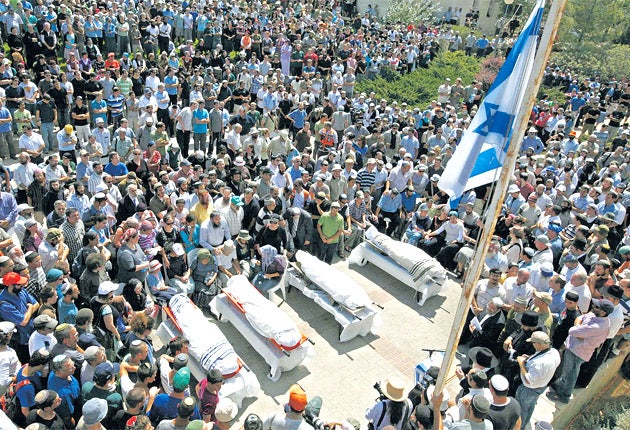
Across the West Bank, Palestinian Authority security forces continued a round up of some 250 Hamas activists in the wake of the Hebron shootings. Rabbi Dov Lior of the settlement of Kiryat Arba, giving the funeral oration for the four victims, declared: "This is a grave tragedy for the families, for the people of Israel and the state. God, avenge the spilled blood of your servants. There is an army, which must be used. The mistake is to think that an agreement can be reached with these terrorists." And settlers' leaders prepared to carry out their threat to start building again in protest and in pre-emptive defiance of the moratorium on construction that Prime Minister Benjamin Netanyhau has promised them will end on September 26.
Here in Ramallah, the demonstators – supporters of a two-state solution, but opponents of negotiations without a halt to settlement building – heard the independent Palestinian politician Mustafa Barghouti declare: "We are not here because we are against peace but to make clear the difference between peace and surrender... settlements and peace cannot go hand-in-hand." Predicting that the talks would fail, Mr Barghouti issued a dire warning of "much more dangerous" consequences than the eruption of the last failed attempt – Camp David in 2000 – into the second intifada. There were few police in evidence and the demonstration ended peacefully – in sharp contrast to last week when a press conference called by the organisers of yesterday's demonstration was broken up by plain-clothes Palestinian security men – for which Prime Minister Salam Fayyad apologised this week.
The full range of opinion, it's true, was on offer. Asked about Wednesday night's killings, Mrs Shabitah said: "As long as there is occupation there will be resistance. The settlers are in the heart of Hebron. This is a reaction to what the Israelis do." But plant and vase retailer Anwar Kurdi, 45, said: "Even if they are settlers they are still civilians and the world will blame us. If they had been soldiers it might be different but the world will blame us for this." Nor did Mr Kurdi criticise Mr Abbas for going to Washington. "The Arab countries and the US told him there would be no more money for the Palestinians unless he went into negotiations. What do you expect him to do?" He had praise for the PA's delivery of services under Mr Abbas and Mr Fayyad. "In a short time they have achieved more than most Arab countries in 30 years." Agreeing emphatically with the demonstrators on one point, that the talks would not produce a solution, he differed on the consequences. "The only achievement of going back into negotiations will be to stop violence and prevent 2,000 or 3,000 people from being killed," he said.
Nevertheless the coalition assembled in Manara Square of those in favour of peace with Israel but against these negotiations is beginning to make its voice heard. Perhaps the most surprising member, in this distinctly leftist company, a tall and commanding figure in his crisp blue and white striped shirt, was Munib al Masri, 75, probably the most successful Palestinian businessman in the country, chairman of the $260m PADICO investment company, ardent patriot and nationalist, intimate friend of both the late Yasser Arafat and Mahmoud Abbas, a self-professed old man in a hurry to see an independent Palestinian state living side by side with Israel, and yet a key figure behind yesterday's protest. As one of those who produced proposals to break the deadlock in reconciliation talks between Fatah and Hamas in June, only to have them rejected by President Abbas, Mr Masri has doubts that negotiations can be successful until the Palestinian schism has itself been healed.
But far more than that for Mr Masri, is the ghost of the Oslo accords and the conviction that the Palestinian leadership may be entering what he calls "Oslo Two". He said yesterday that he had been among those who, along with the late Haider Abdel-Shafi, had warned Arafat against negotiating while settlements were still being built. Unlike Abdel-Shafi, and probably out of personal loyalty to Arafat, he neverthless accepted the Oslo accords – in his view now a tragic error – even though they allowed Israel to continue settlements. Mr Masri hopes and thinks that his friend, the President – an "honest man, a good man, who is making a mistake", will pull out of the talks if Mr Netanyahu ends the partial freeze on settlement building. He also believes Israel and the US may misunderstand that Mr Abbas "cannot give more than Arafat did. He cannot do it at all". But above all he does not want the negotiations to go ahead while Israel freely continues to build settlements. Claiming that Arafat told him in the days before his death that he wished he had halted the settlements, Mr Masri added: "If we negotiate without the [right] terms of reference we will find in a very short time that it will lead us to catastrophe."
Pointing out that Mr Netanyhau recently declared he wanted to meet Mr Abbas every two weeks, he recalled how more than a decade ago he was put in touch with Mr Netanyahu by the US ambassador Martin Indyk. Mr Netanyahu, in his first term of office, told the Palestinian businessman he wanted to see him every month. "I never heard from him again."
THE CHALLENGE
What's top of the agenda?
Keeping the talks going at all. The immediate challenge for Obama is to find a formula which can reconcile Netanyahu's reluctance to prolong a partial freeze on settlement building beyond 26 September – probably strengthened by Wednesday night's killings – and Abbas's threat to pull out of talks if he refuses.
If the talks do survive, what will they be about?
What they've always been about: ending the Israeli occupation which began with victory in the 1967 Six Day War when it took control of the West Bank and Gaza. And that means agreements on borders, which the Palestinians believe must be based on the pre-1967 lines, the future of Jerusalem, which the Palestinians want as a shared capital, and the fate of the families of refugees that were forced from or fled their homes in what is now Israel during the 1948 war.
So can this gap be bridged?
The question is whether the maximum Israel is prepared to move is enough to match the minimum any Palestinian leadership could accept. Most informal plans assume that Israel would get a variation of the pre-1967 lines to bring the big settlement blocs into Israel in return for a land swap that would give the Palestinians 22 per cent of historic Palestine. Jerusalem would be re-divided into the Jewish West and the Arab East. There could also be major compensation for refugees, and for those in camps in Lebanon, Syria, and Jordan to return to the West Bank if they chose, with – perhaps – a token return of a few thousand to Israel.
So what's the problem?
This Israeli government, even more than its predecessor at Camp David, has big ideological issues, for example with dividing Jerusalem or recognising even a notional "right of return" for the 1968 refugees. Anything else?
Netanyahu wants to start the talks by discussing security, principally along the Jordan valley – the border of the putative Palestinian state. This could be solved with an international force supervising an Israeli presence. But this may not be enough for Netanyahu.
Join our commenting forum
Join thought-provoking conversations, follow other Independent readers and see their replies
Comments
Bookmark popover
Removed from bookmarks