Hatred and division in the land that would be Palestine

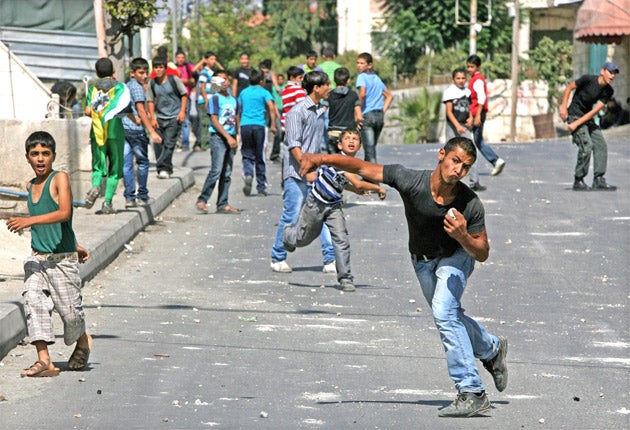
Through the middle of the acrid clouds of eye-stinging, throat-burning tear gas we were trying to escape. One canister fired by the armed border police landed behind and another in front of us – it was hard not to reflect that the force the military was applying during this incident was not being directed at those who started it.
The teenage settlers, around 15 of them and with their faces masked, had come over the crest of the hill above the village, according to the Palestinian residents. They had hurled stones at one large Palestinian house on the hillside, this warm and previously quiet afternoon, before cutting down two or three olive trees, the villagers said. They then retreated back in the direction they had come.
While diplomats at the UN debated the Palestinian bid for statehood, this was the reality yesterday for the people on the front line.
By the time we arrived, a single military jeep was parked on the crest of the hill and there were three border police vehicles at the top of the village's only street, above the group of perhaps two dozen residents who had gathered earlier in the hope of repelling the invaders, almost certainly from the nearby and notoriously hardline Jewish settlement of Yitzhar.
A few Palestinian youths were still throwing stones ineffectually in the direction of the soldiers now patrolling the hill above on foot.
In any other week, the events of yesterday afternoon in this tiny farming village in the rocky hills south of Nablus would have seemed entirely routine, a barely noticed confrontation in which the only person injured was a 14-year-old Palestinian boy, Arif Asari, admitted to hospital after being hit in the shoulder by an Israeli tear-gas canister. Indeed, according to Ali Mahmoud, a local teacher, the settlers had come a mere three weeks ago and that time their attack had been "harder". It was, moreover, an isolated episode in what despite the dire warnings of violence was – so far – a largely quiet West Bank.
But yesterday it somehow epitomised the issue at the heart of the high diplomacy thousands of miles away in New York, where President Mahmoud Abbas is trying through the UN to take another faltering step towards a Palestinian state. If that state existed, Yitzhar, seen by most of the international community, including Britain, as an illegal settlement, along with many others circling Nablus, would not.
The promised settler marches yesterday did not fulfil the wild expectations of organisers who posted bills calling for "hundreds of thousands" to turn out and protest attempts by "our enemy" to install a "terror state in the heart of the heart of the land of Israel". At the entrance to Ramallah settlers burnt a Palestinian flag.
At the entrance to Nablus, settlers from Itamar, where a family of five residents was killed by two Palestinians of no known group earlier this year, danced and sang as dusk fell. But Mr Mahmoud, the local teacher, was fearful, especially if Israel carries out the threats to retaliate against Mr Abbas's diplomatic initiative by withholding funds to and withdrawing co-operation from the Palestinian Authority. "Everybody sees events getting worse and things will be worse in the future. Everyone is very frightened. Our people have big patience but if the [Palestinian Authority] cannot pay people and settlers attack the villages, there may even be a revolution."
But while the mayor of Asira al-Qbilya, Bassam Umran, had no doubt yesterday's attack was connected with the UN bid, he added: "They [the settlers] want to create confusion and drag Palestinians to violence, so the attention will be shifted from the UN to the violence. We told the people in the village not to retaliate and the reaction will be limited. We only defend ourselves."
Noam Sharon, secretary of the hilltop settlement of Psagot, with its panoramic view of the West Bank city of Ramallah, was hoping, despite earlier harsh criticism by settlers of his now abandoned 10-month settlement freeze, that the Israeli Prime Minster Benjamin Netanyahu would be protecting their interests in New York this week. He said: "Benjamin Netanyahu has got very good intentions and is working very well but I am afraid that he will change his mind like Ariel Sharon did [by withdrawing settlers from Gaza in 2005]. We are giving him another chance. We will know whether we are right after this crisis."
He added: "The conflict between us and the Palestinians is not about to end soon. You need to stand on your principles and not give an inch."
Britain faces tough decision on statehood amid rumours of coalition split
Britain faces a "difficult judgement" over whether to support Palestinian statehood at the United Nations this week, Nick Clegg said yesterday, while the Government is yet to declare a position regarding the bid.
The Deputy Prime Minister is rumoured to be pushing for firmer support for the application, amid reports of a Coalition split on the issue. Mr Clegg said there had been "debates" within Government over the position to adopt but said it would be unhelpful to air them in public.
It remains unclear which way Britain will vote at the UN, just days before the Palestinian President Mahmoud Abbas is set to ask the General Assembly to vote on granting Palestinian statehood.
David Cameron warned in May that he would support a Palestinian bid at the UN if Israel declined to take part in substantive peace negotiations. The Prime Minister has even buried political loyalties and sought advice in secret on how to break the deadlock from Tony Blair, the current Middle East peace envoy.
The Shadow Foreign Secretary Douglas Alexander has said that the Labour Party backs the bid, and he has written to the Foreign Secretary William Hague urging him to vote in favour of the resolution. Yesterday Mr Hague said the "only way forward" was a return to the negotiating table.
Join our commenting forum
Join thought-provoking conversations, follow other Independent readers and see their replies
Comments
Bookmark popover
Removed from bookmarks