Robert Fisk: A dictator's trial that even his enemies questioned

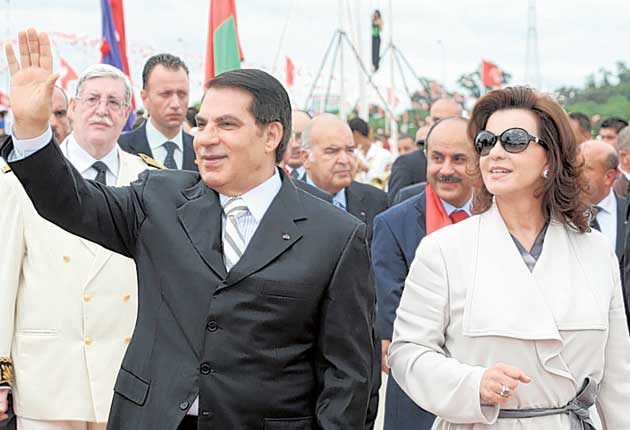
How do you defend a dictator who's been around for years and years and years when he's accused of – well, being a dictator for years and years and years?
When I mention the "trials" of Zine el-Abidine Ben Ali, the former Tunisian autocrat's lawyer throws his hands in the air, an expression of cynicism and laughter on his face. "These weren't judgements, they weren't even real cases – they were a joke," Akram Azoury says of the Tunis courts which last month, after just one-and-a-half hours of deliberations, sentenced Ben Ali and his wife Leila Traboulsi to 35 years' imprisonment and the equivalent of £48m in fines, and then, this week, to another 15-and-a-half years. "The speed of the first trial – the length of time between the opening of the trial and the judgement – was closer to a Formula One race than to a classical judicial procedure."
Oddly, Ben Ali's first farcical trial – with no witnesses and no lawyers chosen by the defendant – enraged both his lawyer and the ex-dictator's most vehement opponents. They wanted charges of high treason and crowds of tortured ex-prisoners to testify to the brutality of the Ben Ali regime. Azoury, a Lebanese Christian who acted for Ben Ali with his French colleague Jean-Yves Le Borgne and who runs a family legal practice in Beirut – his two daughters are also lawyers – wanted a fair trial. "No lawyers were invited to the court," Azoury says with quiet fury. "I had power of attorney, certified by the Tunisian embassy in Beirut. I applied for a visa – but I was not granted a visa. I applied to the Tunisian Bar for authorisation – and I was not granted authorisation." In the end, the Tunisian Bar appointed two lawyers of its own to "defend" Ben Ali.
"This trial, it violates each and every criteria of the 1966 Fair Trial pact that preceded the pact of civil rights of the European Union," Azoury says. "After 1966, the Human Rights Committee was set up in Geneva. This court hearing in Tunis was not eligible to qualify as a trial – so the verdict is not a verdict. No European country can extradite Ben Ali to Tunisia based on this verdict. Should he be free in France, England, Germany, especially if he was in England and the Tunisians wanted to extradite him, no court in England would accept to do this." I forbear to suggest that no immigration officer in England – let alone France – would allow Ben Ali or his wife to enter the country, although Mr Azoury does believe his client should leave Saudi Arabia.
"Ben Ali described the judgements as 'the wording of the justice of the victors'. Don't forget that the mere fact that President..." – and here I note Azoury can still call his client 'President' – "...Ben Ali hired me as his lawyer is a precedent in this part of the world. It means he wants to play by the rules. He doesn't care about a political trial. He governed Tunisia for 25 years and it's the right of the Tunisian people to judge him. In his opinion, these accusations are not made innocently. If you look at the substance of these accusations, they are shameful. They want to kill him morally. Don't forget that all this stuff in the second trial – the drugs and weapons – were 'found' in his official residence two or three months after Ben Ali left. After seven months now, you might 'find' nuclear weapons in his residence!"
The second "trial" of Ben Ali this week – for possession of drugs and illegal weapons – also added another fine of £50,000. Even his Tribunal Bar-appointed lawyers objected that the hearing was unfair. "The only purpose," Azoury says, "was to brand President Ben Ali as a drugs dealer and weapons dealer before the Tunisian elections."
But why did the old dictator hire a Lebanese lawyer to act for him? Azoury has an interesting legal pedigree. In 2000, he defended Lebanese petroleum minister Barsoumian and secured his acquittal before the courts after 11 months of imprisonment; in 2003, he prosecuted board members of the Medina Bank; in 2005, he represented General Jamil Sayed of the Lebanese General Security when he was accused by the UN tribunal of possible involvement in the assassination of ex-prime minister Rafiq Hariri. After four years of false imprisonment, Sayed was released by the UN who admitted it had no evidence against him.
"A lawyer can only perform his job in a court of law," Azoury says. ""Law and politics cannot be present at the same time. My job was to take the politics out of the courtroom. Because if they wanted a political judgement in Tunis, it has already been issued and executed. The guy (Ben Ali) is not going to Tunisia any more. I respect this. But if the Tunisian authorities want to start a real judicial process, they should abide by the principles of a fair trial."
But Akram Azoury is no patsy. "It is an excellent thing to judge heads of state," he says suddenly. "It will help to implement a culture of justice – because the responsibility of the new regime in Tunisia is also to implement due process of law. If these rulers were that bad, there should be no difficulty in convicting them after a fair trial." Azoury lived in Tunis for a month in 1989 when he was consultant to the company building the new Arab League headquarters, but never met Ben Ali. "I wasn't involved in politics," he says.
But he clearly thinks a lot about it. When we talked of the Tunisian revolution, Azoury spoke of the street vendor Mohamed Bouazizi – whose death by self-immolation started the revolt against Ben Ali – in words that I am still pondering. "The body of Bouazizi will either be a light in this part of the world," Azoury says. "Or he will be the fire that will consume it."
Join our commenting forum
Join thought-provoking conversations, follow other Independent readers and see their replies
Comments
Bookmark popover
Removed from bookmarks