Robert Fisk: A glittering palace that's built on shifting sands
Our man in the Middle East finds Abu Dhabi's opulence undermined by the encroaching financial crisis
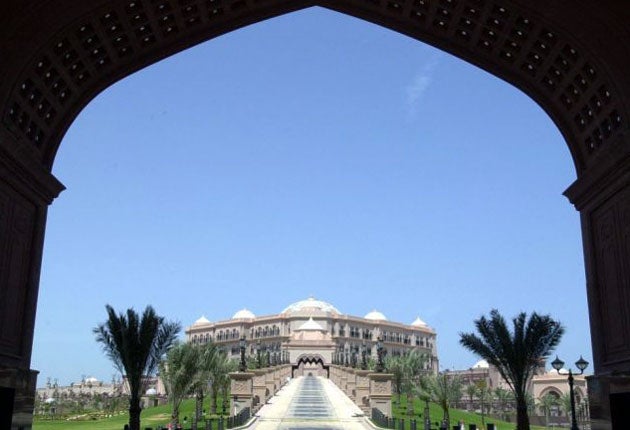
The architecture is Delhi, I suppose, Mogul-Gothic Lutyens with just a hint of Saddam and, if you forget the marble on the floor, a dangerous hint of Titanic. The Emirates Palace Hotel is now one of the best-known symbols of egregious affluence in the capital of the United Arab Emirates and – even if you can forget that the gold on the walls and doors and fittings is indeed real gold and that 1,002 crystal chandeliers haunt the ceilings – there's the guest list of kings and princes and Hollywood-Bollywood glamerati who have taken rooms that run up to £10,000 (repeat: ten thousand) a night.
It was only when I glanced at my menu that I became a trifle concerned. Was I really being offered "rustic" French pâté? I would certainly have been happier to be offered veal hand-carved rather than "hand-cut". Didn't that have rather an executioner's flavour about it? "Garlicky spinach" was even odder. It wasn't a bad try. Who am I to quibble? But amid all this opulence, the menu sounded like the ice that made the Titanic's huge bulk – ever so slightly – tremble as it scraped fatally along its side.
Trembling is what the United Arab Emirates have been doing these past few days, the iceberg having struck Dubai and now troubling the headquarters of the great liner in Abu Dhabi. Will Sheikh Khalifa bin Zayed bin-Sultan al-Nahyan sail to the rescue of Sheikh Mohamed bin Rashid al-Maktoum? Dare Dubai World – the White Star Line of the brasher emirate – be allowed to sink, not to mention all those rich bankers who might go down with her? Such metaphors can be taken to extremes but the Titanic was supposed to be unsinkable and Dubai was meant to sail through the waters of the world's economic collapse even if the real-estate market had already foundered.
Alas no. As the hordes of international bankers now examine the great liner's hull, they are finding some serious flaws in the metal. Everyone believed that Dubai World was guaranteed by Sheikh Khalifa's government but, as international financial consultant John Sfakianakis of Bank Saudi Fransi put it with devastating thoroughness in Abu Dhabi this week, this was an assumption; it was implied, it was imagined, it was taken on trust. But – unless there is proof to the contrary – it does not appear to be true. It was all very well for Dubai's rulers to tell the press to "shut up" after the iceberg struck, but such arrogance breeds more arrogance and thus uncertainty and – the key word, this – further lack of clarity. Why didn't the man in the crow's nest tell us much earlier that the iceberg was on its way?
Mr Sfakianakis is too shrewd a soul to use such journalistic clichés, but "transparency" was what was on his mind this week, a steady questioning of where the money goes in the Emirates. What about the airline of the same name which appears to be a sound and growing business venture? Where do its profits go? Are they ploughed back into the airline? Or do they go to the family of the ruler? How much goes to the family of the ruler? We don't know, of course. What we do know is that all our favourite banks thought that a government guarantee had been "implied" and that their money was as safe as – well – houses.
Now familiar cries are being heard from the boat deck. The banks themselves were to blame for over-exposing themselves. The media was to blame – His Excellency Engineer Sultan bin Saeed al-Mansouri, the Abu Dhabi Minister of Economy, made this very point on Monday, casting a beady eye on The Independent's all too innocent correspondent. How could such distortions be avoided, he asked me, how could we avoid newspapers being so foolish as to mistake the Gulf for the Arabian Sea?
This wasn't quite the problem, I tried to explain. Most folk know where Dubai is. It was a little matter of the truth, transparency which no cry of "shut up" could clarify. And within 24 hours, the appeal for a notional $26bn "restructuring" of debt – the Emirates newspapers and television obediently avoid all talk of default – looked like turning into a princely (or perhaps kingly) $46.7bn. The Dubai Financial Market index fell by 6.1 per cent. UBS said Dubai state-run companies may have to repay the equivalent of 43 per cent of the emirate's GDP within two years.
It didn't help when Abdulrahman al-Saleh, the director general of the Dubai Department of Finance, announced that "we would like to emphasise the difference between support and guarantees – it was clear since the companies' establishment that it's not guaranteed." Was it? Who else thought that? Certainly not the captains of industry who poured their wealth into the emirate's outrageous plans for holiday islands visible from outer-space – or for individual investors who put down an initial half a million dollars for a villa that does not exist. And – as they asked themselves when they turned up to look at the books on Tuesday – may never exist. Morgan Stanley even suggested – and here's a real blow to the unsinkable Titanic – that Dubai's total funding needs may be far greater than the emirate's overall debt of $84bn.
Abu Dhabi is watching all this with a creditor's concern, assuring customers of confidence in its own gargantuan projects – a new arts centre, for example, that will be a branch office of one of the largest museums in the world, the Louvre – but no one knows what private agreements exist between Sheikh Khalifa and Sheikh Rashid. As one European diplomat said bluntly here this week, the relationship between leader and tribe in the Emirates is more important than the relationship between state and citizen (or, he might have added, between bank and state). Abu Dhabi is for aluminium, steel, petrochemicals based on its massive gas deposits, alternative energy fields, tourism on the newly created Yas Island, culture on Saadiyat Island.
But the Emirates are still not a modern state and matters are not settled by laws but rather "in front of the tent". Strategic decisions and control of money is kept inside the tent. People from outside – banks, for example – are asked to come and do the job. No, it's not "Goodbye Dubai". Foreign investors use the place primarily as a hub – and, I suppose, pub – from which to do business in India, Iraq, Saudi Arabia, Kuwait, Qatar. And if real-estate continues to sink, foreign companies – even the movie world – could find Dubai an even more attractive place to be based.
After all, didn't Hollywood make millions from Titanic?
Join our commenting forum
Join thought-provoking conversations, follow other Independent readers and see their replies
Comments
Bookmark popover
Removed from bookmarks