Robert Fisk: A man's life seen through his remarkable possessions

When Edward Nassar asked General Bernard Law Montgomery to sign his autobiography, "Monty" invited the Lebanese collector to his English home. "The front door opened and there was a long corridor in front of me. And there were 20 oil paintings on the wall. And they were all of Montgomery! All 20 of them! There was Montgomery with Eisenhower, Montgomery with Churchill, Montgomery, Montgomery, Montgomery..."
Of course there were. All collectors – and we shall come to the definition of a "collector" later – have a certain egoism about them. And Nassar had met his match. In his private museum north of Beirut, Nigel Hamilton's biography of Monty takes pride of place, alongside signed copies of Sir Edward Spears' struggle to liberate Lebanon from the French, the memoirs of Anthony Nutting who resigned over Suez, and a mass of correspondence with Glubb Pasha, fired by King Hussein (the Plucky Little King Mark One) just before Suez. "If the British Empire had still existed after the war, way into the 1960s," Nassar says, "Israel could never have conquered all of Jerusalem in 1967." Well, maybe, I mutter.
Edward Nassar, I should add, is 85 – he does, really, look 10 years younger – a tall, slim man with long straight white hair that falls over his collar, a multimillionaire (of course) and a lover of fine wines, fine cigars and, well, an awful lot of portraits, landscapes, epic biblical paintings, Roman coins, Greek busts, wonderful oils by his daughter Isis, and lots and lots of newspaper clippings about himself. He was a tin miner in Cornwall, a biscuit manufacturer in Ghana, a producer of macaroni, chocolates, biscuits and sweets in Beirut – with another factory close to the home of Hizbollah leader Hassan Nasrallah, which was attacked by the Israelis in their 2006 war and which resulted in an Israeli bullet flying right into Nassar's office and smashing into a 19th-century landscape of figures by a stream. The stream, I notice, flows on, although the two tiny figures must have been a bit shocked when the live round cracked into a tree on the right hand side of their pastoral idyll and splashed hot 19th-century paint over a thatched cottage.
The newly opened Nassar museum – by private invitation only, he reminds me – is not difficult to find, a turn-of-the-century Ottoman house built by Nassar's cigarette manufacturer father Suleiman, opposite the post office in the rather scruffy north Beirut suburb of Jel el-Dib. Edward owns a villa above Lausanne stuffed with more paintings and Greek goddesses, but he's shipped half his collection to Lebanon. I shake my head as I sit before his desk. Why on earth would this wealthy old man transport all this treasure trove from Switzerland to a country that breathes crisis and fear?
"I was 25 when I started collecting," he says. "I remember one of the Christie's directors telling me: 'You are a born collector.'" I smile to myself. Isn't that what any Christie's director would tell a buyer ready to part with hard cash? "I was living in London then, but I spent the past 50 years of my life in Lausanne. I must tell you that all through those 50 years, I hardly had any contact with Arabs – all my contacts were with the British. Collecting is an instinct. I started off by collecting stamps."
I'm still not quite satisfied with this. Nassar is obviously fascinated by history – and, I suspect, the physical ability to touch history – oil paintings, all those Armenian, Phoenician, Roman, Greek, Byzantine, Ottoman coins, the daggers and sculptures and African death masks and juju sticks and the first edition of Julius Schnorr von Carolsfeld's illustrated bible (Die Bibel in Bildern) of 1800. At the end of a wall, one of Napoleon's original battle flags is carefully moved from its plastic protection so that I, too, can touch the blue and gold silk, a magnificent tricolour whose golden horns and eagle and tongues of fire frame a massive letter N – the same N that you can see on the bridges over the Seine – and the words Honneur, Patrie, Unité, Force, that weird semantic construction which connects, faintly but in sinister fashion, the French empire with Vichy France.
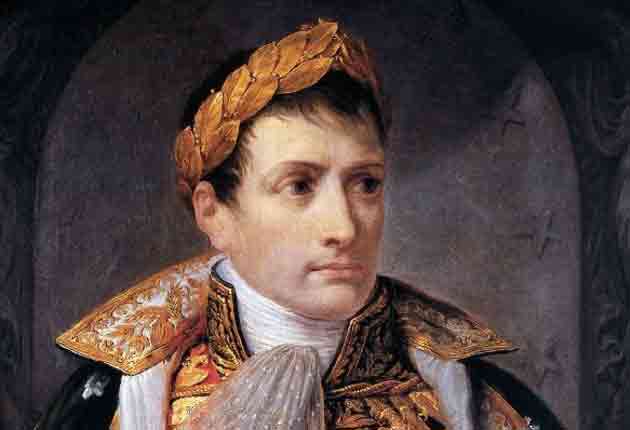
I look above and there, disinterested, eyes staring vaguely – a trifle cynically, perhaps – is the man himself, Napoleon as King of Italy, a grey velvet gloved hand on his crown in 1805, by his court painter Andrea Appiani. There's a large worn discolouration on the right, as if the painting had been strapped face-on to a horse's saddle but it hasn't damaged the image of the man who, between Charles VII and Hitler, almost reached Moscow. The nearest he got to Lebanon was northern Palestine. But Nassar, the man who knew so few Arabs, who lived in Switzerland, came home with half his museum. "Because I am 85 – and I want to die here."
His "decorations" hang on the wall. Norwegian consul general in Accra (the Gold Coast when he arrived) with a letter of accreditation from King Haakon VII, pictures of Nassar with Kwame Nkrumah, his badge of authority at the 1983 Lebanese Lausanne peace conference (at which Lebanon decided it was Arab rather than Phoenician and Walid Jumblatt took a photo of old Suleiman Franjieh because, he said, he liked pictures of "antiquities"). And then the old man disappears and I wander the high-ceilinged rooms. A landscape by the Irish artist John Baines, a portrait of Henrietta Stuart, Duchess of Orléans, Kneller's George I and William Duke of Gloucester, an Arab woman with a dagger in a silk belt by Henri Gouvion de Saint-Cyr (signed and dated 1886), a hoard sold in haste from the Orléans collection after the 1789 Revolution including Christ's crucifixion painted on copper by Annibale Carracci, an arrow-addled Saint Sebastian ("after Runi"). I find the Birmingham painter Henry Stanier (Portrait of a Gentleman at Sunrise in Egypt, 1867, all crimson sunsets and towering pyramids). David holds a grey sword with Goliath's head dripping blood upon it and on the frame is printed "Rubens", but Edward Nassar shuffles back to say "after Rubens" in a soft voice.
There's a picture of a young Princess Elizabeth opening Nassar's under-the-channel tin mine in Cornwall and lots of pictures of his surface mine in Nigeria and literally dozens of his daughter Isis' colour-sprouting Picasso-cum-Lebanon paintings of African villages, Pacific islands and Lebanese civil war ruins and refugees. Her work, I suspect, is his real collection. All her paintings hang above the Knellers and the Baineses and the after-Rubenses. And above the head of that goddess. Nassar has just found a photograph of a headless Greek goddess in toga and sandals, unearthed by the recent storms on a beach in southern Israel. He claims that if the Israelis have the body, he has the head. I look at the photo and I don't think the head would fit. I guess it's another Middle East story; just like that of Edward Nassar, whose collection is his career and who – Napoleon, Monty and all – has come home to die.
Join our commenting forum
Join thought-provoking conversations, follow other Independent readers and see their replies
Comments
Bookmark popover
Removed from bookmarks