Robert Fisk: Afghanistan's ancient treasures must be saved
Over the door of the Kabul museum today is a Persian quotation: 'A nation stays alive when its culture and history are kept alive'
More than 30 years after I watched the Soviet army slithering in their great T-72s past their new headquarters at Bagram north of Kabul, more than nine years since the first Americans took over the same airbase, I have gazed at last upon the treasures of Bagram.
Not in Kabul – where they were spared the destruction of the Taliban by the courage of old museum staff – but in a travelling exhibition in the peace of the village-city of Ottawa, which Queen Victoria named as the capital of her Canadian colony in 1858, a consolation prize between the Scots-Brits of York (now Toronto) and the Québecois of Montreal. Just 16 years earlier, the 23-year-old queen's army had been destroyed in the Kabul Gorge – which left its own belt-buckle antiquities for the Kabul bazaaris to peddle.
Yet as so often in Afghan history, I found the treasures of Bagram and Ai Khanum and Tillya Tepe oddly unAfghan. Why was I standing in Ottawa to stare at a perfect Corinthian capital, something I would scarcely glance at in Athens? Or a gold and turquoise clasp showing Dionysus and Ariadne seated on a monster? Hadn't I polished off Greek mythology at Sutton Valence School in Kent? What was Harpocrates – Horus the Child – from Egypt doing here? Or those big-breasted Kama Sutra women from Bagram? Shouldn't they be in a glass case in Delhi?
But that, of course, is the point. Afghanistan's ancient cities lay on the Silk Road between Rome and China, and its art embraced Greek gods and Chinese princesses and Indian ladies and – breathless here at a future cultural genocide – Buddhas. Afghans today exhibit the same Silk Road features; the thin faces of the Indus, Tajik-Chinese faces, the green eyes of the Greeks and Alexander.
Just as the Roman emperors splashed their names all over the cities of antiquity, so did Alexander. Thank God he didn't invent the steam train. Station announcements in Egypt for slow trains east would have gone something like this: "The 11.05 from Alexandria Central will call at Alexandria Charax (change here for modern-day Basra), Alexandria Areion (modern-day Herat), change here for Alexandria Margiana in present-day Uzbekistan and Alexandria Eschate (which is now Khojat in Tajikistan), Alexandria Caucaso (Bagram) and Alexandria Arachoton (Kandahar)."
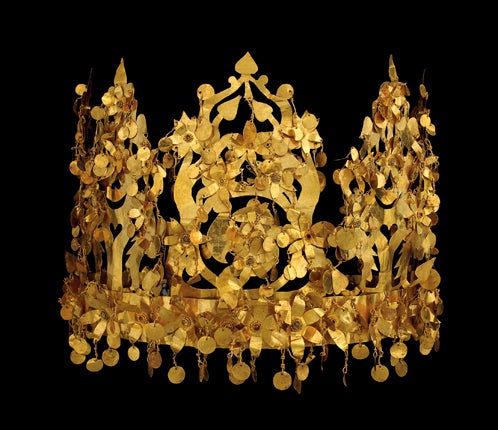
But with what delicacy did the royalty of these lands adorn their palaces and homes. The ivory body of a lion from Bagram flies with the wings of an eagle, snapping at its enemies with the beak of a parrot. From a tomb at Tillya Tepe – in Uzbek, the "Golden Hill" (65 miles due west of Mazar-e-Sharif) – comes a young woman's jewellery, ornaments of flowers, hearts, masks, raindrops, squares, triangles; the fragment of a funerary monument, a gift from Clearchos, a student of Aristotle with an inscription in Greek which says with fourth-century wisdom: "As a child, learn good manners; as a young man, learn to control your passions; in middle age, be just; in old age, give good advice; then die without regret." There is lacquer from China, roosters with human heads, a fish-shaped flagon with ribbons of liquid glass for fins and gills, and fish on Roman-Egyptian glass goblets and, perhaps most remarkable of all, a five-part take-it-to-bits crown of gold and turquoise, fit for any king – but easy to dismantle when you have to carry it on your camel convoy to neighbouring cities.
A Hellenic capitol comes from Balkh – in 300BC, the largest Afghan city, just to the east of Tillya Tepe – which was destroyed by Genghis Khan almost 1,000 years later. Fly over Kandahar and Helmand – indeed over the fourth century BC sites of Lashkar Gar – yes, one of our favourite anti-Taliban biffing fields – and it is still just possible to make out the sand-swamped walls of forgotten villages that were erased by the very same Ghengis Khan.
And why, I wonder, do we so brazenly destroy the story of our own history and humanity? The Afghan hoard was damaged and pillaged during the country's civil war – the magnificent museum at Hadda, near Jalalabad, was burned after the 1979 Soviet invasion – and the Kabul National Museum was hit by a rocket and burst into flames in 1994 while being used as a military base. In Beirut, the National Museum stood on the front line throughout the 1975-1990 civil war, its Phoenician sarcophagi gashed by shell fragments. The great libraries of Sarajevo were deliberately shelled to ruins in the 1990s. The loss of Iraq's inheritance of civilisation in 2003 remains an American as well as an Iraqi disgrace.
Over the door of the Kabul museum today is a Persian quotation: "A nation stays alive when its culture and history are kept alive." But is it possible to believe that even these golden artefacts from Afghanistan will survive the 21st century in their new Kabul home? The Taliban, courtesy of the Saudis and the Pakistanis, brought deliberate destruction to the physical history of Afghanistan. And to Bagram came first the Soviet army – at their base, they taught the Afghans how to use electricity rather than nail pliers to extract information from prisoners – and to Bagram 21 years later came the Americans to waterboard their victims. From antiquity, Afghanistan obtained the culture of gold and collapsible crowns. From us, they obtained the culture of torture.
Join our commenting forum
Join thought-provoking conversations, follow other Independent readers and see their replies
Comments
Bookmark popover
Removed from bookmarks